
In This Article

Customer trust in businesses just hit an all-time high. Seventy-three percent of people trust small businesses more than they trust government, media, or large corporations. That’s not nostalgia. That’s structural.
But here’s the catch: trust doesn’t translate to word-of-mouth on its own. You have to make it easy. Most small business owners struggle with how to get customers to share your business without it feeling awkward or forced.
When customers have a great experience, most don’t think to talk about it. They’re busy. They forget. Or they don’t know you’d appreciate the share. What separates businesses that get talked about from ones that stay invisible is one simple thing: they create obvious moments where sharing feels natural.
This isn’t about manufacturing virality or begging for reviews. It’s about designing your customer experience so that the best part—the moment of relief, delight, or clarity—is so worth sharing that customers volunteer to be your marketing.
User-generated content (UGC) converts 160% better than branded content. And it costs almost nothing. But only if you know where to look for it and how to ask.
Walking in Your Customer’s Shoes: Where Sharing Happens
The first move is the hardest one to make: actually trace the journey your customer takes with you.
Not the journey you think they take. The one they actually take.
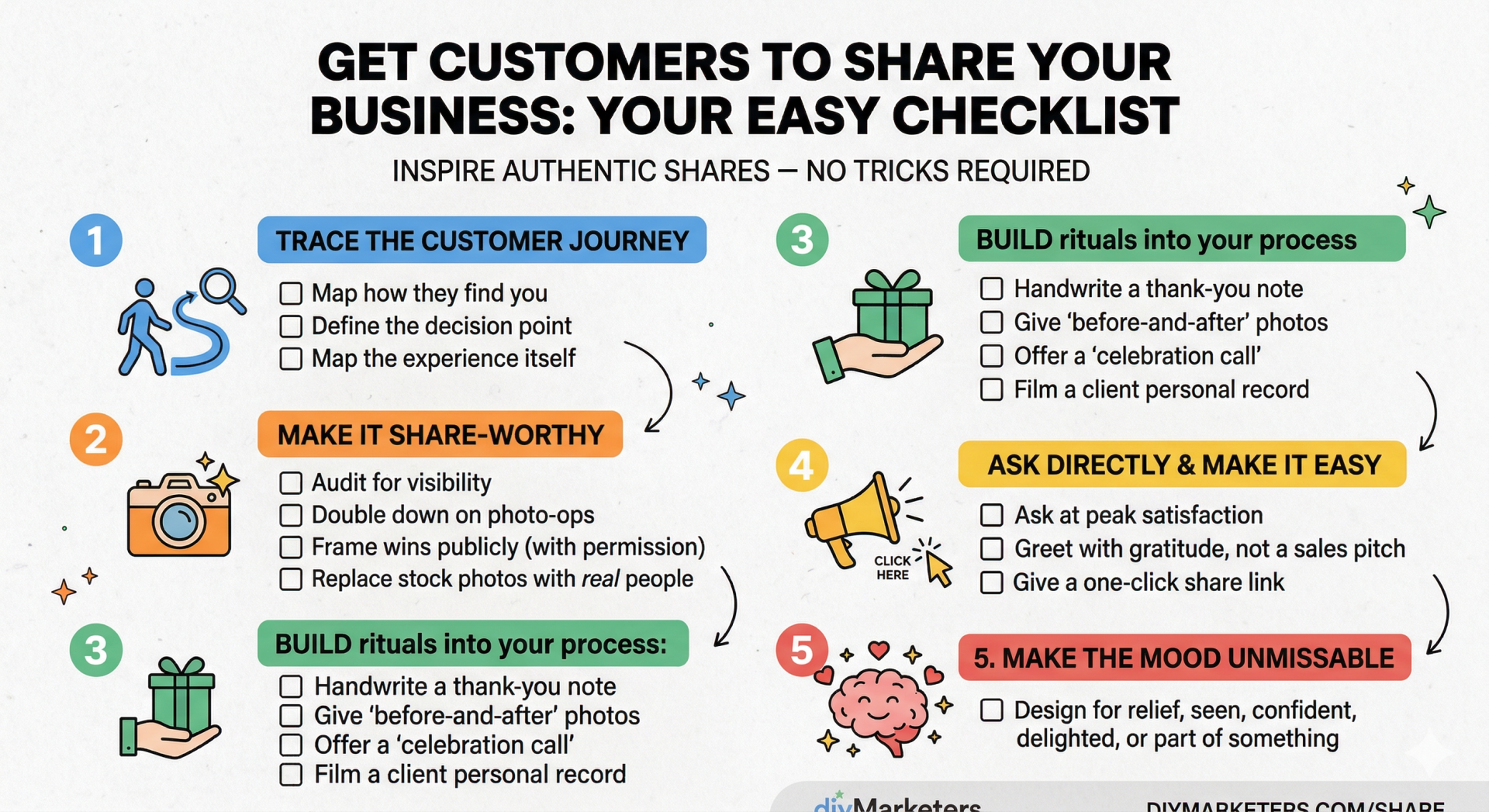
Start here. Map three moments:
Moment 1: How They Find You
Where does your customer encounter your business for the first time? Online search? Friend’s recommendation? Local listing? Word of mouth? Each entry point has different energy.
If they find you through a Google search and land on a messy website, the first feeling is doubt. If they walk into your office and it smells like coffee and feels human, the first feeling is relief.
Moment 2: The Decision Point
After they find you, what happens next? Do they scroll through testimonials? Call you? Book a consultation? Read your about page?
This is where most businesses lose the plot. They assume the customer is reading sales copy. They’re not. They’re looking for proof that you won’t waste their time or money.
Moment 3: The Experience Itself
This is where UGC starts. Not after. During.
A customer walks into your salon and you remember their name and their preferred coffee order. A consultant listens instead of pitching. A product arrives and it’s better than expected. These moments are the ones people text about immediately.
The question: Are these moments obvious? Visible? Easy to photograph or describe?
The Truth About Why Customers Don’t Share
Before you can inspire sharing, understand why sharing doesn’t happen in the first place.
People don’t share because:
They don’t think it’s shareable. Your service solves a real problem, but it doesn’t feel exciting or noteworthy. Fixing their website traffic or cleaning their house or preparing their taxes—these are table-stakes. They’re not “Instagram-worthy.”
They don’t know you want them to. You’ve never asked. You’ve never made it clear that you’d appreciate a mention or a testimonial or a photo.
It feels awkward. Asking someone to share feels sales-y. And most small business owners hate feeling sales-y, so we don’t ask at all.
Friction is too high. Even if they want to share, the process is clunky. They’d have to write a review on Google. Leave a comment on Facebook. Film a video. Most people won’t clear that bar.
There’s no reason to RIGHT NOW. The moment of delight fades. A week later, they’re not thinking about you anymore.
The businesses that crack UGC solve all five of these problems at once.
How to Make Your Business Share-Worthy
Here’s the thing: you don’t need a “shareable moment” to be dramatic. You need it to be authentic.
Make the experience visible
The first rule: if it’s not visible, it won’t be shared.
A therapist who remembers every client’s birthday and sends a handwritten card—that’s invisible. But a therapist who frames client wins on their office wall (with permission) and talks about them openly? That’s visible.
A consultant who delivers results—invisible. A consultant who sends a before-and-after breakdown showing exactly what changed—visible.
A barber who gives a great haircut—expected. A barber who has a waiting area full of plants and plays jazz and chats about your week—visible.
The move: audit your business through a customer’s eyes. What would they photograph? What would they mention to a friend? Double down on that.
Humanize your presence (especially online)
The data is screaming this: 72% of Gen Z distrusts AI-generated content. Your customers want to see your face, hear your voice, and know you’re real.
This doesn’t mean you need to be an influencer. It means:
Replace stock photos on your website with real photos of you, your team, or your actual customers (with permission). Film short videos of you explaining how you work—unscripted, imperfect, honest. Share stories about customer wins without being salesy about it. Show your process, not just your results. Be visibly happy and helpful, even in small moments.
When customers see a real human on the other side, they’re more likely to share it because it feels authentic, not like they’re advertising for a corporation.
10 minutes a week. Every economic signal your business needs.
I read a dozen economic reports each week so you don’t have to. SIGNALS gives you the numbers that matter, what they mean for your business, and one action step you finish before lunch. Free, every week.
Build share-worthy rituals into your process
The businesses winning with UGC have built moments of delight into their standard operating procedure.
A coaching business sends a handwritten note card with the client’s breakthrough insight written on it. Not after the engagement ends—during, in the middle of the work. Clients photograph it and share it.
A landscaping company takes before-and-after photos of every project and gives a printed copy to the customer. Most customers post it.
A software consultant ends every project with a 15-minute “celebration call” where they walk through what changed, what it means, and what’s possible next. Clients talk about that call for months.
A personal trainer films a 30-second clip of their client hitting a personal record—just for that client, no permission needed from anyone else. The energy is real. The client shares it everywhere.
These aren’t gimmicks. They’re making the normal process slightly more intentional and slightly more shareable.
Ask directly (and make it easy)
Here’s what most small businesses don’t do: they don’t ask.
You finish the work, the customer is happy, and then you hope they’ll share. They won’t. Not because they don’t want to—because they don’t know you want them to.
The ask matters. Here’s how to do it without being pushy: “Hey, I know you’ve probably had a good experience here. If you felt like sharing it—even just a sentence on Google or a mention to a friend—it would mean a lot. No pressure at all. But if you feel like it, here’s how to do it in 60 seconds.”
Then give them the link. Make it a one-click share.
The timing matters too. The moment of peak satisfaction is your window. This is when you need to know how to get customers to share your business—at the exact moment they’re happiest.
Make the mood unmissable
The micro-trend data from this briefing shows that mood-modifying purchases are driving behavior. People aren’t buying products—they’re buying feelings.
The feeling someone has when they work with you is the most shareable thing you have.
If you leave them feeling relieved (someone finally understands the problem), seen (you remembered them, you cared), confident (they can do this now), delighted (this was better than expected), or part of something (they belong here)—they’ll tell people.
The move: ask yourself what feeling you want them to leave with. Then design backward from there. What would create that feeling? Is it your tone of voice? A ritual? A surprise? A moment of vulnerability where you admit something?
User-Generated Content Beats Everything Else
Here’s the data you need to know:
270% higher conversion when customers see peer reviews instead of brand marketing. 40% of consumers trust micro-community recommendations as much as personal recommendations from friends. 73% of people are more loyal to brands they find authentic. Only 27% of consumers trust that big companies are being honest. 73% trust small businesses.
UGC works because it’s not you talking about you. It’s a real person, like them, saying “This is worth your time and money.”
That’s worth more than any ad budget you could buy.
The Real Opportunity: Build Your Micro-Community
The businesses pulling ahead right now aren’t chasing 20,000 followers who scroll past them.
They’re building micro-communities of 200-500 engaged people who know them, trust them, and refer them consistently.
Here’s how:
Map your best customers. Not the ones who spend the most. The ones who are most enthusiastic about the work.
Make it easy for them to talk about you. Not in a formal “leave a review” way. In a natural “tell your friends” way.
Stay visible to them. Monthly email. Weekly social post. A message on their birthday. Just enough so you’re in their circle.
Ask them to introduce you. “If you know someone else who has this problem, introduce us.”
Surprise them. A handwritten note. A gift. An unexpected discount. Something that makes them feel like you value them as humans, not revenue.
A micro-community of 200 people who all know you and like you will generate more revenue than 20,000 passive followers ever will.
Where to Start This Week
Pick one moment in your customer journey where they’re most happy or relieved.
That’s your share-worthy moment.
Now ask yourself: Is it visible? Could someone photograph it? Could someone describe it easily?
If yes, your only next move is to ask them to share it.
If no, redesign that moment to make it visible. Add a photo op. Create a ritual. Make it unmissable.
Then ask.
That’s it. That’s the move.
You don’t need permission from the algorithm. You don’t need a huge following. You need real customers talking about real experiences.
And right now, with trust in small business at an all-time high, your customers are already primed to believe you’re worth talking about.
You just have to make it easy.
FAQ
What if my business isn’t “visual”? How do I make it shareable?
Everything is visual if you frame it right. A bookkeeper isn’t visual, but a bookkeeper explaining “Here’s what changed in your tax situation” with numbers on screen—that’s visual. A consultant isn’t visual, but a consultant showing a client’s before-and-after results—that’s visual. The share-worthy part isn’t always a photo. Sometimes it’s a story, a number, a feeling, or a moment of clarity.
Isn’t asking for reviews/shares aggressive?
Only if you ask wrong. If you ask at the right moment (when they’re happy), with the right tone (grateful, not pushy), and make it easy (one-click), it doesn’t feel aggressive. It feels like you respect them enough to ask. Most people are happy to help if you give them a clear, simple way to do it.
How do I get reviews without paying for them or using review sites?
Ask directly. Send an email or text to your best customers: “I know you had a great experience. If you felt like sharing it on Google (or wherever), here’s the link.” You don’t need a service or software. You just need to ask. The conversion rate is surprisingly high when you ask the right people at the right time.
What if a customer shares something negative?
Let them. If it’s fair, respond publicly, fix it, and thank them for the feedback. If it’s unfair or false, respond privately and professionally. Either way, don’t delete it or hide. Customers trust brands more when they see real humans handling real criticism professionally. That’s more shareable than a perfect 4.9 rating.
Does this work for B2B or only B2C?
Both. B2B customers have buying committees and decision-makers. B2B UGC—a case study, a testimonial, a before-and-after result—is often the deciding factor. In fact, B2B customers are hungrier for peer validation because the stakes are higher. A referral from a peer is worth its weight in gold.
How much does UGC cost to set up?
Nothing. The cost is time and intention. Time to map your customer journey. Time to ask for shares. Time to respond when customers do share. If you want to make it easier (printed cards, video software), you might spend $50-200/month. But the core strategy is free.
The UGC strategy works best when your entire customer experience is designed around getting and keeping customers. Check out how to build a direct marketing strategy that generates referrals to layer this into your bigger marketing plan. And if you’re still unclear about your core offer, read about how to create an offer your customers actually want to talk about.
For a deeper understanding of why the three core marketing strategies (direct, content, paid) matter, check out why only three strategies work—and why everything else is noise.
Sources Referenced in This Article
- Gallup 2026 — Small Business Trust at All-Time High (73%)
- Mindforce Research — 270% Higher Conversion with Peer Reviews; 95% Subconscious Decisions
- Forbes 2026 — 72% of Gen Z Distrusts AI-Generated Content
- Kantar Marketing Trends 2026 — Micro-Community Trust (40%)
- Forbes 2026 — 73% Loyalty to Authentic Brands
- Edelman Trust Barometer 2026 — Trust Gap Between Executives and Consumers; Small Business vs. Corporate Trust
- ICERTIAS 2026 — 95% of Purchase Decisions Are Subconscious