
In This Article

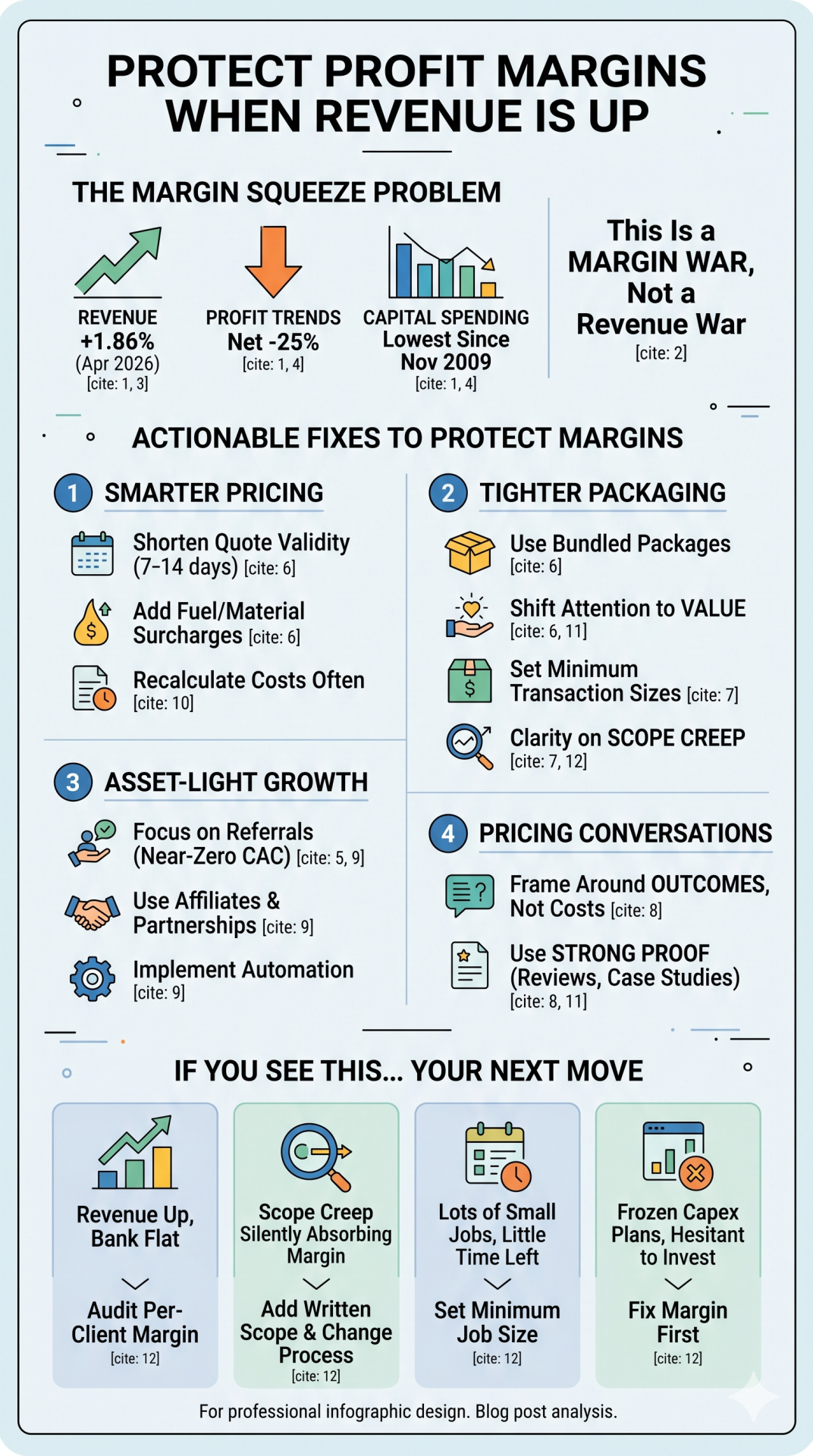
Small business revenue rose 1.86% month-over-month in April 2026, according to the Intuit QuickBooks Small Business Index — but NFIB data shows profit trends at net -25% and capital spending at its lowest point since November 2009. That gap is the margin squeeze: businesses are selling more and keeping less. The way to protect profit margins right now is not more marketing — it’s smarter pricing, tighter packaging, and faster cost pass-through.
Thirty years of watching small businesses, and this pattern is the one that hurts the most — because it’s invisible until it isn’t. You look at your revenue and feel good. Then you look at your bank account and wonder where it all went. One client of mine — a residential cleaning service — had her best revenue month ever in Q1. She also had her worst net profit quarter in five years. Her prices hadn’t moved. Her costs had moved a lot.
What the data actually tells us about small business profit margins right now
The April 2026 numbers create a picture that looks optimistic on the surface and alarming underneath. The Intuit QuickBooks Small Business Index shows real monthly revenue per business at $51,810 — up 1.86% from the prior month. Businesses with 1–9 employees are still generating real revenue growth. That’s the good news.
Now the bad news. The NFIB March 2026 survey shows a profit trend at net -25%. Capital expenditure plans sit at 16% — the lowest reading since November 2009. Owners are not investing because there’s nothing left to invest.
Producer prices re-accelerated in March: headline PPI hit +4.0% year-over-year, the largest jump since February 2023, driven by energy costs up 8.5% and gasoline up 15.7%, per the Bureau of Labor Statistics PPI release. If your business touches anything that moves — freight, materials, energy — your input costs went up sharply. Your prices probably didn’t keep pace.
And consumers? The University of Michigan’s April 2026 preliminary sentiment reading came in at 47.6 — down 10.7% from March’s already-low 53.3. Year-ahead inflation expectations jumped to 4.8%. Customers are nervous and value-conscious. Raising prices into that headwind feels risky. So most owners don’t raise prices. And the squeeze tightens.
Why “sell more” is the wrong answer to a margin problem
The instinct when profit shrinks is to generate more revenue. More leads. More clients. More projects. More volume. That instinct is wrong — and it’s expensive.
If your margin per transaction is negative or razor-thin, selling more just accelerates the loss. You’re not scaling a business; you’re scaling a problem. The math doesn’t change because the volume goes up. It gets worse because overhead, time, and stress all scale with volume.
The businesses I’ve watched navigate margin squeezes successfully share one habit: they stopped treating pricing as a set-and-forget decision. Price is an active management tool. When your input costs move, your price has to move too — or you absorb the hit yourself.
The referral-heavy businesses in my network have an advantage here. A referral-based growth model keeps customer acquisition costs near zero, which preserves more of each revenue dollar. When you’re not spending on paid ads or expensive lead generation, cost pass-throughs on input prices are easier to absorb — or pass along to clients without losing them.
How to protect profit margins when you can’t cut costs any further
Cost-cutting is the first tool owners reach for. It’s also the one with the shortest runway. At some point you’ve cut everything cuttable, and the margin problem is still there. The fix has to come from the revenue side — specifically from how you price and package what you sell.
Here are the specific levers that work in a squeeze-and-hesitation environment like this one:
Shorten your quote validity windows. If you’re quoting jobs or projects and holding that price for 30, 60, or 90 days, you’re absorbing any input cost increases that happen in that window. With PPI up 4% year-over-year and energy costs volatile, a 30-day quote window is a liability. Tighten it to 7–14 days and add explicit language about fuel or material surcharges.
Move toward bundles instead of à la carte pricing. Bundled packages shift the buyer’s attention from per-item cost to total value. They also give you margin flexibility — you can include higher-margin services in the bundle while keeping the headline price competitive. A service business that prices by the hour is more exposed to cost pressure than one that prices by the outcome.
Set minimum transaction sizes. Small transactions often have the same overhead as large ones — the intake call, the invoicing, the follow-up. A minimum order or minimum project size filters out the clients who consume margin without generating enough revenue to justify it.
Add scope clarity to every engagement. Scope creep is a silent margin killer. When clients can add deliverables without triggering a price conversation, you absorb labor cost increases that were never built into the original quote. A clear scope document with explicit change order language isn’t bureaucratic — it’s margin protection.
The pricing conversation your customers actually need to have: Focus on what VALUE they are getting
A lot of small business owners avoid price increases because they assume customers will push back hard. Sometimes they do. More often, the friction is internal — the owner’s own discomfort with the conversation.
With sentiment as low as it is right now, the way to frame a price increase is not “our costs went up.” That’s true, but it doesn’t answer the customer’s question, which is “what am I getting for this?” Frame your pricing around the outcome, not the input. “This package delivers X result in Y timeframe with Z guarantee” is a price conversation. “We had to raise our rates” is not.
Look at it this way. Your customer is doing everything they can to protect profit margins too. So speak to how your offer will cut costs, improve productivity, make them more efficient, or increase their profits.
The businesses holding pricing power in this environment are the ones with the strongest proof. Reviews. Case studies. Before-and-after numbers. Put your best evidence as close to the purchase decision as possible. When customers are nervous, they need more reassurance before they say yes — not a lower price.
Right now, everyone is looking to protect profit margins, and one way to do this is to reduce their risk. This is especially true for consultants and marketers. It’s hard to guarantee success, so break down your outcomes into much smaller wins.
Referral-based businesses have an inherent advantage here too. When referrals stop working, it’s often because the underlying value proposition got fuzzy. If your margins are under pressure, that’s a signal to tighten your positioning, not just your pricing.
| If You See This… | It Means… | Your Next Move |
|---|---|---|
| Revenue up, bank account flat | Input costs rising faster than your prices | Audit per-client margin, tighten quote windows |
| Clients adding scope without pushback | Scope creep absorbing margin silently | Add written scope + change order process |
| Lots of small jobs, little time left | Overhead is eating the margin on small transactions | Set minimum job size, move toward retainers |
| Clients comparing you to cheaper options | Your value proposition isn’t landing | Lead with proof (reviews, results, guarantees) |
| Capex plans frozen, hesitant to invest | Owner cash flow too tight to reinvest | Fix margin first — growth comes after stability |
How to grow your business when you have no budget to spend
Only 16% of small business owners plan to make capital investments right now — the lowest number since 2009. Owners are not buying equipment. They’re not hiring aggressively. Most are in hold mode, and given the environment, that makes sense.
So how do you grow without spending money you don’t have? You focus on channels where the cost comes after the sale, not before it. Referrals cost you a thank-you. Affiliate partnerships cost you a commission on revenue you already closed. Automation costs you a monthly subscription that typically pays back in hours saved within the first 30 days.
The businesses who protect profit margins right now aren’t outspending anyone. They built customer acquisition systems that run on relationships, not ad budgets. Structured referral networks exist for exactly this reason — warm leads with no upfront cost.
The one pricing move most small businesses skip that will protect profit margins
Here’s what I see constantly: owners track revenue closely and check profit occasionally. Margin per client or per transaction? Rarely, if ever.
The single most useful thing you can do right now is build a simple margin analysis for your top 10 clients or revenue streams. What does it actually cost you to serve them — fully loaded, including your time? What are they paying? The gap between those two numbers is your real margin. And in many cases, the math is uncomfortable.
Some clients are profitable. Some clients are loss leaders you’ve been tolerating because they’ve been with you for years. Some projects look great on an invoice and terrible on an actual time-and-cost basis. You can’t protect profit margins without knowing where they’re leaking.
This is the work that precedes any pricing conversation. You can’t price correctly if you don’t know your costs. And right now, with energy and freight volatile, you need to be recalculating those costs on a shorter cycle than you probably have been.
Frequently asked questions about protecting profit margins in a small business
What does it mean when small business revenue is up but profit is down?
It means your costs are rising faster than your prices. This is a margin squeeze — not a revenue problem. Input costs like energy, freight, and materials have re-accelerated in 2026, and if your pricing hasn’t kept pace, the gap between what you’re earning and what you’re keeping widens even as top-line revenue grows.
How do I raise prices without losing customers?
Frame the increase around outcomes, not inputs. Customers don’t respond to “our costs went up” — they respond to “here’s the result you’re getting and why it’s worth this price.” Pair any price increase with stronger proof: reviews, case studies, a clear guarantee, and reduced purchase risk. Customers in a hesitant economy need more reassurance before they say yes, not a discount.
What is a bundled pricing strategy and how does it protect profit margins?
Bundled pricing groups services or products into a package with a single price rather than selling each item à la carte. It protects margins because it shifts the buyer’s focus from per-item cost to total value, gives you flexibility to include higher-margin services in the package, and typically increases average transaction size — which spreads your overhead over more revenue.
What’s the fastest way to find where my margins are leaking?
Build a fully loaded cost analysis for your top 10 clients or revenue streams. Include your time at a realistic hourly rate, all direct costs, and a proportional share of overhead. Compare that to what you’re actually charging. The clients or projects where the math doesn’t work are where your margin is going. Start your pricing fix there.
Should I cut costs or raise prices to fix a margin problem?
Usually both — in sequence. Cut the waste first: subscriptions you don’t use, low-margin clients consuming high amounts of time, inefficient processes. Then address pricing. Once you’ve tightened costs, you know your real floor, which makes pricing decisions much clearer. Trying to fix margin with price alone, without knowing your costs, is guessing.