
In This Article

A newsletter landed in my inbox last week that stopped me cold and made me wonder about how newsletter strategies have chanfed over the years.
I get dozens of newsletters. Most sit unread. A few I skim. Even fewer make me think. But this one—a profile of Lucy Werner’s newsletter business—made me rethink everything I thought I knew about newsletters.
Lucy earns £2,350 a month from her newsletter. Not from ads. Not from sponsors. From subscribers paying for access to her directories, templates, and proven systems that helped them land paying clients. One reader closed a £3,000 coaching package from a single resource Lucy shared.
That stopped me because I’ve been treating newsletters like everyone else treats them—as lead magnets. Build the list. Nurture relationships. Hope people eventually buy your services. But Lucy’s newsletter isn’t the appetizer before the main course. Her newsletter is the business.
That realization sent me down a research rabbit hole on how newsletters evolved from “stay top of mind” tools to actual revenue engines. Here’s what I learned about what makes newsletters successful in 2026.
The newsletter landscape shifted while most of us weren’t paying attention. According to beehiiv’s 2025 State of Newsletters report, newsletters aren’t just making a comeback—they’re generating over $8.6 million in subscription revenue on their platform alone. The daily newsletter market reached $14.2 billion in 2024 and is projected to hit $23.92 billion by 2033. That’s a 6.4% CAGR we’re looking at.
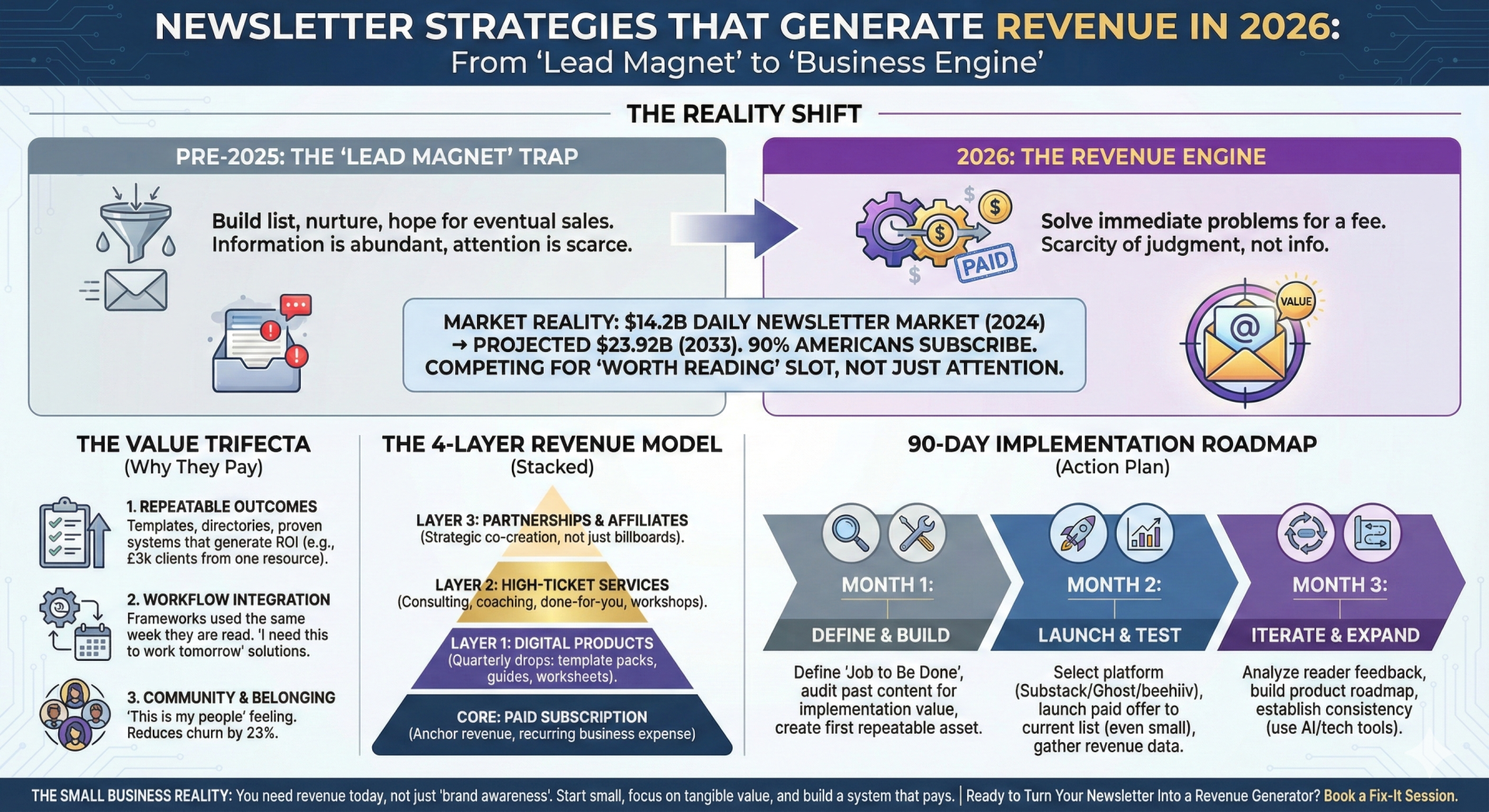
But here’s what’s changed: information alone doesn’t cut it anymore. Your subscribers are drowning in a firehose of content. 90% of Americans subscribe to at least one newsletter. The average person gets 376 billion emails sent worldwide daily. Your newsletter isn’t competing with other newsletters—it’s competing with every notification, every social media algorithm, every distraction pulling attention away from the inbox.
The newsletters winning in 2026 solve a different problem than “keeping people informed.” They solve the “I need this to work tomorrow” problem. And the newsletter strategies that work reflect this shift completely.
Why Traditional Newsletter Strategies Stopped Working
Print newsletters in the pre-digital era charged hefty subscription fees because information was scarce and expensive to obtain. You paid $500+ annually for a niche financial newsletter because missing one market insight could cost you thousands. The information itself was the product.
Fast forward to 2026, and information is abundant but judgment is scarce. According to industry research, the value proposition flipped completely. People pay less for raw information and more for curation, context, and implementation. This shift is why platforms like Substack saw recommendation graphs driving around half of all subscriptions—readers want trusted filters, not more content.
The “lead magnet newsletter” model most small business owners were taught doesn’t account for this shift. You were told to:
- Build your list with a freebie
- Send weekly tips and insights
- Nurture relationships over time
- Eventually convert readers to paying clients
That approach assumes your newsletter is the appetizer and your actual service is the main course. But 27% of creators planned to start newsletters in 2025 specifically because newsletters were their most engaging content format—not because newsletters fed other business lines, but because newsletters became the business line.
What Newsletter Subscribers Pay For in 2026
I pulled the research on successful paid newsletters, and three patterns kept showing up across every case study:
Repeatable outcomes subscribers can bank on. Lucy Werner positions her paid tier as a business expense that should generate multiples of its cost. She doesn’t sell access to her thoughts—she sells access to the exact directories and templates that helped readers land £3,000 clients. The newsletter isn’t information; it’s infrastructure.
Workflow-level integration. The most successful newsletters plug directly into how subscribers do their work. Lucy’s subscribers use her media pitch directories and promotional calendars to schedule their outreach. Lenny’s Newsletter, the #1 business newsletter on Substack with over 1 million subscribers, provides deeply researched frameworks product managers use the same week they read them.
Community and belonging. According to recent data, newsletters with community features reduce churn by 23%. This isn’t about creating another Slack channel—it’s about making subscribers feel like they’re part of something specific and valuable. The “this is my people” factor keeps them subscribed even when they’re too busy to read every issue.
Workflow integration: Tools subscribers use the same week they read your newsletter
Community access: The “this is my people” feeling that reduces churn by 23%
The Newsletter Business Model That Works
Here’s what changed my approach. I stopped thinking about my newsletter as a marketing channel and started thinking about it as a micro-media business with multiple revenue streams feeding from one core asset.
Lucy Werner’s model shows exactly how this works. Her newsletter generates £2,350 monthly from paid subscriptions, but that’s anchored to workshops, mentoring sessions, retreats, book sales, and brand partnerships adding several thousand more per month. The newsletter is both a product and a sales channel into higher-ticket services.
According to HubSpot’s 2025 research, 55% of newsletter professionals believe earning revenue from newsletters will become more challenging by 2030. Translation: the newsletters that survive will be the ones that figure out monetization beyond one-revenue-stream models.
Here’s the framework that’s working:
The Core: Paid newsletter subscription. This is your anchor. beehiiv paid subscriptions generated $8.6 million in revenue for their creators in 2024. You’re not replacing your business—you’re creating recurring revenue that funds everything else.
Layer 1: Digital products. Write With AI newsletter executes quarterly digital product drops to their list—template packs, worksheets, guides—and generates the same revenue from products as they do from subscriptions. Four product drops per year doubled their business to $400K ARR.
Layer 2: High-ticket services. Your newsletter becomes the credibility engine that sells your consulting, coaching, or done-for-you services. Lucy Werner uses her newsletter to feed mentoring sessions and workshops. The newsletter proves she knows what she’s talking about; the services are where she makes real money.
Layer 3: Partnerships and affiliates. Once you have attention, you can monetize it through strategic partnerships. But—and this matters—don’t just sell billboards. Build actual partnerships where you’re co-creating content, testing products, and bringing genuine value to your readers.
How to Position Your Newsletter as a Business System
The shift from “lead magnet” to “business system” requires rethinking what you’re actually selling.
Define the job your newsletter does. Not the vague “keep people informed” job. The specific, recurring, bankable job. Lucy’s job: help self-employed creators get seen and get paid through PR-driven opportunities. Lenny Rachitsky’s job: give product managers deeply researched frameworks they can use immediately. What’s your job?
For small business owners, the winning jobs break down into three categories:
Create tangible, bankable outcomes. Print newsletters always justified high prices with proprietary information. Modern newsletters justify pricing with outcomes. When Lucy shares a reader landing a £3,000 client from one resource, she’s positioning her subscription as a business expense that generates multiples of its cost.
Your newsletter should include:
- Case studies and “wins of the week” connecting content to financial outcomes
- Repeatable systems readers can implement (templates, scripts, frameworks)
- ROI examples showing what subscribers saved or earned
Build products around the problems your readers keep hitting. Write With AI uses a simple process for product ideas: read replies and feedback, identify recurring questions, create solutions. They execute quarterly digital product drops that generate the same revenue as their entire subscription business.
The pattern: your newsletter content reveals exactly what products your audience needs. Pay attention to which issues get the most engagement, which questions show up repeatedly, and which topics drive the most saves or shares.
Platform Strategy: Ownership vs. Growth
Lucy Werner’s move from Substack to Ghost after losing 13,000 subscribers underlines a 2026 reality: platform risk is real.
Substack, Ghost, and beehiiv differ in fee structures, ownership, and built-in growth tools. According to platform comparison research, the tradeoffs look like this:
Substack offers integrated discovery through recommendation graphs (driving around half of all subscriptions) and minimal technical setup. You pay 10% of subscription revenue. The platform owns reader relationships to some degree, and migration is messy if you leave.
Ghost gives you 100% ownership and zero platform fees but requires more technical setup and doesn’t include built-in discovery. You own your data, your subscribers, and your archive completely.
beehiiv sits in the middle with robust growth features (ad network, boosts, referral system), 700% increase in newsletters on their platform in 2023, and transparent pricing based on subscriber counts rather than revenue cuts.
Newsletter Strategies for Implementation in 2026
Stop building a lead magnet. Start building a business. Here’s what that means in practice:
Week 1: Define your job to be done. What specific, recurring problem does your newsletter solve that subscribers would pay to have solved faster? Write one sentence. Test it with five people in your target audience.
Week 2: Audit your content for outcomes. Look at your last ten newsletter issues. Did any of them give readers something they could implement and see results from within a week? If not, you’re writing an information newsletter, not a business newsletter. Shift your content toward implementation.
Week 3: Create your first repeatable asset. Template, framework, checklist, directory—something subscribers can use repeatedly. This becomes your paid tier foundation or your first digital product.
Week 4: Set up monetization infrastructure. Pick your platform (I gave you the decision framework above). Turn on paid subscriptions or prep your first digital product. Price it as a business expense, not an impulse buy. $5-$15/month for subscriptions; $25-$97 for digital products.
Month 2: Test your first paid offer. Don’t wait until you have 10,000 subscribers. Lucy Werner started with a “Power 100” founding cohort. Launch to your current list, even if it’s 200 people. You need feedback and revenue data more than you need scale.
Month 3: Build your product roadmap. Use reader feedback to identify quarterly digital products. Write With AI executes one per quarter and doubles their business. You don’t need more than four products a year to significantly increase revenue.
What to Expect (Real Numbers)
beehiiv data shows the average newsletter open rate is 38.7%. That’s down 4% from 2022’s 42.9%, which tells you competition for attention is increasing. Your content needs to work harder.
According to subscription benchmarks, average monthly churn is 5.3%. Top-performing newsletters keep it below 3%. Annual plans reduce churn by 51% compared to monthly, which is why Lucy Werner offers annual subscriptions with strategic pricing.
If you’re running a paid newsletter, expect conversion rates from free to paid around 3-5% once you’ve built trust. Write With AI, now at $400K ARR, started small and executed consistently with quarterly product drops and a founding member offer that generated $25K in two months.
For small business owners who can’t dedicate full-time effort to newsletter creation, 28% of newsletter creators use AI for brainstorming, saving 1-3 hours per week. The tech layer matters—use it to stay consistent.
The Small Business Owner Reality Check
Most small business advice around newsletters assumes resources you don’t have. Time. A content team. Marketing budget. According to research, 66.3% of small business owners spend less than $1,000 on marketing annually. You’re bootstrapping this with personal savings and whatever hours you can carve out between client work.
That’s why the newsletter-as-business model matters more for you than it does for venture-backed creators. You need revenue today, not “brand awareness” that pays off in three years. The framework I gave you—paid subscriptions plus quarterly digital products plus high-ticket services—gives you multiple ways to make money from one asset.
You don’t need 100,000 subscribers. Lucy Werner built a sustainable business with 5,000. Lenny Rachitsky became Substack’s #1 business newsletter by focusing on deeply researched, shareable content that grew through word-of-mouth, not paid ads.
Start with 100 engaged subscribers who would pay $10/month, and you have $1,000 in monthly recurring revenue. Add one $97 digital product per quarter, and you’re adding $400-$1,000 more depending on conversion rates. That’s $15K-$25K annually from a side project that takes 4-6 hours per week.
Compare that to the “nurture your list until they maybe buy your $3,000 service” approach. One generates revenue this month. The other generates revenue… eventually.
Additional Reading
If you’re rethinking your newsletter strategy, you’ll want to check out these related resources:
- Email marketing strategies for small business – See which platforms save the most time for solopreneurs
- Marketing automation tools comparison – Discover how to automate your newsletter workflow
- Direct marketing tactics that work – Learn why newsletters outperform social media for small business
Frequently Asked Questions
How long does it take to build a paid newsletter to $1,000/month?
Depends on your existing audience and content quality, but expect 6-12 months with consistent weekly publishing. Lucy Werner took about 18 months to reach £2,350/month. Write With AI spent a year hovering around $300K ARR before implementing quarterly product drops and jumping to $400K. The key is treating it like a business from day one, not a side project you’ll monetize “eventually.”
Should I start with free content or launch a paid newsletter immediately?
Start free to build trust and prove you can deliver value, then add a paid tier within 3-6 months. Free subscribers become your proof of concept—if people won’t subscribe for free, they definitely won’t pay. But don’t wait too long to monetize. You need revenue data to know what’s actually working, and you’ll get more serious subscribers when money is on the line.
What if I don’t have time to write a weekly newsletter?
Write biweekly instead, or publish shorter issues (300-500 words). Research shows newsletters sent once a week get a 48.31% open rate versus 43.2% for twice weekly, so consistency matters more than volume. Use AI tools for brainstorming (28% of creators do this), batch-write content in one session per month, and focus on quality over quantity. One valuable issue beats three mediocre ones.
How do I price my paid newsletter without scaring people away?
Position it as a business expense, not entertainment. If your newsletter helps subscribers make or save money, price it between $10-$20/month or $100-$200 annually. Lucy Werner deliberately avoids heavy discounting so the subscription feels like a business investment. Test annual pricing with a founding member discount (Write With AI added a $250-$500 founding tier and generated $25K in two months). Always offer a monthly option for people who want to test before committing.
Can I monetize my newsletter without annoying my free subscribers?
Yes, if you give free subscribers genuine value and make paid content feel like an upgrade, not a paywall. Share wins and case studies from paid subscribers. Offer paid members early access or exclusive templates while keeping your core insights free. Lucy Werner’s approach: the newsletter proves her expertise, and paid tiers offer the exact tools readers need to implement what they learned. Free subscribers should feel helped, not excluded.
✓ No meetings required
✓ Personalized video + action plan