
In This Article

I don’t do proposals, and here’s why.
The single fastest way for a fractional executive to double their close rate is to stop writing proposals. Not reduce them. Stop. A proposal is not a sales tool — it is a stall tactic dressed up in a PDF. And every one you write for free costs you hours of unbilled strategic thinking that you will never get back.
I’ll never forget the first time I said “I don’t do proposals” out loud. My stomach dropped. I needed that contract badly. The client looked at me like I had three heads. So I took a breath and said, “I’d be happy to do a proposal — for $5,000.” More wide eyes. Then I said something that changed everything: “You know, a proposal goes over what we’re going to do. And that’s the key — the doing part is easy. It’s knowing what to do, when, and how. Do YOU know what to do?” He said no. I said, “Well, I do.” It was the scariest conversation of my career. Now it’s the most natural thing in the world.
Why a free proposal is the most expensive mistake a fractional executive makes
Want the short answer? It’s because the potential client asks for one. So you give them one. But what’s really going on here?
Expert quote boxes · HTML
Copy
When a prospect says “can you send me a proposal,” they are often already decided. They either want to move forward but feel uncomfortable committing without a paper trail — or they want a polite exit that costs them nothing. A proposal request is rarely a green light. It is almost always a yellow one, and sometimes a red one wearing a disguise.
And that’s the kind answer. There are definitely companies out there who are “farming” free ideas from the proposals they get. In other words, they pick your brain, get you to do hours of work and spill your secret sauce and then turn around and hand it over to someone less experienced and less qualified to implement it.
How does a fractional executive run a discovery conversation that closes without a proposal?
Think of yourself as a doctor. A surgeon doesn’t walk into the exam room and say “you need surgery.” They ask questions, run diagnostics, and then make a recommendation. That is what a discovery conversation is — a professional diagnostic, not a pitch.
The framework below is adapted from the Sandler Selling System for fractional executives selling $5,000–$10,000/month strategic relationships. At that level, you are a peer. You have sat in the chair your prospect is sitting in. You managed the P&L, made the hiring decisions, navigated the board meetings. You are not auditioning. You are diagnosing.
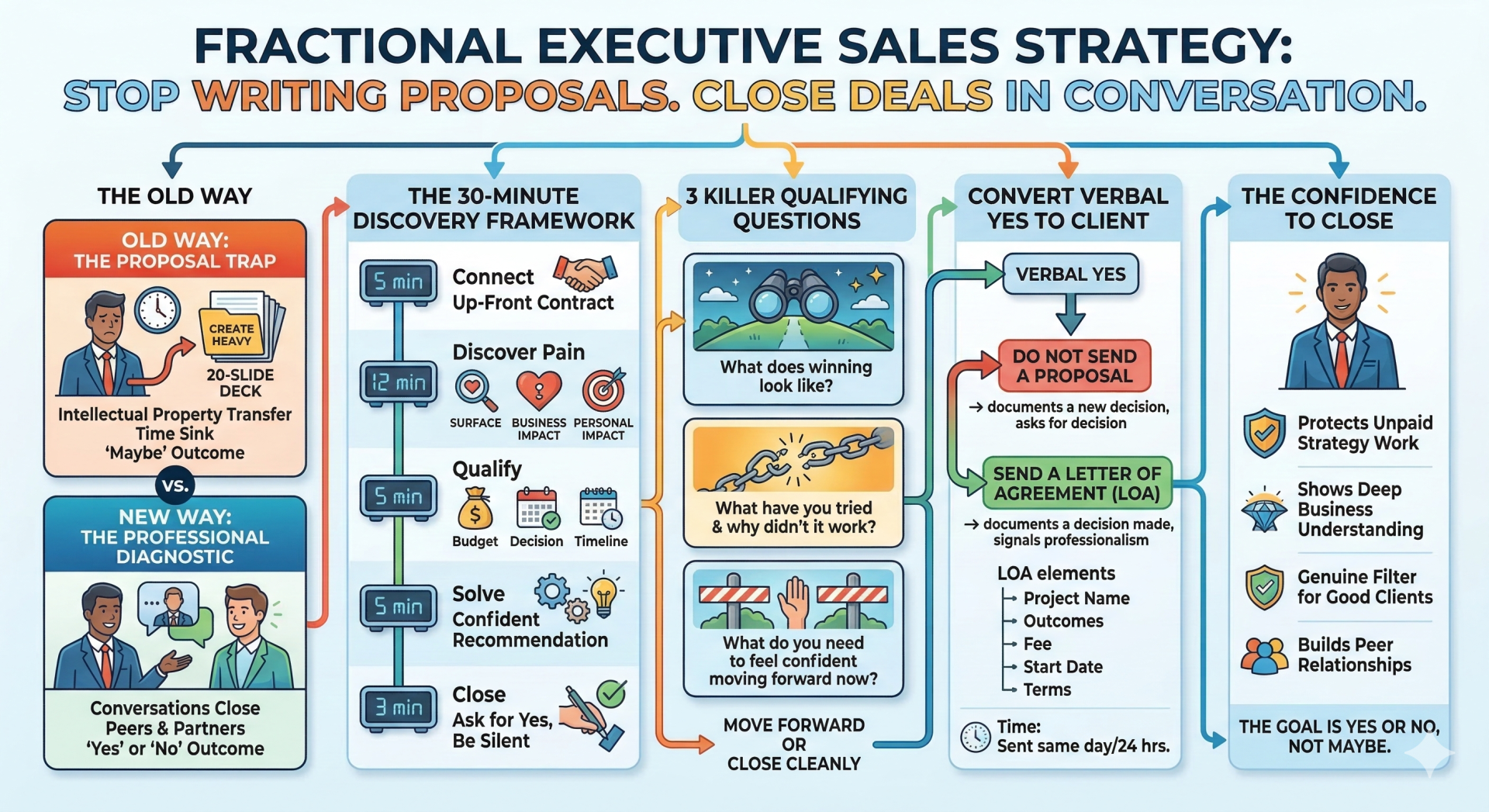
The conversation runs five stages in 30 minutes:
- Connect (5 minutes): Establish yourself as a peer, not a vendor. Set the agenda up front — tell them exactly what will happen in this call and what the possible outcomes are. This is the Up-Front Contract. It eliminates awkwardness and signals that you are organized and in control.
- Discover the Pain (12 minutes): This is where deals are won or lost. Go three levels deep: surface problem, business impact in dollars and missed opportunities, and personal impact — the emotional weight the CEO actually carries at 2 AM.
- Qualify (5 minutes): Confirm budget range, decision-making authority, and timeline before you recommend anything. Skip this and you hear “I need to talk to my partner” after you’ve already done the work.
- Solve (5 minutes): Only get here when pain is confirmed, money is workable, and you are talking to the decision-maker. Then make a confident recommendation — no deck, no document. A clear verbal statement in 60 to 90 seconds.
- Close (3 minutes): Ask for the yes. Then be quiet. Wait for the answer. Do not fill the silence.
The three qualifying questions that replace the entire proposal document
Before any prospect gets a proposal from me — paid or otherwise — I run three questions that either move the deal forward or close it cleanly. These come directly from the discovery framework I use with every new fractional client conversation.
Question 1: What does winning look like in the next 12 months? This forces the prospect to articulate their actual goal, not their perceived problem. The answer almost always reveals something their “proposal request” would never have surfaced.
Question 2: What have you already tried, and why didn’t it work? This tells you exactly what NOT to recommend — because they’ve already been burned by it — and shows you where their real skepticism lives. Their answer also tells you how self-aware they are about their own business.
Question 3: What do you need to see right now to feel confident moving forward without a document? This is the most important question in your entire sales process. It forces the prospect to stop hiding behind paperwork and name the real hesitation. Budget? Authority? Timing? You’ll find out in 10 seconds.
| When they say this… | They actually mean… | Your next move |
|---|---|---|
| “Just send over a proposal.” | They’re avoiding a budget conversation. | Ask: “What budget range have you set aside for this?” |
| “We need to see the steps.” | They don’t trust your process yet. | Share a relevant case study — not a new plan. |
| “We’re talking to five others.” | You’re being treated as a commodity. | Exit the race or charge for a paid strategy session. |
| “I need to think about it.” | You missed something in discovery. | Ask: “Of everything we discussed, what’s giving you the most pause?” |
How to uncover the pain that actually makes a fractional client say yes
Most fractional executives stop at Level 1 pain. The prospect says “our revenue is inconsistent” and the consultant says “I can help with that” and jumps straight to the pitch. That’s where deals die quietly, not dramatically.
The discovery framework uses a three-level pain funnel. Level 1 is the surface complaint — what they volunteer first. Level 2 is the business impact — what that problem is costing them in dollars, delayed decisions, and missed opportunities. Level 3 is the personal impact — the sleepless nights, the board meeting dread, the anxiety that sits in their chest on Sunday evenings.
CEOs don’t open up to Level 3 with someone they don’t trust. You earn it by listening at Levels 1 and 2 without rushing to solve. When a CEO tells you “I lie awake wondering if we’re going to make it through Q4,” that is not a complaint. That is a buying decision waiting for someone to show up with confidence and a clear answer.
What is a Letter of Agreement and why do fractional executives use it instead of a proposal?
Once you have a verbal yes, you send a Letter of Agreement (LOA). Not a proposal. The distinction matters more than it sounds.
A proposal asks for a decision. An LOA documents one that’s already been made.
The LOA covers the engagement name, the specific outcomes you discussed on the call, the start date, the fee, and payment terms. Keep it clean and readable in under two minutes. No marketing language. No padding. No “the following comprehensive strategic engagement will include…” One page if you can manage it.
Send it within 24 hours. Same day is better. Speed signals professionalism and tells the client you are ready to deliver. Follow up once at 48 hours if unsigned. After two follow-ups with no response, move on. They said no. Leave the door open and keep moving.
What to charge for a paid strategy session when a prospect wants a plan first
Some prospects genuinely need a roadmap before signing a monthly engagement. That’s legitimate. But your roadmap is your work product — charge for it.
A paid strategy session or diagnostic positions your thinking as exactly what it is: valuable. The fee filters out everyone who is shopping for ideas rather than buying implementation. If a prospect won’t invest $500 to $1,000 in a strategy session, they almost certainly won’t invest $5,000 per month in the engagement.
Frame it simply: “Before I build a roadmap, I need to understand your business deeply enough to build one worth following. I offer a paid strategy session for $[fee]. We walk away with a clear priority plan, and you decide whether to move forward from there.” Then stop talking. Let them respond.
How fractional executives build the confidence to close deals in the conversation
The first time feels terrifying. The second time feels awkward. By the fifth time, you stop thinking about it.
Confidence comes from knowing you are protecting both sides of the table — yourself from unpaid strategy work, and the prospect from a generic document that won’t move their business forward. High-quality clients respect this. They’ve dealt with vendors who buried capabilities in a PDF hoping to impress. When you show up differently — direct, diagnostic, confident — they lean in.
The deals that close in the conversation are almost always the best client relationships. The ones that require three rounds of proposals, two months of follow-up, and four “just checking in” emails? Those are usually the ones that end badly and leave you wondering why you said yes in the first place.
Frequently asked questions about the no-proposal strategy for fractionals
How do I tell a prospect I don’t write proposals without sounding difficult?
Frame it as a benefit to them, not a policy for you. Try: “I’ve found that proposals answer the wrong question — they explain what I’ll do, but not whether it will actually fix your problem. Let’s figure that out in this conversation first. If we’re aligned, I’ll send a Letter of Agreement that documents what we already decided together.” That’s not arrogance. That’s professionalism.
What if the company requires a formal RFP process?
For solo fractionals and small teams, RFPs are almost always a losing game without a pre-existing relationship with the decision-maker. Without an internal champion actively advocating for you, you are filling a procurement checkbox, not being genuinely considered. Your time is worth more than that. Walk away and stay in touch for when the timing changes.
What should I do when a prospect says they need to talk to their partner?
This means you either didn’t identify the decision-maker early enough, or you didn’t uncover enough pain to create urgency. Don’t let the prospect sell for you. Ask: “Would it make sense to get the three of us on a quick call so I can answer their questions directly?” If they resist that, it tells you something important about how this engagement would go.
How much should a fractional executive charge for a paid strategy session?
A reliable benchmark is 10% of the total engagement value. If you’re positioning a $5,000/month retainer, charge $500 for the paid diagnostic. Anyone unwilling to pay for a clear strategic roadmap is signaling how they’ll treat your expertise throughout the engagement. The fee is not the point — the filter is.
What do I do when a prospect goes cold after a great discovery call?
Send a brief recap email within two hours of the call. Summarize their pain, the engagement you discussed, and the fee. Follow up once at the agreed time. Follow up one more time five days later. After two follow-ups with no response, stop. Leave the door open — “If the timing shifts, I’m happy to reconnect” — and move on to your next conversation.
Related reading for fractional executives
- How to Price Your Fractional Services Using Good-Better-Best
- What Is a Fractional CMO and Do You Need One
- The Only Three Marketing Strategies Small Businesses Need