
In This Article

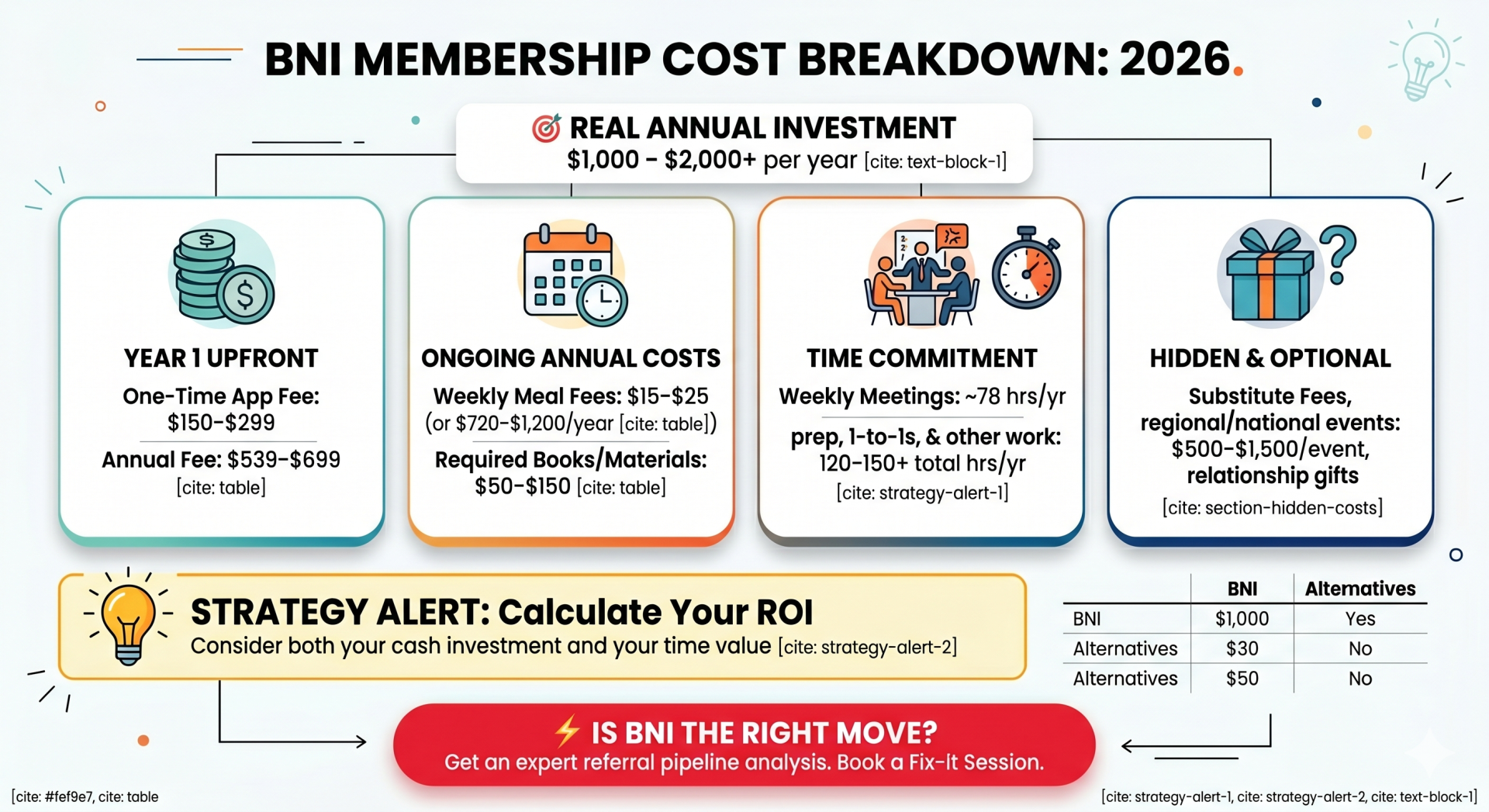
BNI membership cost ranges from $700 to $1,500+ per year, depending on your chapter, region, and how many meals, events, and materials you factor in. The base annual fee is typically $539–$699, but most members spend significantly more once you add the application fee, required books, weekly meal costs, and national conference fees. BNI membership cost is the real question you need to answer before you walk into that visitor’s day.
The pitch always sounds the same. Someone you trust tells you about their BNI chapter, how they generated $50,000 in referrals last year, and you should absolutely come see it for yourself. So you do. The room is energetic, the people are enthusiastic, and by the time the meeting wraps up, you’re half-sold. Then they hand you the membership application — and suddenly you’re doing math in your head.
I’ve watched this scene play out more times than I can count. And the number that catches people off guard isn’t the annual fee. It’s everything around it.
BNI Membership Cost by Region: The Fee Table You Actually Need
BNI sets guidelines, but chapters set their own fees within those guidelines. This means the “official” number you see on BNI’s website is rarely what you’ll pay at a specific chapter. Here’s what to expect across different regions:
| Fee Type | US (Typical) | UK (Typical) | Canada (Typical) |
|---|---|---|---|
| Annual Membership Fee | $539–$699 | £699–£799 | CAD $800–$1,000 |
| One-Time Application Fee | $150–$299 | £100–£200 | CAD $150–$250 |
| Weekly Meal/Meeting Fee | $15–$25/week | £10–£20/week | CAD $15–$25/week |
| Annual Meal Cost (48 meetings) | $720–$1,200 | £480–£960 | CAD $720–$1,200 |
| Required Books/Training | $50–$150 | £30–£100 | CAD $50–$150 |
| Total Year 1 Estimate | $1,459–$2,348 | £1,309–£2,059 | CAD $1,720–$2,600 |
These numbers reflect typical chapter costs. Some premium metro-area chapters run higher. Some rural chapters run lower. The only way to know your exact number is to ask the chapter director directly — before your visitor’s meeting, not after.
What Does BNI Membership Cost Include?
The annual fee covers your seat in the chapter — meaning your profession or category is protected. No one else in your BNI chapter can sell the same service or product. That seat-exclusivity is what you’re actually paying for, not the breakfasts.
Your membership also includes access to BNI Connect (their online referral tracking platform), training through BNI’s online learning center, and the ability to attend other chapters as a visitor when traveling. You get listing in BNI’s global member directory, which occasionally surfaces in local search results.
What it does not include: the weekly meal fees, the books you’ll be strongly encouraged to buy, travel to regional events, or the time you’ll spend at one-to-ones (the one-on-one meetings members hold with each other outside of chapter meetings).
The Hidden BNI Costs Most Members Don’t Mention
The meal fees are predictable. These costs are less obvious — but real.
Substitute fees. Miss a meeting? Many chapters require you to send a substitute. Some chapters charge a small fee when you miss without finding one. Chronic absences can lead to membership termination.
Regional and national events. BNI holds regional trainings and national conferences. These aren’t mandatory, but ambitious members attend. Registration, travel, and hotel can easily run $500–$1,500 per event.
Books and training materials. BNI has its own ecosystem of books and training. Givers Gain by Ivan Misner, the BNI founder, is essentially required reading. Other titles are strongly recommended. Budget $50–$150 for materials in year one.
Gifts and relationship costs. Strong BNI relationships often involve goodwill gestures — referring a contact to lunch, sending a thank-you for a referral, or attending a referred client’s event. These costs don’t appear on any fee schedule, but they’re real.
The opportunity cost of a slow start. Most BNI members say it takes 6–12 months before referrals start flowing consistently. If you join and need ROI in 90 days, the math is tough. That first year is an investment in relationship capital, not an immediate revenue channel.
BNI Membership Cost vs. Other Networking Groups
BNI isn’t the only structured networking game in town. Before you sign on the dotted line, here’s how it stacks up against the most common alternatives:
| Organization | Annual Fee | Meeting Frequency | Exclusivity? | Best For |
|---|---|---|---|---|
| BNI | $539–$699 + meals | Weekly | Yes (by profession) | Service-based businesses seeking structured referrals |
| Chamber of Commerce | $300–$800 | Monthly (varies) | No | Businesses seeking community visibility and advocacy |
| LeTip | $400–$600 + meals | Weekly | Yes (by profession) | Alternative to BNI; similar structure, lower fees |
| EO (Entrepreneurs’ Organization) | $3,000–$5,000+ | Monthly (plus forums) | No (revenue threshold) | Growth-stage businesses; peer learning over referrals |
| Local Leads Groups (independent) | $0–$200 | Weekly or bi-weekly | Varies | Budget-conscious; testing referral networking |
The Chamber comparison is worth a full look before you decide. I went deep on that in my article on BNI vs. Chamber of Commerce — the answer isn’t as obvious as most people think.
Is BNI Membership Tax Deductible?
BNI membership fees are generally tax-deductible as a business expense in the United States, because the purpose is to generate business referrals. The annual membership fee, application fee, and related business expenses (training materials, travel to BNI events) typically qualify under ordinary and necessary business expenses per IRS guidelines.
The weekly meal fees are trickier. Meals are subject to the 50% deductibility rule for business meals — meaning you deduct half the cost, not all of it. Keep your receipts and log the business purpose for each meal.
State tax rules vary. Always confirm with your accountant or CPA, especially if you’re in a state with more restrictive business expense rules. The IRS doesn’t give BNI any special treatment — it falls under the same rules as any other professional membership and business meal.
Can You Negotiate BNI Membership Fees?
The short answer: sometimes, but not in the way you might expect.
BNI’s corporate fee structure is set at the global level, so the chapter director doesn’t have authority to discount the annual membership fee. What chapters do sometimes negotiate: payment plans (quarterly or semi-annual instead of annual upfront), waived or reduced application fees for members who join during a chapter recruitment push, or trial periods for certain markets.
A few things worth asking before you sign:
- Does the chapter offer quarterly payment options?
- Is the application fee waived during the current recruitment period?
- Are there any scholarship or sponsored membership opportunities for certain industries?
- What’s the chapter’s policy if your business closes or you need to pause membership?
The meal fees are also negotiable in a sense — some chapters allow you to pay quarterly in advance at a slight discount. Ask the membership coordinator, not just whoever invited you to visit.
What Happens If You Quit BNI?
BNI membership is an annual contract. If you resign mid-year, you don’t get a prorated refund of the annual fee in most cases. The standard policy is that fees paid are non-refundable once the membership period has started.
Your seat in the chapter goes back into the available pool — another professional in your category can now join. If you’re in a strong chapter, someone will fill your seat relatively quickly.
Your referral relationships don’t disappear, but they shift. Members are loyal to the seat and to whoever fills it over time. Your personal relationships with individual members remain yours, but don’t expect the chapter referral machine to keep producing for you after you leave.
Some chapters have a 30-day written notice requirement before the renewal date. Read your membership agreement before you sign, not when you’re already frustrated and ready to quit.
Is BNI Worth the Cost for a Small Business Owner?
Worth is the wrong word. The right question is: what does your referral pipeline look like right now, and is BNI the most efficient way to fix it?
BNI works when you have a service-based business, sell to other business owners or local consumers, have time to invest in weekly meetings and relationships, and are willing to give referrals before you expect to receive them. The membership fee is not the variable that determines success. Engagement is.
Members who fail at BNI almost always share the same pattern: they join, attend irregularly, don’t work the one-to-ones, and then complain the referrals never came. Members who succeed treat it like a sales channel with a system — which is exactly what it is.
My full analysis on how BNI stacks up for different business types is in my complete BNI review. If you’re evaluating whether to join, read that before you pay anything.
And if you’ve already joined and the referrals aren’t flowing yet, the problem usually isn’t the group. My article on how to get referrals walks you through the system that actually moves the needle — inside or outside a formal networking group.
How to Evaluate a BNI Chapter Before You Pay
Not all BNI chapters are equal. Chapter culture, engagement levels, and member mix vary enormously — and all of those factors affect whether you generate referrals or just pay for breakfasts.
Before you commit to any chapter’s BNI membership cost, visit at least twice. Ask these questions during your visits:
- What is the chapter’s TYFCB (Thank You for Closed Business) total for the past 12 months?
- How many active members does the chapter have (target: 25–40 for a healthy chapter)?
- Is your profession currently open, or is someone already in your seat?
- What’s the chapter’s average tenure — do members stay, or is there high turnover?
- How active are members in one-to-ones outside of meetings?
A chapter that can’t answer the TYFCB question clearly has a data problem. A chapter with high turnover has a culture problem. Both are expensive for you to discover after you’ve paid.
BNI Membership Cost: Frequently Asked Questions
How much does BNI membership cost per year in the US?
BNI membership cost in the United States runs $539–$699 per year for the base annual fee. When you add the one-time application fee ($150–$299), weekly meal costs ($720–$1,200 annually), and required training materials ($50–$150), total first-year costs typically range from $1,459 to $2,348 depending on your chapter and region.
What is the BNI membership fee for the first year vs. renewal?
First-year BNI membership cost is higher because it includes a one-time application fee of $150–$299 on top of the annual membership fee. Renewal years drop that application fee, so your ongoing annual commitment is typically $539–$699 in membership fees plus meal costs. Some chapters also charge a smaller renewal administration fee — confirm this before you sign.
Is BNI membership tax deductible for small business owners?
Yes, BNI membership fees are generally tax-deductible as an ordinary and necessary business expense under IRS guidelines for US businesses. This includes the annual membership fee, application fee, and BNI-related training materials. Weekly meal fees follow the 50% business meal deduction rule. Always verify with your accountant, as state rules and individual business circumstances vary.
Can you negotiate your BNI membership fee?
The annual membership fee itself is set at the corporate level and chapters typically cannot discount it. However, you may be able to negotiate payment terms (quarterly vs. annual), waived application fees during recruitment drives, or discounted meal rates for advance payment. Ask the chapter director directly — not the member who invited you — for the current flexibility on fees.
What happens to your BNI membership fee if you quit mid-year?
BNI membership fees are non-refundable once the membership year has started. If you resign mid-year, you forfeit the remaining months of your paid membership. Your seat returns to the chapter’s available pool. Read your membership agreement before signing — some chapters require 30 days’ written notice before the renewal date to avoid automatic renewal charges.
How does BNI membership cost compare to a Chamber of Commerce?
Chamber of Commerce membership typically costs $300–$800 per year with no weekly meal fees, making it less expensive than BNI in raw dollar terms. BNI’s higher cost reflects the structured, exclusive referral system — you’re paying for profession-exclusive access and a formal referral-generating process, not just networking access. Whether that premium is worth it depends entirely on how many referrals you realistically generate from each.
What is included in BNI membership for the annual fee?
BNI annual membership includes your exclusive seat in the chapter for your profession or business category, access to BNI Connect (the referral tracking platform), access to BNI’s online training center, visitor privileges at other BNI chapters when traveling, and listing in BNI’s global member directory. It does not include weekly meeting meal fees, printed training materials, or event registration costs.