
In This Article

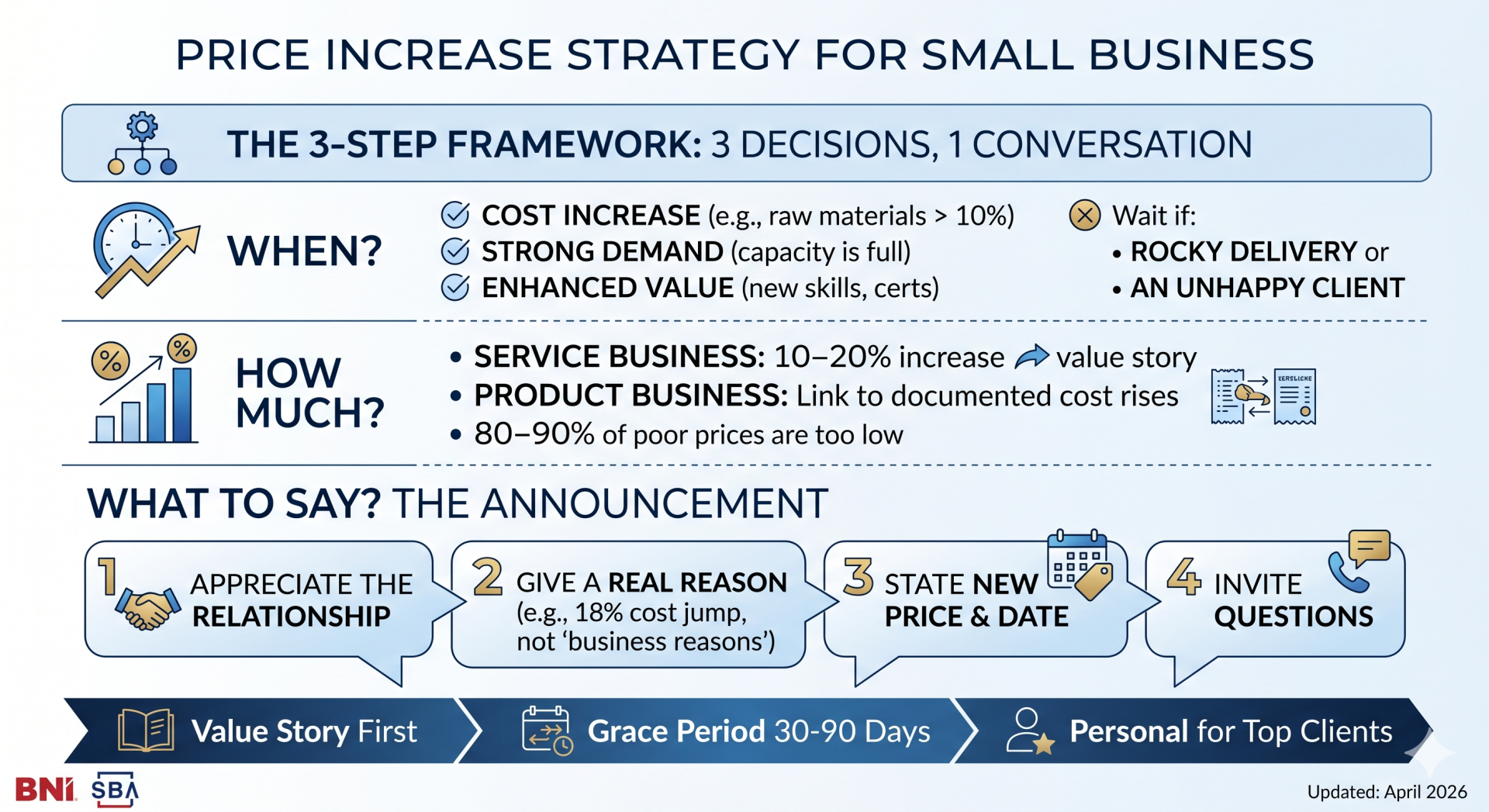
A price increase strategy for small business is a structured plan for raising rates without triggering customer churn. It covers three decisions: when to raise prices, how much to raise them, and how to communicate the change to existing customers. Most small business owners get at least one of these wrong — not because they don’t understand their costs, but because they treat pricing as a math problem when it’s really a communication problem.
Sixty-seven percent of small business owners raised prices or planned to in 2025. The ones who kept their clients didn’t have better timing or lower cost structures. They had a plan for the conversation. The owners who lost customers were the ones who sent a single email with a number and no story behind it.
When Is the Right Time to Raise Prices
The worst time to think about a price increase strategy is when you’re already losing money. By that point, you’re reactive — and reactive pricing reads as desperate to customers who’ve been loyal for years.
The best time to raise prices is when demand is strong, your delivery is consistent, and you have concrete evidence of the value you’re delivering. These three conditions don’t have to align perfectly, but you need at least two of them before you move forward.
There’s a decision framework pricing expert Rafi Mohammed outlines in his research: prices should reflect the value customers receive, not just the costs you incur. When those two numbers drift apart — when costs rise faster than your rates — you don’t just have a pricing problem. You have a positioning problem that pricing alone won’t fix.
Here’s how to read the signals correctly:
Raise prices now if: Your costs have risen 10% or more in the last 12 months. You’ve added capabilities, certifications, or service depth since you last updated your rates. Customers are getting results that dramatically exceed what they’re paying for. Your competitors are charging more for comparable or lesser service.
Wait if: You’re in the middle of a rocky delivery. A major client is already unhappy. You’re about to lose a significant account for reasons unrelated to price. You haven’t clearly defined — to yourself — what makes your service worth more.
How Much to Raise Your Prices
The number most small business owners land on is based on what they think customers will accept — not on what the service is actually worth. That’s backwards, and it’s why most small business price increases are too small to matter.
Research consistently shows that 80–90% of poorly chosen prices are set too low. The owners who underprice usually know it. They just don’t have a framework for justifying a higher number to themselves, let alone to their customers.
A solid price increase strategy for small business uses three reference points to arrive at a defensible number:
Your cost floor. What do you need to charge to keep the lights on, pay yourself, and maintain quality delivery? This isn’t your price — it’s your minimum. If you’re pricing below this, no amount of communication strategy will save you.
The competitive range. What are comparable providers charging? Not to copy them, but to understand the range. If you’re at the low end and delivering at the high end, you have pricing room you haven’t used.
The cost of not solving the problem. What does it cost your customer in time, money, or stress if they don’t work with you? This is where value-based pricing lives. When you can articulate the outcome, you stop defending a number and start describing a return on investment.
The practical result: most service-based small businesses can raise prices 10–20% in a strong market without meaningful churn, provided they lead with value before they announce the number. The sequencing matters as much as the percentage.
What a Price Increase Strategy Looks Like for Different Business Types
A freelance copywriter raising rates handles this differently than a retail shop adjusting product prices. The strategy is the same; the execution is different.
Service businesses (consultants, coaches, agencies, fractionals): You have the most flexibility and the most personal exposure. Your clients hired you specifically. The conversation about price is a conversation about your relationship. Lead with outcomes you’ve delivered, then announce the new rate with a grace period for existing clients. Personal communication — a call or a personal email — outperforms a mass announcement every time.
Product-based small businesses: You have less relationship equity per transaction, but you have more data. Look at what’s driving cost increases (materials, shipping, labor) and be transparent about it. Customers who’ve been buying from a local or small business for years generally accept cost-driven increases when they’re explained clearly. Surprises lose customers; explanations keep them.
Subscription and retainer models: Grandfathering is your most useful tool. Current clients stay at their rate for 90 days while new clients start at the new rate. This respects the relationship, gives people time to plan, and creates a natural deadline for the conversation. It also gives you a data point: how many existing clients upgrade without the deadline, and how many need the nudge.
How to Announce a Price Increase Without Losing Customers
This is where most small business price increase strategies fall apart. The decision to raise prices is sound. The number is defensible. And then the announcement goes out — one flat paragraph in an email — and the phone starts ringing with cancellations.
The announcement has four parts, in this order. Skip any of them and you’re leaving retention to chance.
1. Lead with appreciation, not apology. Apologizing for a price increase signals that you don’t believe you’re worth it. Appreciating the relationship signals that this is a business decision made from a position of strength, not desperation. “I’m proud of what we’ve built together” lands differently than “I’m sorry to do this.”
2. Explain the reason in plain language. Customers don’t need your P&L. They need a one-sentence explanation that connects to something real. “Material costs are up 18% this year” is real. “To continue delivering the quality you expect” is real. “Business reasons” is not a reason.
3. State the new price and the effective date clearly. No vague timelines. No “sometime in Q2.” A specific date gives clients a planning window and demonstrates respect for their budget cycles. Thirty to sixty days is standard for service businesses. Ninety days is appropriate for long-term retainer relationships.
4. Make it easy to ask questions. Include a direct invitation to reach out. This isn’t a negotiation — but some clients need to hear the rationale in their own words before they’re comfortable. A brief phone call after the announcement email has saved more at-risk accounts than any loyalty discount ever will.
This is also where your referral and word-of-mouth relationships matter most. Clients who refer others, who participate in your community, who’ve told you publicly that they value your work — those clients receive a personal outreach before the mass announcement. Treat your best relationships like the assets they are. If you want to strengthen those referral relationships, this guide to getting more referrals is a good parallel read.
Price Increase Email Templates That Actually Work
The templates most people find online are written for corporate procurement teams, not for the small business owner whose clients know them by name. Here are two versions that work in real small business contexts.
Template A: The Warm Value-First Approach (best for service businesses with strong client relationships)
Subject: A note about [your service] pricing starting [date]
Hi [Name],
Working with you on [specific outcome or project] has been genuinely rewarding — [one sentence of genuine specificity about their results or the relationship].
I’m writing to let you know that my rates are changing effective [specific date]. [Your service] will move from [current price] to [new price]. This reflects [one-sentence honest explanation: rising costs, expanded capabilities, increased demand].
Your current rate is locked through [grace period end date]. After that, the new pricing applies going forward.
If you have questions or want to talk through what this means for your [specific project or retainer], I’m happy to get on a call. Just reply here and we’ll find a time.
Thank you for being the kind of client who makes this work worth doing.
Template B: The Direct Transparency Approach (best for product-based businesses, larger client bases, or cost-driven increases)
Subject: Pricing update — effective [date]
Hi [Name],
Straight to the point: our prices are increasing on [date].
[Product/service] will go from [current price] to [new price]. This is driven by [specific cause — materials, labor, supplier costs]. We’ve absorbed as much as we can without cutting the quality you’re used to.
If you want to lock in current pricing, orders placed before [date] will honor today’s rates.
Questions? Reply here.
Thank you for your continued support.
Grandfathering Versus Full Price Increases
Grandfathering means existing clients keep their current rate for a defined period while new clients start at the new rate. It’s not a discount — it’s a transition tool.
The case for grandfathering: long-term clients who’ve built their budget around your rate deserve time to adjust. Honoring that relationship with a 60–90 day grace period costs you very little in the short term and preserves the relationship for the long term. The referrals and renewals from those retained accounts will outperform any short-term revenue gain from hard cutoffs.
The case against full grandfathering: if some clients stay at the old rate indefinitely, you’ve created a two-tier system that’s administratively messy and economically unsustainable. Grandfathering works as a transition, not as a permanent pricing policy. Set the end date clearly and honor it.
For most small service businesses, the right price increase strategy combines both: a 60–90 day grandfather period for current clients, a clear cutoff date, and personal outreach to your top five to ten accounts before anything goes out broadly. The most common reason referral marketing stops working is that the relationship capital gets spent during moments like this without any investment made beforehand.
Build Your Value Story Before You Announce the Price Increase
The single biggest mistake in a price increase strategy for small business is leading with the number. The price is the last thing you announce — not the first. What you lead with is the story of what customers have gotten and what they’ll continue to get.
A value story is not a sales pitch. It’s a factual account of outcomes delivered. “Since we started working together, your [specific metric] improved by [specific amount].” Or: “I’ve added [specific capability, tool, or certification] since we last updated rates — here’s what that means for the work we do together.”
The strongest value stories are specific and recent. They reference something the client experienced directly, not a general claim about service quality. If you don’t have recent data, collect it before you announce the increase. A simple one-question check-in — “What’s the most valuable outcome you’ve gotten from our work together?” — gives you the language clients use to describe your value, which is the most persuasive language you can use back to them.
There’s a reason this matters beyond the price conversation. Clients who articulate your value to you are also the clients who articulate it to others. That’s the referral behavior that makes a price increase survivable — a strong incoming referral flow means any departures don’t create a cash gap. If your referral network needs strengthening before your next pricing round, looking at structured networking alternatives is worth your time. Networks like BNI generate 5–10 qualified referrals per month for active members — that’s the kind of pipeline that makes pricing conversations feel like decisions instead of risks.
For service businesses in particular, your value story also needs to account for what’s changed in the market — not just in your own business. When your clients see that comparable providers are charging more, or that demand in your category has tightened, the price increase makes sense in context. You’re not raising rates arbitrarily; you’re aligning with a market that has moved. This is the kind of strategic framing that separates owners who approach pricing as a business discipline from those who raise rates apologetically and lose ground in the process.
If you’ve never thought about your business’s referral system as part of your pricing infrastructure, this is the connection to make. Strong inbound demand is leverage in a price conversation. Weak demand is not. A well-functioning referral network means you can hold the line on price because you have options — and customers sense that confidence in the conversation.
Price Increase Decision Table
| If You See This… | It Means… | Your Next Move |
|---|---|---|
| Costs up 10%+ in past 12 months | Margin is eroding whether you feel it yet or not | Audit your cost structure, then set a new rate this quarter |
| Demand exceeds your capacity | Your price is below market — you’re subsidizing customers who’d pay more | Raise rates for new clients immediately; grandfather existing for 90 days |
| Competitors charge 20%+ more for similar service | You have pricing room and a positioning gap | Strengthen your value story first, then close the gap in stages |
| Clients rarely push back on price during sales conversations | You’re underpriced — price objections are normal; absence of them is a signal | Test a higher rate on your next three new client proposals |
| You’ve added certifications, tools, or service depth since last rate update | Your offer improved; your price didn’t keep up | Lead the announcement with what’s changed, then state the new rate |
What to Do When Customers Push Back on Your Price Increase
Some pushback is normal. Ten percent of your clients will express concern regardless of how well you’ve communicated the change. Most of them are not actually going to leave — they’re processing.
The mistake most owners make at this stage is negotiating. The moment you offer to hold the old rate for a client who pushed back, you’ve signaled that the new rate was arbitrary. Other clients who accepted without pushback will eventually find out, and you’ve created an internal equity problem.
The right response to pushback has three parts: acknowledge the concern, restate the value, and hold the line.
“I hear you — it’s a meaningful change. What I can tell you is that the new rate reflects [specific value: your results, the expanded scope, the market shift]. I’m not in a position to hold the old rate beyond [grace period date], but I’d love to figure out how we make the new structure work for your budget.”
Then stop talking. Silence in a pricing conversation is not awkward — it’s the space where the client makes their decision.
The clients who leave over a well-justified, clearly communicated price increase were price-sensitive from the beginning. They were never your long-term clients. The ones who stay are the relationships worth investing in — and a referral from one of them is worth more than the margin you gave up trying to hold an unhappy client. If your referral network isn’t generating the volume you need to absorb that client turnover, this guide on asking for referrals addresses the specific conversation most owners avoid.
How to Build a Price Increase Strategy for Small Business Into Your Annual Routine
The owners who handle price increases best don’t treat them as crises. They build pricing reviews into their annual calendar the same way they file taxes or renew insurance — not because it’s urgent, but because neglecting it has consequences.
A simple annual pricing review has four checkpoints:
Pricing research from Harvard Business Review consistently shows that most companies wait too long to raise prices — and that the delay costs them more than the increase would have. The same pattern holds for small businesses: the owners who raise prices on a regular schedule recover faster and retain more clients than those who make one large catch-up increase after years of holding rates flat. The SBA’s financial management guidance reinforces this: pricing discipline is part of financial health, not separate from it.
Q1 — Cost audit. What did raw materials, labor, software, and overhead actually cost last year? Where did costs increase? What’s projected for this year? This isn’t accounting — it’s giving yourself the data to make a pricing decision from a position of knowledge instead of gut feeling.
Q2 — Market scan. What are three to five comparable providers charging right now? Not last year — now. Markets shift faster than most small business owners update their rates.
Q3 — Value assessment. What did your clients actually receive? What outcomes can you document? What new capabilities have you added? This is your evidence file for the announcement conversation.
Q4 — Decision and communication plan. Do you raise prices, hold, or restructure the offer? If you raise, what’s the announcement timeline, who gets personal outreach, and what’s the grandfather window?
Most small businesses that run this annual cycle raise prices 5–10% per year without meaningful churn, compound their margins steadily, and never face the panicked “I haven’t raised prices in four years and now I’m underwater” conversation that is, genuinely, one of the most stressful moments in small business ownership.
If you want a broader framework for integrating pricing decisions into your overall marketing approach, the three-strategy framework at DIYMarketers is a good starting point — pricing decisions don’t live in isolation from how you generate and retain customers.
Frequently Asked Questions About Price Increase Strategy for Small Business
How do you raise prices without losing customers?
A price increase strategy that retains customers leads with value before announcing the number. Explain what has changed in your costs or capabilities, give existing clients a grace period (30–90 days), communicate personally with your highest-value accounts before sending a mass announcement, and be direct about the effective date. Vague timelines and apologetic language are the two most common mistakes that trigger churn.
How much should a small business raise prices?
Most service-based small businesses can raise prices 10–20% in a strong market with minimal churn if the communication is clear and the value story is solid. Product-based businesses typically work in smaller increments tied directly to documented cost increases. The floor is your actual cost structure; the ceiling is the cost your client would incur by not working with you. The number in between is your pricing zone. Research consistently shows that 80–90% of small business prices are set too low — which means most owners have more room than they think.
How do I announce a price increase to existing customers?
Send a personal email — not a mass newsletter blast — to your top accounts before any broad announcement. The email has four components: appreciation for the relationship, a clear and honest reason for the change, the new price and effective date, and an invitation to ask questions. Give existing clients 30–90 days at their current rate before the new pricing takes effect. The personal outreach to top accounts is the step most owners skip, and it’s the step that prevents the most churn.
What is a good reason to give customers for a price increase?
The best reasons are honest and specific: rising material or labor costs, expanded service scope, increased expertise or certifications since the last rate update, or market rate alignment when your prices have drifted below comparable providers. Vague reasons (“to maintain quality service”) are technically accurate but feel evasive. Customers who’ve been with you for years can handle a real explanation. What they can’t handle — and what causes them to leave — is feeling like they’re getting a form letter instead of a genuine conversation.
When is the wrong time to implement a price increase strategy?
Avoid announcing price increases when you’re mid-delivery on a troubled project, when a key account is already at risk, or when you haven’t clearly defined your own value story. If you can’t explain in two sentences why your service is worth the new rate, clients won’t be able to either — and that’s when price becomes the conversation instead of value. Fix the positioning before you fix the number. If your marketing strategy isn’t generating enough new client flow to absorb any potential churn, that’s the first thing to address. A stalled referral channel going into a pricing cycle makes every price increase harder than it needs to be.