
In This Article

Updated: April 2026
Before I give you my BNI review, you need to know what BNI is.BNI (Business Networking International) is a weekly paid referral networking group where members pass leads exclusively within their chapter. Membership costs $998–$1,398 for the first year, plus an application fee of ~$249. BNI works — but only for members who arrive with a clear ideal client, a ready referral system, and the patience for a 6–12 month relationship-building runway. Here’s my personal BNI review and recommendations to get the most out of it.
- BNI is a referral channel — not a referral system. Joining without one means paying $2,000+ a year to attend breakfast and wonder why the leads aren’t coming.
- BNI’s own data shows members average $12,000 in new business annually — but that average hides a massive gap between members who arrive prepared and members who show up and wait.
- By the end of this review, you’ll know exactly whether BNI is right for your business right now — and what to build before you write the check.
Will BNI work for your business?
BNI works best when five parts of your referral system are already in place. Take this free five-question check before you commit $2,000 and 100+ hours to a membership.
It’s 6:45 AM. You’re nursing lukewarm coffee, staring at a plate of rubbery scrambled eggs in a windowless hotel conference room, and wondering why you’re paying for the privilege of being here.
If you’re reading this, you’re likely in one of two camps: you’re considering joining BNI and want to know if the $1,000+ investment is worth it — or you’re already a member, you’re exhausted by the CEUs and rigid rules, and the referrals aren’t coming.
I’ve watched BNI work like a lead-generation miracle for some people and become an expensive early-morning hobby for others. This is the unfiltered truth about what makes the difference.
What Is BNI and How Does It Work?
BNI stands for Business Networking International. It’s a global referral networking organization founded by Ivan Misner in 1985, built around the philosophy of “Givers Gain” — you refer business to members, and they refer business back to you.
The structure is rigid by design. Each chapter holds one seat per profession, so there’s exactly one accountant, one web designer, one insurance agent. That exclusivity is the entire value proposition: you’re the only option in the room when someone needs what you do.
Every week, members meet — usually at 7:00 AM — for a tightly structured 90-minute session. Open networking, 60-second member pitches, a featured presentation, a referral count, and a treasurer’s report. It runs like a well-oiled machine. Whether that machine produces for you depends almost entirely on what you bring to it.
How Much Does BNI Membership Cost?
BNI membership costs vary by region and chapter, but here’s what you can expect across most U.S. markets:
| Membership Type | 1-Year Cost | 2-Year Cost |
|---|---|---|
| New Member | $998–$1,398 | $1,298–$2,189 |
| Prior Member Renewal | $899–$1,099 | $1,546–$1,890 |
| Application Fee | ~$249 (one-time) | — |
| Meeting Meals / Room | $10–$20/week | $520–$1,040/year |
Add it up and a single year of active BNI membership lands somewhere between $1,750 and $2,700 when you include meals and the application fee.
That’s before you factor in your time — roughly 2–3 hours per week including travel, prep, and the meeting itself. Over a year, that’s 100–150 hours. At even a conservative billing rate of $75/hour, your true cost of BNI is closer to $9,000–$13,000 when you count opportunity cost.
For a full breakdown including hidden costs and how to calculate your break-even referral volume, see BNI membership cost: what you’ll really pay in 2026.
Is BNI Worth It? The Honest Answer
BNI is worth it for the right person in the right chapter at the right time. That’s not a cop-out — it’s the actual answer, and the research on referral marketing backs it up.
BNI’s own data reports that members average $12,000 in new business annually from referrals. But averages hide the distribution. Some members close $100,000 from their BNI seat. Others close $0 and quit bitter. The difference almost never comes down to the chapter — it comes down to whether the member had a clear referral system before they joined.
Word-of-mouth is already the #1 source of new clients for most service businesses. BNI is a structured system to amplify what’s already working — which means if nothing is working yet, BNI amplifies nothing.
What BNI Members Get Right (and What They Get Wrong)
I’ve seen two kinds of BNI members. One thrives. One grinds for 12 months and quits. Here’s the breakdown:
Accountant A — The Generalist: Joe’s weekly pitch was “I do taxes and bookkeeping. Send me anyone with a business.” After a year, Joe had a handful of small personal tax returns. He barely covered his dues. He called BNI a waste of time.
Accountant B — The Specialist: Sarah spent two weeks before joining crafting her ideal client profile. Her pitch was specific: “I help HVAC contractors find at least $10,000 in hidden tax leaks in 30 days or less.” Every member in that room knew exactly who to look for. The plumber referred her to five tradespeople. Sarah’s BNI seat became a $100,000 revenue stream.
Same room. Same dues. Same time commitment. Completely different outcomes — because of what they brought to the table before they sat down.
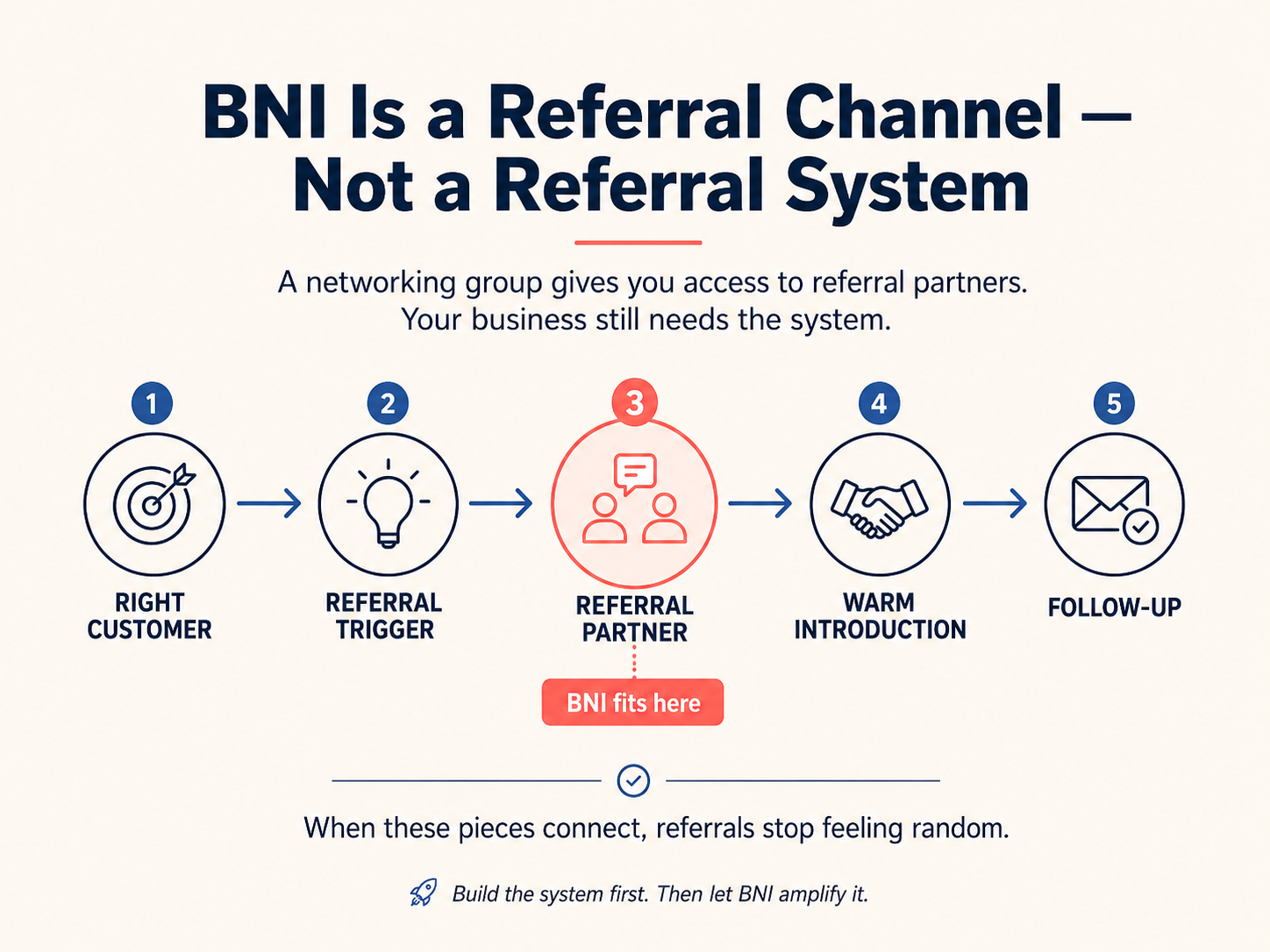
What the Sarah vs. Joe example shows is that BNI gives you access to a room of potential referral partners. What happens inside that room depends on the referral system you bring with you: who you want referred, what situation should make someone think of you, what words to use, and what to do after the introduction happens. The group is the channel. The system is yours. See the DIYMarketers Referral Marketing System →
BNI vs. Alternatives: Is It the Only Referral Networking Game in Town?
BNI is the 800-pound gorilla of structured referral networking, with over 300,000 members in 70+ countries. But it’s far from the only option — and for some businesses, it’s not the right fit at all.
Here’s a quick comparison of BNI and its closest alternatives:
| If You See This… | It Means… | Your Next Move |
|---|---|---|
| You need structure + accountability | BNI’s rigid format works in your favor | Join BNI — but come prepared |
| You want lower commitment + flexibility | Weekly mandatory meetings will feel like handcuffs | Try a Chamber of Commerce or local meetup first |
| You serve a local, trade-heavy market | BNI’s cross-referral model is built for this | Find the most active chapter in your service area |
| You’re a fractional executive or consultant | Your referral partners aren’t other service providers — they’re decision-makers | Build a targeted referral network instead |
LeTip is BNI’s closest structural competitor — weekly meetings, category exclusivity, mandatory tip-passing. The main difference is scale: LeTip is far smaller, which can mean tighter relationships or a less active pipeline, depending on the chapter.
Chambers of Commerce are a completely different animal. Much looser, focused on mixers and community visibility, with none of BNI’s referral accountability. For a full breakdown, read BNI vs. Chamber of Commerce: which networking group is right for you.
If you’re exploring the full range of options, networking groups like BNI covers the top alternatives worth knowing before you commit. For a side-by-side breakdown of all three major options, see BNI vs. LeTip vs. Chamber of Commerce.
Is BNI a Scam? What the “Horror Stories” Are Really About
Search “BNI horror stories” or “is BNI a scam” and you’ll find plenty of frustrated ex-members. Almost none of those stories are actually about BNI being fraudulent. They’re about unmet expectations — and that’s a different problem entirely.
BNI is transparent about its costs, its requirements, and its structure. The frustration comes from members who expected passive referral income in exchange for showing up. That’s not what BNI sells, even if some chapters oversell the magic during recruitment.
Here’s what the BNI horror stories have in common:
- Members joined without a clear ideal client definition
- Members expected referrals in months 1–3, before trust was established
- Members didn’t learn how to teach their chapter to refer them
- Members got “business card” leads instead of warm introductions — and didn’t know the difference
A lead is a contact. A referral is a warm introduction. BNI promises to facilitate referrals — but it cannot force your chapter members to have warm contacts in your target market. That alignment has to be evaluated before you join, not after you’ve paid dues for six months.
My BNI Review: What I Got Wrong
When I started my business, I was at every networking event I could find. BNI was one of the groups I joined early, hoping to tap into a consistent referral stream. What I found was that I walked in without a strategy and was surprised when the referrals didn’t come.
The biggest mistake I made was expecting referrals to happen automatically. I showed up, gave my pitch, handed out business cards — and waited. That’s not how BNI works. BNI is a system that rewards the people who teach it what to do for them.
What I noticed in my local chapter: the pressure to bring referrals every week pushed members to bring business cards — contacts that weren’t vetted, relationships that weren’t warm. That’s not a BNI problem per se. It’s a chapter culture problem. And it’s exactly why visiting multiple chapters before joining matters more than the organization’s national reputation.
For the full picture on what makes referral strategies actually work (and what breaks them), read how to ask for referrals the right way — it’s the foundation you need whether or not BNI is in your future.
When BNI Is Not the Right Move
BNI is a long game. If any of these describe you right now, hold off:
- You’re in the first 6 months of business. You need revenue faster than BNI’s relationship runway allows.
- Your cash flow is tight. The $1,200+ year-one investment plus time opportunity cost is significant. There are other ways to build referral momentum without the upfront commitment.
- Your business is primarily online or national. BNI’s cross-referral model runs on local, in-person trust networks. If your clients are scattered across the country, the chapter composition will rarely match your market.
- You’re in a narrow, specialized niche. BNI works best when your ideal client is the kind of person other BNI members know — a business owner, homeowner, or professional service buyer. If your niche is too narrow, the room won’t have natural referral connections for you.
- You haven’t defined your ideal client yet. This is the non-negotiable. If you walk into a BNI meeting and your pitch is “I help small businesses,” you’ll leave with nothing. Period.
What to Do Before You Write the BNI Check
Three things you need to have ready before you spend a dollar on BNI membership:
1. Your Ideal Client Profile — in writing. Not “small business owners.” Your specific client: industry, company size, the problem they’re bleeding from, the language they use to describe it. If you can’t say it in a sentence that makes someone go “Oh, I know exactly who that is,” you’re not specific enough.
2. Your Referral Guideline. A one-pager that tells your chapter members what to say, who to look for, and how to introduce you. Most people skip this. It’s the single biggest lever for getting quality referrals instead of business cards. Here’s how to structure that ask so people actually follow through.
3. A 6-month commitment mindset. BNI trust-building has a runway. If you’re expecting leads in month two, you’ll quit in month three and call it a scam. The members who win in BNI are the ones who invest in relationships before they expect a return.
You’re showing up. So why aren’t referrals happening?
Check the five places a BNI referral system commonly breaks. It takes about two minutes and requires no email.
The Bottom Line: Is BNI Worth It in 2026?
BNI is worth it if you treat it like a business investment, not a lottery ticket. That means showing up with a clear ideal client, a referral strategy, and the patience to let trust compound over 6–12 months.
BNI is not worth it if you’re expecting a passive referral pipeline from showing up and waiting. No amount of early morning eggs and lukewarm coffee will compensate for walking in without a strategy.
The members who thrive in BNI aren’t the ones with the most connections. They’re the ones who made it easy for their chapter to refer them — by being specific, by teaching their referral partners exactly who to look for, and by understanding that getting referrals is a skill you develop, not a benefit you passively receive.
If you’re showing up, participating, and building relationships but referrals still aren’t happening consistently, the networking organization may not be the problem. The breakdown may be somewhere else in your referral system — targeting, referral triggers, asking, timing, or follow-up. Diagnose your referral system →
Frequently Asked Questions About BNI
What does BNI membership cost per year?
BNI membership costs between $998 and $1,398 for the first year in most U.S. markets, plus a one-time application fee of approximately $249. Add weekly meeting meals at $10–$20 per week and your total first-year investment typically lands between $1,750 and $2,700. Two-year memberships run $1,298–$2,189. Renewal rates for prior members are slightly lower than new member rates. Costs vary by region, so contact your local chapter for exact pricing. Before calculating whether the fee is worth it, calculate your break-even referral volume: divide your total annual BNI cost by your average revenue per new client. That’s how many clients BNI needs to produce each year to pay for itself. Most members need two to four new clients annually to cover dues alone — not counting the time cost.
Is BNI worth it for a small business owner?
BNI is worth it for small business owners who serve local markets, have a clearly defined ideal client, and can commit to a 6–12 month relationship-building runway before expecting consistent referrals. It’s less effective — and often a poor ROI — for business owners who are still defining their niche, primarily serve online or national markets, or need revenue faster than BNI’s trust timeline allows. The clearest sign that BNI is a good fit: you already get referrals informally, you know exactly who you want referred, and you have a clear way of describing your ideal client that non-experts can repeat. If those three things are true, BNI gives you a structured weekly system to amplify what’s already working.
How is BNI different from a Chamber of Commerce?
BNI and the Chamber of Commerce operate on fundamentally different models. BNI requires weekly attendance, charges $1,000+ annually, and holds members accountable for passing referrals — with one seat per profession in each chapter. The Chamber of Commerce is typically more affordable, requires no attendance commitments, and focuses on community visibility and networking mixers rather than structured lead-passing. For service businesses that need referrals regularly, BNI’s structure produces more consistent results. For businesses building community awareness or seeking event visibility, the Chamber may offer better value. A key distinction: BNI’s accountability structure means members feel real pressure to produce referrals, which creates a higher floor for engagement. Chambers don’t have that mechanism, so results depend almost entirely on how actively you participate. For a deeper comparison, read BNI vs. Chamber of Commerce.
What is a BNI 60-second presentation and how do I make mine better?
The BNI 60-second presentation is your weekly member pitch — 60 seconds to tell your chapter who you are, what you do, and exactly who you’re looking for this week. The most common mistake is being too broad: “I help anyone with a business” produces zero referrals because no one knows who to look for. The most effective pitches name a specific type of person, describe a specific problem, and request a specific kind of referral — “This week I’m looking for HVAC contractors who are behind on their quarterly filings.” The more specific the ask, the easier it is for chapter members to act on it. For examples that consistently generate referrals — including the exact language structure that works — read BNI 60-second commercial examples. The principle is the same whether you’ve been a member for two weeks or two years: specificity is what converts a pitch into a referral.
What should I do if BNI isn’t producing referrals?
If you’re in BNI and referrals aren’t coming, don’t add more 1-to-1s and don’t quit yet. Diagnose the real problem first. Most BNI stalls trace back to one of three issues: your pitch is too vague for members to know who to look for, your offer isn’t clear enough for members to pitch you confidently, or your chapter doesn’t have enough members who interact with your target market. Review your 60-second pitch, tighten your ideal client profile, and ask your chapter’s top referral producers for direct feedback on your positioning. If the pitch is solid and the chapter has the right people, the next place to look is your referral system outside of BNI. Read why referral marketing stops working and how to fix it. The referral system you bring to BNI is what determines how well BNI works for you — and strengthening that system often produces results faster than changing chapters.
WHAT SHOULD YOU DO NEXT?
Still deciding on BNI?
Want an honest look at the full membership investment before you commit?
Ready for more qualified introductions?
If your real goal is a steady referral pipeline — regardless of which networking group you join — start here.
Additional Reading
- Networking Groups Like BNI: Your Best Alternatives in 2026
- BNI vs. Chamber of Commerce: Which One Is Right for Your Business?
- Referrals vs. References: What’s the Difference and Why It Matters
- How to Ask for Referrals Without Feeling Awkward About It
- Why Your Referral Marketing Stopped Working (and What to Do About It)