
In This Article

Value-based pricing for services isn’t magic—it’s the math of what your work is actually worth to your customer. Most consultants and service providers either skip this step entirely or botch it by guessing. Then they wonder why they’re simultaneously too cheap and too broke. The problem is that how to set value-based pricing for services looks like it comes out of thin air. You pick a number, hope it sticks, and cross your fingers. But there’s real structure underneath, and if you understand three things, you can get it right.
I learned this the hard way. I spent years quoting projects by the hour, which meant I was leaving money on the table whenever I was efficient, and eating my profit when things took longer. I watched consultants underprice transformational work because they had no framework for pricing based on what the work was worth to the client. Then I watched them hire employees, realize their labor costs had doubled, and have nowhere to go with pricing because they’d already told all their prospects they were cheap. That’s when I realized: value-based pricing isn’t optional for service businesses—it’s survival.
How to Set Value-Based Pricing for Services: The 4-Step Process
How to set value-based pricing for services follows a specific four-step process. You quantify what the customer’s outcome is worth (Step 1), calculate what it costs you to deliver (Step 2), understand what the market will pay (Step 3), then run the formula that finds where those three numbers intersect (Step 4).
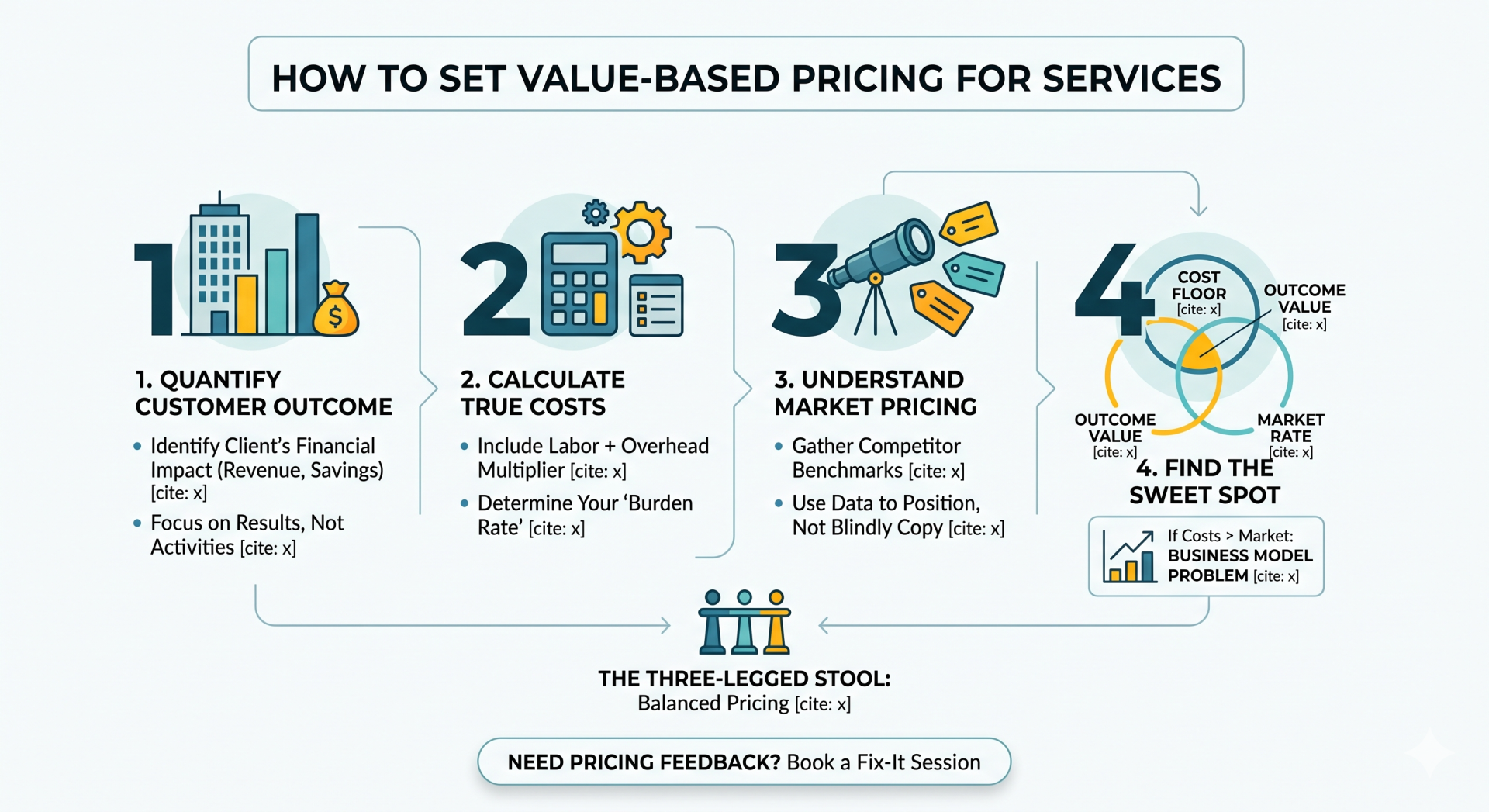
Most service providers skip one or more of these steps and call the result “value-based pricing.” It isn’t. Genuine value-based pricing for services requires all three inputs working together—and when they don’t align, the math tells you something is structurally wrong with your business model.
The Three-Legged Stool: Why Most Service Providers Get Value Pricing Wrong
Most service providers price based on one leg, then act surprised when the table tips. Labor statistics show that service providers across industries tend to anchor to competitive rates rather than calculating true value delivered or true cost to serve.
Some consultants focus entirely on customer outcome (“This work will generate $100K in revenue for my client, so I should get a percentage of that”). That’s value thinking, but if their costs are $50K to deliver and the client’s budget is $15K, the math doesn’t work.
Others obsess over their costs (“I need to make $75/hour to cover my salary, benefits, and overhead”). That’s reasonable accounting, but it ignores what the client actually gets out of it. You end up charging $15K for work that’s worth $150K to the customer.
Still others watch competitors and anchor to whatever the market is charging (“Coaches typically charge $5K for a three-month program, so that’s what I’ll charge too”). That’s competitive pricing, which has its place, but it ignores both your costs and your customer’s specific outcome.
Value-based pricing requires all three. And when they don’t align—when your costs are too high relative to customer value, or when the market won’t pay what the value justifies—that’s not a pricing problem. That’s a business model problem, and pricing is the diagnosis.
Step 1: Quantify What Your Customer Gets (The Foundation of Value-Based Pricing for Services)
This is where most service providers get stuck when they’re figuring out how to set value-based pricing. They describe what they do instead of what the customer gets.
A marketing consultant might say, “I run a 90-day content marketing strategy.” That’s an activity. What the customer gets is: “A predictable flow of leads that costs less than paid advertising, and a library of content that ranks on Google and keeps generating leads for years.”
A business coach might say, “I provide 12 coaching sessions and accountability.” What the customer actually gets is: “Clarity on their biggest revenue blocker, a 90-day action plan to fix it, and a 30% increase in gross profit because they’re not wasting time and money on the wrong strategies.”
The shift from activity to outcome is everything. Because your customer doesn’t care how many hours you work or what your process is. They care about what changes in their business because of your work.
How to Find the Outcome
Start with these questions. Ask your best clients or prospects:
- What happens if you don’t solve this problem? (What does it cost them to stay stuck?)
- What’s the financial impact of solving it? (Revenue generated, cost reduced, time freed up, risk mitigated?)
- How much faster/better/cheaper does your business run because of this solution?
- What would you pay to never have to deal with this problem again?
The answers to these questions are your outcome value. Sometimes it’s revenue (a sales consultant helps close 3 more deals = $45K additional revenue). Sometimes it’s cost savings (a bookkeeping consultant saves you $600/month in overpayment of taxes = $7,200/year). Sometimes it’s time freed up (a copywriter takes 20 hours/month off your plate = 240 billable hours you can sell elsewhere). Research from HubSpot on pricing strategy shows that businesses using outcome-based pricing models consistently capture more value from their customers.
Write this down. Put a number on it. This is the value you’re anchoring to.
Step 2: Calculate Your True Costs (What Most Skip When Setting Value-Based Pricing)
This is where the wheels come off for most service businesses. Value-based pricing for services only works when you know your real cost floor—not just what you want to earn per hour, but what it actually costs to run your business and put yourself in front of a client.
Let’s say you want to earn $100/hour. Sounds simple. But what’s it actually costing you to be in business?
Your labor cost is only part of the picture.
Software subscriptions (project management, CRM, accounting, email marketing, design tools): $300–$800/month
Office space or home office equipment: $200–$1,000/month
Insurance, taxes, retirement contributions: 25–40% of gross revenue
Marketing and business development: 5–15% of revenue to stay in the pipeline
Contractors or employees (if you’re past solopreneur stage): Usually 40–60% of revenue they bring in
Professional development, certifications, licenses: $100–$5,000/year
Accounting, legal, bookkeeping: $100–$500/month
Here’s the math that changes everything: If you want to earn $100K/year and you work 1,500 billable hours (a realistic number after accounting for admin, marketing, and nonbillable work), your labor rate needs to be $67/hour. But your blended rate—what you actually need to charge customers to cover all overhead and profit—is often 150–200% of that. Research from SCORE shows that most service business owners consistently underestimate their overhead burden, which is why they end up underpriced.
So that $67/hour billable rate? You probably need to charge $100–$134/hour just to break even after all costs. Then add profit on top.
The Burden Rate: What It Actually Costs to Deliver

Accountants call this your “burden rate.” It’s the total cost to put you in front of a customer, divided by the hours you bill.
[IMAGE PLACEHOLDER: Chart or infographic showing the relationship between labor rate, overhead multiplier, and blended rate. File name: how-to-set-value-based-pricing-for-services.png. ALT text: “How to set value-based pricing for services — the blended rate calculation showing how overhead and taxes multiply your base labor cost”]
Here’s a simple formula:
(Annual fixed costs + your desired salary) ÷ billable hours per year = your real hourly cost
Let’s run the numbers for a freelance consultant:
| Cost Category | Annual Cost |
|---|---|
| Desired salary | $80,000 |
| Taxes & payroll (25% of salary) | $20,000 |
| Software and tools | $6,000 |
| Office/equipment | $3,000 |
| Marketing and biz dev | $8,000 |
| Insurance, accounting, misc | $5,000 |
| Total Annual Costs | $122,000 |
| Divide by billable hours (1,200/year) | $101.67/hour |
That consultant now knows their true cost to deliver is $101.67/hour before any profit. If they’re charging $75/hour, they’re actually losing $26.67 per hour. They thought they had a $75/hour business. They actually have a negative-margin business.
This is why cost-based pricing is your foundation. You must know what it costs you to deliver. That’s your floor.
Step 3: Understand Market Pricing (Without Getting Obsessed)
You need to know what competitors charge. Not because you’re going to blindly copy them, but because the market gives you a ceiling.
If your customer outcome is worth $100K to them, but the market has decided that similar services cost $10K, you have a positioning problem. You can either convince them your service is different and worth more, or you need to adjust what service you’re selling.
How to Research Competitor Pricing Without Losing Your Mind
- Look at 3–5 direct competitors. Not every coach or consultant in your space, just the ones doing similar work for similar clients. (This is different from dynamic pricing, where you’re adjusting your own price based on demand. Here, you’re just gathering market intelligence.)
- Check their public pricing. Website, landing pages, proposal templates if they’re available. Some consultants publish rates. Others keep them private.
- Ask a friend to request a quote. If pricing isn’t public, you can do research by pretending to be a prospect. (Yes, this is a bit sneaky, but it’s market research.)
- Ask your network what they pay for similar services. This is gold. Real market data from real customers.
- Look at job postings for similar roles. If you’re pricing a service that competes with hiring, see what companies are actually paying for that position. A fractional CFO charges what a part-time CFO would cost.
Now you have three data points: your costs, your customer’s outcome value, and what the market typically charges. If all three align, you’ve got your price. If they don’t, you’ve got a problem to solve.
Step 4: The Value-Based Pricing Formula for Services (Where It All Comes Together)
Now you have three numbers. This is the step that makes how to set value-based pricing for services concrete instead of theoretical:
A = Your true hourly or project cost to deliver
B = Your customer’s quantified outcome value
C = What the market typically charges
Your price should land somewhere between A and B, informed by C.
Here’s a simple framework:
If A < C < B: Charge closer to B (you’re undervalued). Raise your price to capture more of the value you create. You’re still below what it’s worth to the customer, so you won’t leave money on the table.
If A < B < C: Charge B or slightly below C (market is overpriced). You can undercut competitors while still covering costs and profit. But watch out: if B is too low relative to A, you have a fundamental problem. You may be in the wrong market or need to restructure your offering.
If C < A: Your costs are misaligned with the market. Either you’re operating inefficiently (costs too high), you’re in the wrong market (too low-value customers), or you need to change what you’re selling (different service, different client tier). This is your diagnostic moment.
Running Scenario Analysis
Let’s walk through an example. Say you’re a marketing consultant, and you work with small e-commerce businesses.
Your true cost to deliver a 90-day engagement: $12,000 (your time + overhead allocated across 3 months)
Your customer’s typical outcome: 25% increase in revenue. If they’re doing $500K/year, that’s $125K in additional revenue. You’d capture 10% of that value = $12,500.
Market rate for similar work: $8K–$15K for a 90-day engagement.
Your sweet spot? $12,500–$15,000. You’re below the customer’s outcome value, you’re covering your costs with profit, and you’re at the top of the market range. If customers push back on price, you have proof that you’re worth it.
Now run that same analysis with a different customer segment. Say high-ticket B2B services where your 90-day engagement generates $500K in pipeline value for the customer.
Your cost: Still $12,000
Your customer’s outcome value: $50,000 (10% of $500K pipeline)
Market rate: Still $8K–$15K because the market hasn’t caught up to the value differentiation
Now you can price at $25,000–$35,000 (still well below your customer’s value), and you’d be leaving money on the table at market rates. This is where positioning and sales copy become important. You need to articulate why your service is worth more for this customer segment than that one.
When Value-Based Pricing Reveals Your Business Model Is Broken
This is the part nobody talks about when they teach how to set value-based pricing for services: sometimes the math doesn’t add up—and that’s the most valuable thing it tells you.
Maybe you discover that your costs are too high relative to the value you create. You’re running at a loss or barely breaking even, even though you’re busy. That’s not a pricing problem. That’s a cost or positioning problem.
Or you realize that the market won’t pay what your service is worth to customers. Your ideal clients can’t afford the price that makes sense. That tells you either you need different clients (higher-value targets), or you need a different service model (productized instead of custom, lower-touch, retainer-based instead of project-based).
Or—and this is common—you discover that the outcome you thought you were delivering is smaller than you believed. A coach might think they’re worth $20K for a transformation, but the market and customer feedback say that outcome is worth $8K. That’s valuable information. It means you need to either increase the scope of what you deliver, or reset your pricing expectations.
Value-based pricing isn’t magic. It’s diagnosis. When the math doesn’t work, it’s pointing at something broken. The earlier you catch it, the sooner you can fix it.
Common Mistakes When Setting Value-Based Pricing for Services
Even when service providers understand the framework, they still trip up. Here are the four mistakes that derail value-based pricing for services most often.
Mistake 1: Underestimating the Customer’s Outcome
You think your work saves a client 5 hours/week. It actually saves them 15. Or you think your sales training helps close 1 additional deal/month. It helps close 3. When you do customer interviews, you find the outcome is 3x bigger than you thought. Price accordingly.
Mistake 2: Mixing Pricing Methods Midstream
You quote a project based on value ($25K for a 90-day engagement), then halfway through, a scope creep issue comes up, and you revert to hourly thinking (“That’s 20 hours of extra work at $150/hour, so $3K more”). This confuses both you and the customer. Pick a method and stick with it. If value-based pricing is your model, use it all the way through.
Mistake 3: Not Updating Your Costs
You calculated your true costs in 2022. It’s now 2026. You hired staff, added software, moved to a nicer office. But you’re still charging like a solopreneur. Recalculate annually. Your costs go up. Your prices need to track that.
Mistake 4: Charging the Same Price for Different Outcomes
A coach charges every client $10K for 12 weeks. But Client A goes from $100K to $200K revenue (200% ROI on the coaching). Client B goes from $100K to $120K revenue (20% ROI). You’re underpricing Client A and overpricing Client B. If you’re going to use value-based pricing, acknowledge when the value is different.
How to Switch to Value-Based Pricing for Services (Without Losing Existing Clients)
For New Clients
Easy. Start with value-based pricing for services immediately on every new engagement. When you scope the project, ask the three questions: What’s the outcome? What does it cost me to deliver? What does the market charge? Price at the intersection.
For Existing Clients on Hourly or Fixed-Price Agreements
Trickier, but doable. You don’t renegotiate mid-contract. Let existing contracts finish. At renewal, reframe the conversation: “We’ve delivered X outcome for you (list specifics). The new engagement will build on that. Here’s what it’s worth based on what we’re creating together.”
Some clients will stay. Some will feel the price increase and push back. That’s okay. It clarifies the relationship. If they can’t see the value, maybe they’re not your ideal customer.
You can also handle price objections by walking them through the math. Show them the outcome. Show them what it would cost to hire someone to do this work internally. Reframe “expensive” as “ROI-positive.”
How to Communicate Value Pricing to Prospects
Don’t lead with price. Lead with outcome. Your website, your proposals, your sales conversations should all be about what you deliver, not what you charge.
When a prospect asks, “How much do you charge?” don’t dodge it, but don’t jump straight to a number either. Ask: “What outcome are we trying to create here? Let me scope what that’s worth.”
Your proposal should show:
- What problem they have (and what it’s costing them to stay stuck)
- What outcome they’ll get (specifically and in dollars if possible)
- Your price and why it’s a fraction of the value created
- What happens next (start date, deliverables, timeline)
This frame makes the price almost irrelevant. They see the value first.
FAQ: Value-Based Pricing for Services
How do you set value-based pricing for services?
To set value-based pricing for services, you follow four steps: (1) quantify what your customer’s outcome is worth in dollars, (2) calculate your true cost to deliver including overhead and taxes (not just your hourly rate), (3) research what the market typically charges for similar services, then (4) price somewhere between your cost floor and the customer’s outcome value, informed by market rates. When all three inputs align, you’ve found your price. When they don’t, your pricing math is revealing a structural problem in your business model.
Can I use value-based pricing with retainers?
Yes. A retainer is just value-based pricing spread across 12 months instead of a lump sum. Instead of charging $12K for a 90-day project, charge $1,000/month for 12 months (which might total $12K, or it might be higher or lower depending on the ongoing value). The math works the same way. You’re calculating the annual value you deliver, not the hours you work.
What if I can’t quantify the customer outcome in dollars?
Some services (coaching, therapy, training, design) don’t have a direct revenue impact. You can still quantify the outcome—it’s just not financial. “Improved team morale and retention” means you’re saving $50K in turnover costs. “Better design” means faster customer decision-making and higher conversion rates. Sometimes you work backward from what they’d spend to hire someone to do this full-time internally. That’s your ceiling.
How do I price if I’m brand new and have no track record?
Start by studying the market and understanding your costs. Charge within market range, biased toward the lower end (to build case studies). As you deliver outcomes, build your pricing data. After your first 10 clients, you’ll have real numbers for what your work is worth. Raise prices then. Don’t discount yourself forever just because you’re new.
Should I charge differently based on the customer’s budget?
No. Charge based on value delivered, not based on what you think they can afford. If a $10K service is worth $50K to them, they can afford it. If they can’t, they’re not your customer. Don’t undercharge to “fit their budget.” That leaves money on the table and attracts price-sensitive customers who will always be your cheapest option.
What if my costs are way higher than what customers will pay?
You have a business model problem. Your options: (1) raise your customer value through better positioning or service, (2) lower your costs through automation or efficiency, or (3) leave the market. You can’t sustainably charge below cost, so something has to give. This is where value-based pricing becomes your diagnostic tool.
The Bottom Line on Value-Based Pricing for Services
How to set value-based pricing for services isn’t about magic or guesswork. It’s three inputs—your costs, customer outcome, market rates—combined into a single pricing decision. When those three align, you’ve got sustainable pricing. When they don’t, your pricing is flagging something structurally broken.
Most service businesses never do this math. They charge what feels right, or what competitors charge, or what their time is worth. Then they wonder why they’re always stressed about money. This framework fixes that.
Start with your next proposal. Ask yourself: What’s my true cost to deliver? What’s the customer’s outcome worth? What does the market charge? Then price at the intersection. You’ll be surprised how often it comes out to something higher than you thought you could charge.