
In This Article

- Requiring a deposit from clients isn’t aggressive — in 2026, it’s the minimum standard for running a professional service business without bleeding cash.
- The 2025 QuickBooks Small Business Late Payments Report found that 56% of U.S. small businesses are currently owed money from unpaid invoices, with the average outstanding balance sitting at $17,500 per business.
- After reading this, you’ll know exactly how to require a deposit from clients, how to frame it so clients say yes without pushback, and which deposit structure matches your business model.
Knowing how to require a deposit from clients is one of the most financially protective things a small business owner can do in 2026. A deposit policy is a formal requirement that clients pay a portion of the total fee — typically 25% to 50% — before work begins. It protects your cash flow, filters out low-commitment clients, and gives you legal standing if things go sideways. With 55% of all U.S. B2B invoiced sales now past their due date, according to CashIn USA’s 2025 B2B Late Payments Report, a deposit isn’t optional. It’s table stakes.
A few months ago, someone posted in a small business Facebook group: “We just lost $3,000 because a client backed out after we’d already done half the work.” The comments lit up with sympathy — and then with something more useful: about 40 people sharing the deposit policies they wish they’d had from day one. The thread was a masterclass in expensive lessons nobody writes about in business school. This article is the cheat sheet version.
Why requiring a deposit from clients matters more than ever in 2026
The payment delay problem has crossed from “annoying” to “structural.” According to the 2025 Intuit QuickBooks Small Business Late Payments Report, 56% of U.S. small businesses are currently owed money from unpaid invoices. The average outstanding balance is $17,500. And nearly half — 47% — report invoices overdue by more than 30 days.
Meanwhile, BillGO’s 2026 Small Business Payments Pulse, which surveyed over 500 small businesses with Ipsos, found that 49% cite delayed customer payments as a top cash flow challenge. Another 43% say inconsistent cash flow is their single biggest barrier to getting growth financing.
Xero’s data shows U.S. small businesses are being paid an average of 7.8 days late — and that’s the best-case scenario. In manufacturing and B2B services, the wait stretches to 43 days on average.
The deposit benefit nobody talks about: better clients, not just faster payments
Here’s the thing research keeps confirming that surprises people: requiring a deposit upfront doesn’t just protect your bank account. It actually changes the quality of the client relationship.
Solo Finance Hub’s analysis of 100+ service projects found the correlation between deposit payment and client engagement is nearly perfect. Clients who pay a deposit show up to meetings, respond to feedback requests, and hit their own deadlines. Clients who don’t — ghost. The deposit acts as a commitment signal. Once someone has skin in the game, their behavior changes.
There are three documented benefits beyond faster cash:
- Legal standing: A deposit creates documented “consideration” — proof that a binding contract exists. If a client vanishes mid-project, you have a legal foundation for collections that invoice-only arrangements don’t provide. (Consultant Journal)
- Psychological commitment: Behavioral economics calls this the “sunk cost” effect. Once money is paid, clients are measurably more invested in outcomes. They show up. They decide faster. They communicate better.
- Client quality screening: Reluctance to pay a deposit is a documented red flag. In a widely-cited Reddit thread on r/smallbusiness, contractors overwhelmingly agreed: the clients who push back hardest on deposits are the ones most likely to cause payment problems later.
How much of a deposit should you require from clients?
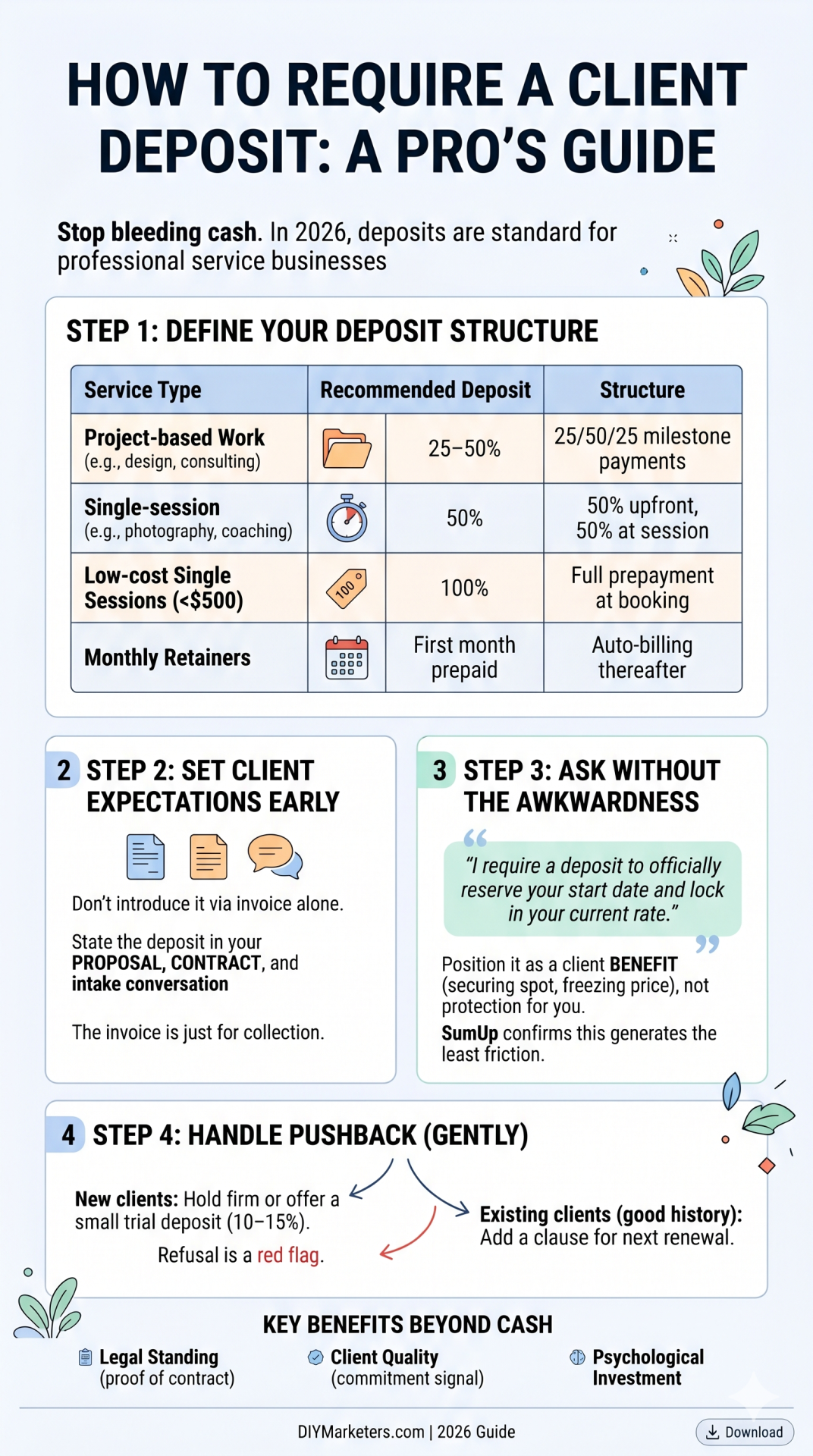
The contractor and consulting industries have converged on one structure more than any other: 25/50/25 milestone payments. That breaks down as 25% at signing, 50% at a key deliverable midpoint, and 25% before the final handoff. For project-based service work, this is the professional benchmark, according to ContractorPlus and the National Association of Decorative and Allied Trades.
For simpler engagements — single-session work, workshops, event bookings — 50% upfront is cleaner and easier to enforce. Some industries, particularly event planning and photography, are moving toward 100% prepayment for sessions under $500 because the administrative cost of chasing the remainder isn’t worth it.
For ongoing retainer relationships, connect deposits to your broader payment plans and pricing strategy. Monthly retainers with auto-billing eliminate the deposit conversation entirely — which is often the cleanest outcome for repeat clients.
Here’s a simple reference table:
| Service Type | Recommended Deposit | Structure |
|---|---|---|
| Project-based work (design, consulting, construction) | 25–50% | 25/50/25 milestone payments |
| Single-session services (photography, coaching, workshops) | 50% | 50% upfront, 50% at session |
| Low-cost single sessions (under $500) | 100% | Full prepayment at booking |
| Monthly retainers | First month prepaid | Auto-billing thereafter |
How to ask clients for a deposit without making it weird

This is where most service providers get stuck. The framing matters more than the amount. There’s a script that practitioners across multiple industries report works almost every time — and it doesn’t lead with protection or distrust. It leads with value.
Try this: “I require a deposit to officially reserve your start date and lock in your current rate.”
Notice what that does. It positions the deposit as a benefit to the client (you’re securing their spot, freezing the price), not a protection for you. SumUp’s invoicing research confirms that this framing — “locks in your rate and availability” — generates the least friction of any deposit explanation tested.
A few additional principles from practitioners who’ve run deposit policies for years:
- State it in the proposal, not just the invoice. By the time you’re invoicing, the expectation should already be set. Put deposit terms in your proposal and your contract. The invoice is just the collection mechanism.
- Use digital payments only. Checks introduce fraud risk and clearing delays. Stripe, Square, or PayPal give you a clean paper trail and faster access to funds.
- Don’t negotiate the deposit itself. You can negotiate scope. You can negotiate timeline. The deposit percentage should be non-negotiable — because the moment you make it optional, it becomes optional.
For more on how deposit requirements fit into a broader price increase strategy, or how to introduce new pricing terms to existing clients, the principles are the same: position changes as standard professional practice, not reactions to individual client behavior.
Should you require deposits from existing clients too?
The short answer: probably not retroactively, and definitely not abruptly. The research and practitioner consensus both point to a tiered approach rather than a blanket rule.
For existing clients with a clean payment history, keep current terms — but add a clause to your next contract renewal that persistent late payment triggers deposit requirements going forward. This protects the relationship while giving you a documented exit ramp if payment patterns change.
For existing clients with a spotty payment record, this is the inflection point. Use the next project as the moment to introduce deposit terms. The framing: “I’ve updated my standard project terms — starting with this engagement, I’m collecting a deposit at signing. It helps me plan resources better on my end.” Clean, professional, forward-looking.
This connects directly to value-based pricing principles — the way you structure and collect payment signals your level of professionalism. Clients who see a clear, consistent payment policy respect it more than they’d admit. It’s the ones who’ve never had to pay a deposit who are most surprised to find they’re willing to.
What happens if a client refuses to pay a deposit?
Treat it as information, not a negotiation. According to The Creative Agency Book, refusal to pay a deposit is one of the clearest early signals of a difficult client relationship ahead. The freelancers and agency owners surveyed overwhelmingly reported that clients who pushed back hard on deposits caused the most payment problems later in the engagement.
You have two clean options. First: hold firm and lose the client. Second: offer a smaller initial deposit (10–15%) as a first step for brand-new clients where you want to test the relationship. Some practitioners use a “first project” policy — smaller deposit, standard terms after that — as a lower-risk way to onboard unknown clients while still establishing that deposits are a real part of how they work.
What you don’t do is waive the deposit entirely “just this once.” Because it won’t be once, and now you’ve established that your policies are negotiable. Read more on how to raise prices without losing clients — the same firmness applies here.
Frequently asked questions about client deposit policies
How to require a deposit from clients who have never paid one before?
Frame the deposit as a feature, not a fee. Use language like: “I require a deposit to reserve your project start date and lock in your current pricing.” Send a short email when introducing the policy, explaining this is now your standard practice for all new engagements. Most clients — especially those who have worked with professional service providers before — will accept this without question. The clients who push back hardest are typically the ones most likely to cause payment issues later.
What percentage should you charge as a client deposit?
For most service businesses, 50% upfront is the clearest and easiest structure to enforce. For longer or larger projects, the 25/50/25 milestone model (25% at signing, 50% at mid-project, 25% before final delivery) is the professional standard across consulting, construction, and creative services. For simple single-session work under $500, full prepayment at booking is increasingly common and easiest to manage administratively.
Is it legal to require a client deposit upfront?
Yes — requiring a deposit before work begins is entirely legal in the United States and most jurisdictions worldwide. A deposit actually strengthens your legal position by creating documented “consideration,” which is proof that a binding contract exists. Include deposit terms in your written contract, specify what happens if the client cancels after the deposit is paid, and you have solid legal footing for collections if needed. Always consult an attorney for your specific situation and jurisdiction.
How do you handle a client who refuses to pay a deposit?
Treat it as an early signal about the client relationship. You have two options: hold your policy and decline the engagement, or offer a smaller initial deposit (10–15%) for first-time clients as a trial arrangement with standard deposit terms for all subsequent work. What you should not do is waive the deposit entirely. Doing so signals that your payment terms are negotiable, and that creates a pattern that’s hard to reverse with that client.
Should you charge a deposit to long-term clients with a good payment history?
Generally, no — at least not retroactively. For existing clients with clean payment records, maintain current terms but add a clause to future contracts stating that late payment patterns trigger deposit requirements going forward. Reserve deposit requirements for new clients and for existing clients whose payment behavior has become unreliable. The goal is protecting cash flow without damaging relationships that are already working well.