
In This Article
- The famous “$42 for every $1 spent” email ROI stat traces back to surveys commissioned by email platforms, with no independent verification. The real number, when measured with holdout tests, is closer to 12:1.
- Email open rates have dropped significantly over the last five years, and nearly half of B2B emails never even reach the intended inbox. If your numbers look worse than the industry benchmarks, the game changed. Your strategy is fine.
- Email still works. But only when you focus on buyers instead of subscriber counts, cull your list aggressively, and pair it with offline touchpoints that Gen Z and younger customers respond to.
Email marketing ROI small business owners can measure looks nothing like the industry benchmarks. The numbers you’ve been handed are mostly self-serving fiction. The $42:$1 figure that gets quoted everywhere? It comes from surveys run by Litmus, Constant Contact, and the DMA, all of which have a direct financial interest in you believing email is magic. When independent researchers run holdout tests (measuring what revenue would have happened anyway, even without the email), the incremental lift looks more like 12:1. Still good. But not the number you’ve been sold.
Here’s the thing that should make you feel better: if your email results have been disappointing, you’re not doing it wrong. The channel itself has changed. Open rates that used to top 30% are now averaging 20-25% for small business lists, before factoring in Apple’s Mail Privacy Protection, which inflates open-rate numbers by auto-loading pixels on every email. What looks like a 40% open rate on your dashboard is often closer to 15% actual human opens. You’ve been measuring your own performance against stats that were never real in the first place.
Why does the $42:$1 email ROI stat keep circulating?
Follow the money. Litmus sells email testing software. Constant Contact sells email marketing subscriptions. The DMA (Direct Marketing Association) is funded by direct marketers who want email to look essential. When these organizations commission surveys asking marketers to estimate their ROI, they get optimistic answers from the marketers who are happiest with their results (classic selection bias). The marketers who abandoned email or couldn’t measure it aren’t filling out industry surveys.
A Mailgun survey asked real email senders a simpler question: can you measure your email ROI? Less than half said yes. Of those who could measure it, the 40:1 return only appeared in 13% of campaigns. For the rest, returns were significantly lower, or unknown entirely.
The deeper problem is attribution. Most email platforms use last-click attribution. So if a customer saw your Instagram post on Monday, Googled your business on Wednesday, visited your website twice, and then clicked your cart abandonment email on Friday, and your email platform claims 100% of that sale. One marketer ran a genuine holdout test on a brand celebrating “40:1 ROI” and found the actual incremental lift was 12:1. Why? Because 70% of that revenue was happening anyway, through other touchpoints. Email was showing up at the finish line and taking the trophy.
Twelve to one is still excellent. Email is still worth doing. Stop managing your marketing based on numbers that were never accurate.
Has email marketing gotten worse, or did the benchmarks change?
Both, but the benchmark shift matters more than you think. Average email open rates for small businesses sit between 20–25% in 2025, down from 28–30% five years ago, according to Campaign Monitor’s annual benchmarks. Click-through rates average 2–3%, with click-to-open rates around 10%. Those numbers look worse until you understand what changed.
First, Apple’s Mail Privacy Protection (MPP), launched in 2021, pre-loads email pixels for every Apple Mail user, whether they open the email or not. If a significant chunk of your list uses Apple Mail (often 40–60% of small business lists), your open rate is inflated by ghost opens. An apparent 35% open rate on a list with 50% Apple Mail users could reflect only 17–18% of actual human opens. The platform is lying to you, and the lie is baked into every benchmark comparison you’re making.
Second, Gmail’s spam filters tightened considerably in 2024, requiring bulk senders to authenticate with DMARC, DKIM, and SPF. According to Validity’s Email Deliverability Benchmark Report, 48% of B2B emails never reach the intended inbox. Office 365 inbox placement dropped 26.7% in a single year. If your open rates are down, the first question isn’t “what’s wrong with my subject lines?” It’s “are my emails even arriving?”
Third, subscriber behavior changed. People sign up for email lists now more defensively. They expect offers, they know they’ll unsubscribe if they don’t get value quickly, and they’re more likely to mark something as spam than to unsubscribe cleanly. A list that grew rapidly during the pandemic years may have aged into a deliverability liability.
Should you focus on buyers instead of growing your email list?
Yes, and this reframe changes everything. Most small business owners treat their email list as a vanity metric. The size of your list is not a measure of its value. A 500-person list of buyers who open every email and buy whenever you make an offer is worth dramatically more than a 5,000-person list of freebie-seekers who haven’t engaged in six months.
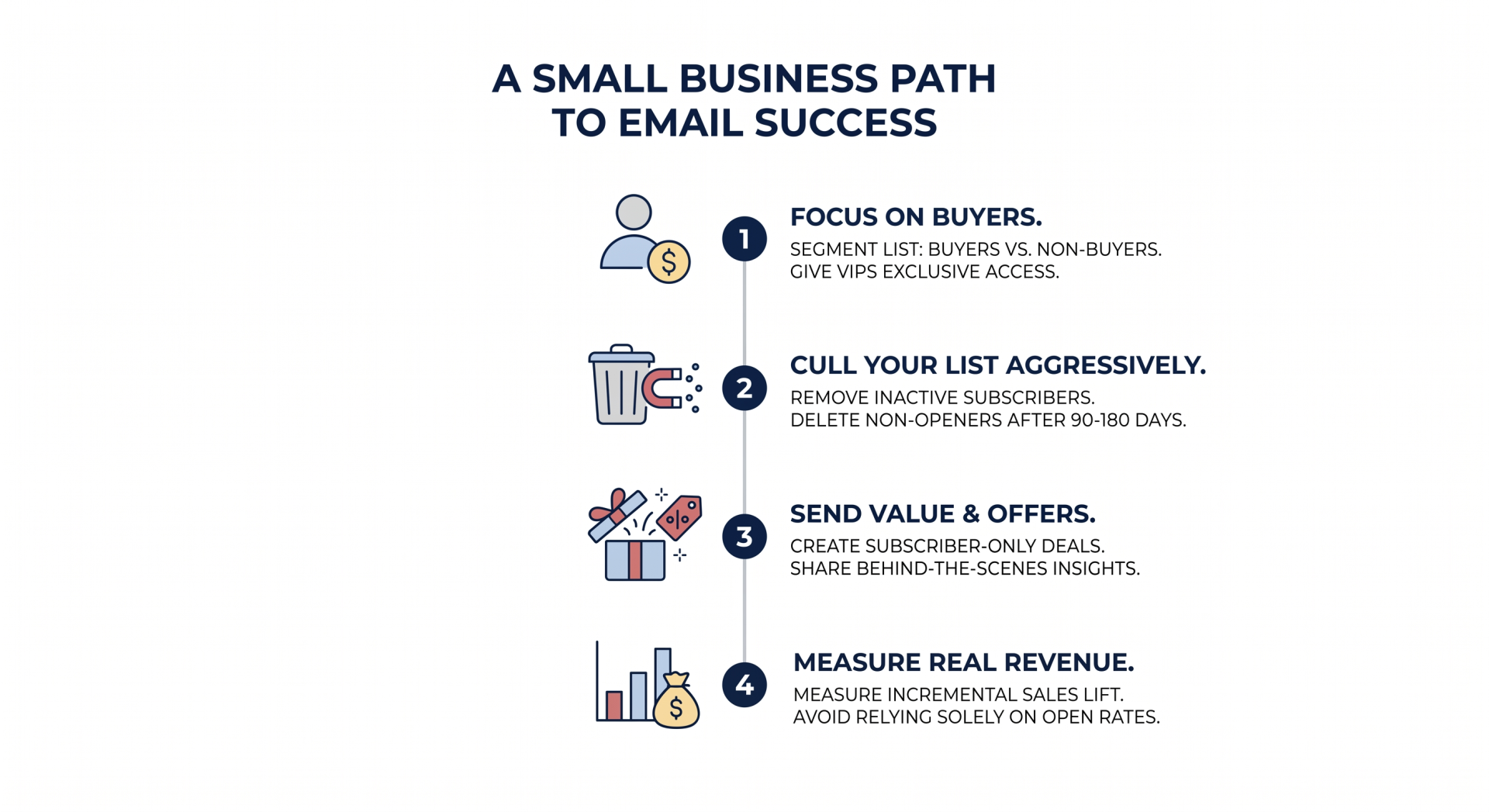
The shift is simple: segment your list into buyers and non-buyers, and treat them differently. Your buyers get early access, exclusive offers, and personal communication. Your non-buyers get a different kind of nurture sequence, one designed to convert them or get them to self-select out. Segmenting your email list by behavior is one of the highest-leverage moves in email marketing, and most small businesses don’t do it at all.
A practical framework:
- Buyers (purchased in last 90 days): Your VIP segment. Highest open rates, most receptive to offers. Email them more often, not less.
- Engaged non-buyers (opened in last 90 days, never purchased): Still worth nurturing. Give them a compelling reason to buy: a time-limited offer, a free consult, a product trial.
- Lapsed subscribers (no opens in 90–180 days): Send a re-engagement sequence. If they don’t respond to three attempts, remove them.
- Dead weight (180+ days, no opens): Delete. They’re hurting your deliverability, not helping your numbers.
How often should you cull your email list and what’s the best approach?
More often than you think, and more aggressively than feels comfortable. Email list cleaning isn’t a one-time project. It’s an ongoing practice. Industry data consistently shows that email lists decay at roughly 22–25% per year through address changes, abandoned inboxes, and deliverability shifts. If you haven’t cleaned your list in 18 months, you’re probably mailing a list that’s 30–40% unreachable.
A simple quarterly cleaning process:
- Pull everyone who hasn’t opened an email in 90 days.
- Send a three-email re-engagement sequence: “Are we still good?” with a clear offer, a reminder, and a final “we’re removing you” notice.
- Delete anyone who doesn’t respond to all three.
- Run a hard bounce cleanup after every send. Remove all hard bounces immediately.
- Use a verification tool (ZeroBounce, NeverBounce, or similar) once a year to scrub invalid addresses before a major campaign.
A smaller, cleaner list will always outperform a larger, stale one. Your open rates go up. Your deliverability improves. Your sender score improves. And you stop paying your email platform for subscribers who will never buy anything.
What should you put in your emails to get results?
Your list signed up for a reason: they wanted something specific from you. The fastest way to kill email performance is to forget what that reason was and default to “content” when what your audience wants is offers.
Research on small business email consistently shows that subscribers respond most to:
- Exclusive offers and discounts: Subscriber-only pricing, early access, or bundled deals they can’t get anywhere else. Your list should feel like an insider advantage, not a newsletter.
- Behind-the-scenes and process content: How you do what you do, what’s coming next, what you’re working on. This builds the relationship between offer emails without feeling like a broadcast.
- Short, specific recommendations: “I tried this and here’s what happened” outperforms “here are 10 ways to improve your X.” Your opinion, applied to one specific thing, converts better than a generic roundup.
- News that affects them directly: Price changes, service updates, new offerings, capacity limits. People open emails when the subject line signals something relevant is changing.
One pattern that reliably works for small businesses: the 3-1-1 rhythm. Three value emails (a tip, a resource, a behind-the-scenes moment) for every one hard offer, with one re-engagement check-in per quarter. You’re not running a media company. You’re maintaining a relationship with people who’ve already raised their hand.
For a closer look at how to structure emails that sell, the mechanics are straightforward once you stop chasing open rates and start building for buyers.
What offline marketing works alongside email for Gen Z and younger customers?
Email works best when it’s not the only thing you’re doing. For customers under 35, the combination of digital and physical touchpoints is where the real loyalty lives. Gen Z’s relationship with digital content is complicated: word of mouth and in-person recommendations drive their purchasing decisions far more than social media ads or email campaigns.
The data is worth paying attention to. Direct mail has an 80–90% engagement rate versus email’s current 20–25%. Seventy percent of consumers say physical mail feels more personal than digital messages. The ANA Response Rate Report puts direct mail ROI at 161% for house lists, compared to social media ads at around 21%. And for younger consumers who’ve grown up drowning in digital content, the tangible mail experience makes a physical piece of mail genuinely memorable in a way that the 47th email this week is not.
Three offline moves that work well alongside email:
1. The quarterly postcard to your top buyers. Pull your top 20–50 customers by revenue or purchase frequency. Send them a physical postcard once a quarter: a handwritten note, a loyalty offer, a “we appreciate you” acknowledgment. This costs $50–$100 in postage and materials. The effect on retention and referrals is disproportionate.
2. Small in-person gatherings for your best clients. Six to ten people, a coffee shop or restaurant back room, a real conversation. No pitch, no presentation. Pure connection. Relationship-based marketing has always outperformed broadcast marketing for service businesses. In-person events are its highest expression.
3. Physical brand touchpoints at key moments. A handwritten thank-you card after a first purchase. A branded notebook with a client’s first deliverable. A welcome package for new subscribers. These don’t scale the way email does, but they create the kind of memory that email can’t. When that customer needs to refer someone, they remember the experience, not the newsletter.
What email marketing ROI small business owners should be tracking
Stop measuring email performance in isolation. The attribution problem is too deep and the channel is too interconnected with everything else you do for a single number to tell you anything useful. Instead, measure what matters for your business: revenue in periods where you emailed versus periods where you didn’t, repeat purchase rates from email subscribers versus non-subscribers, and customer lifetime value broken down by acquisition channel.
A simple dashboard for small business email:
| Metric | What It Tells You | Healthy Benchmark |
|---|---|---|
| Click-to-open rate | Are the people who open your emails interested enough to act? | 10–15% is solid |
| Buyer segment open rate | Are your best customers still engaged? | 35%+ is excellent |
| Revenue per email sent | What does each send generate? | Track trend, not absolute |
| List growth rate vs. churn rate | Is the list getting healthier or degrading? | Growth should exceed churn |
| Unsubscribe rate per send | Is content relevant to people who signed up? | Under 0.5% per send |
Notice what’s not on that list: total subscriber count, overall open rate, or any comparison to the 42:1 benchmark. Those numbers feel good and tell you little about how your email program performs for your business.
For a closer look at email newsletter strategies that generate actual revenue, the principles are the same: buyer focus, consistent value, and honest measurement.
Frequently asked questions about email marketing ROI small business owners have
Is email marketing still worth it for small businesses in 2025?
Email marketing is still worth doing for small businesses, but the economics look different than they did five years ago. Deliverability challenges, Apple’s Mail Privacy Protection inflating open rate data, and increased competition in every inbox mean the channel requires more attention to list quality and segmentation than it used to. The real email marketing ROI for small business, when measured with holdout testing rather than last-click attribution, sits between 10:1 and 25:1 for well-maintained lists, lower than the often-cited $42:$1 figure, but still excellent. The businesses getting the best returns focus on buyers over subscriber counts, cull their lists quarterly, and pair email with offline touchpoints for their best customers.
Why have my email open rates dropped so much?
Email open rates have declined across the board for several reasons, and most of them are outside your control. Apple’s Mail Privacy Protection (MPP), launched in 2021, pre-loads email pixels on every email opened by Apple Mail users, inflating your reported open rate while making actual opens harder to measure. Gmail and Outlook tightened their spam filters significantly in 2023 and 2024, with 48% of B2B emails now failing to reach the intended inbox according to Validity’s deliverability data. List decay also plays a role: email lists lose roughly 22–25% of their effective reach per year through abandoned inboxes, address changes, and disengagement. If your open rates have dropped and your list hasn’t been cleaned in 18 months, the list itself is likely the problem.
How do I measure email marketing ROI for my small business?
The most accurate way to measure email marketing ROI for your small business is to run a simple holdout test: compare revenue in a period where you actively emailed your list to a comparable period where you sent nothing. The difference is your actual incremental email revenue. Most small businesses can’t run a true controlled test, but you can track revenue per email sent over time, compare purchase rates between email subscribers and non-subscribers, and watch your buyer segment’s engagement as a leading indicator. What to avoid: relying on your email platform’s last-click attribution model, which will overstate results by crediting email for purchases driven by other channels. The click-to-open rate and revenue per send are better operational metrics than raw open rate.
What should I put in my emails to get more sales?
Your email subscribers want two things from you: exclusive value and relevant offers. For small businesses, the emails that consistently perform best are subscriber-only deals (not public sales), behind-the-scenes updates about your business, short and specific recommendations from your own experience, and timely news that directly affects them (price changes, new services, capacity limits). A practical rhythm that works: three value-focused emails for every one direct offer, with a re-engagement check-in for lapsed subscribers each quarter. What doesn’t work: generic newsletters with no clear point, content-only emails with no offer, and sending at inconsistent intervals. Your list should feel like an insider advantage, not a broadcast channel they’re tolerating.
What offline marketing should I pair with email for small business customers?
For small businesses, the highest-ROI offline marketing to pair with email includes direct mail to your top buyers, small in-person gatherings for clients and referral partners, and physical brand touchpoints at key moments in the customer relationship. Direct mail to your house list produces an average ROI of 161% according to the ANA Response Rate Report, significantly higher than social media ads (around 21%). A quarterly postcard to your top 20–50 customers costs $50–$100 and has an outsized effect on retention and referrals. In-person events, even small ones, build the kind of trust that email can signal but can’t create. For customers under 35, who grew up in digital saturation, a physical touchpoint is often the thing that makes your business memorable.
Additional reading: