
In This Article

- Market research has no glamour, so many small business owners skip it and pay for the guesswork later.
- CB Insights found 43% of failed startups had poor product-market fit, and an empty bank account was usually the last event in the story. See the study.
- Five days, one free survey tool, and a handful of real conversations replace the guessing, and AI does the sorting.
AI market research for small business means using tools such as Perplexity, ChatGPT, and Claude to gather industry data, organize what customers say, and draft surveys, then confirming every finding with real people. AI speeds up the work, and real customers supply the evidence. Plan on five days, a free survey tool, and five honest customer conversations.
Before Thanksgiving, your inbox will fill with the same promise: make 2027 your best year ever. Most of those pitches end at a checkout page. I start with research. It has no glamour, no hack, and no countdown timer, which is why few people do it and why it pays.
Research also gets cheaper every year, because AI now handles the sorting, summarizing, and drafting work which used to eat entire weekends.
Why do small business owners skip market research?
Research feels like homework. It has no deadline, no applause, and no sale attached. When cash is tight, an ad or a new offer feels more productive, so research slides to next month.
The price of this slide shows up in the Federal Reserve’s data. In the 2025 Report on Employer Firms, 57% of small employer firms named reaching customers and growing sales as an operational challenge, up from 53% the year before. The 2026 report ranked it first again.
What does the research say about why businesses fail?
Start with how many close. Bureau of Labor Statistics data tracks employer establishments from the year they open. About half close within five years: 48.6% of the establishments opened in the year ending March 2020 were gone by March 2025.
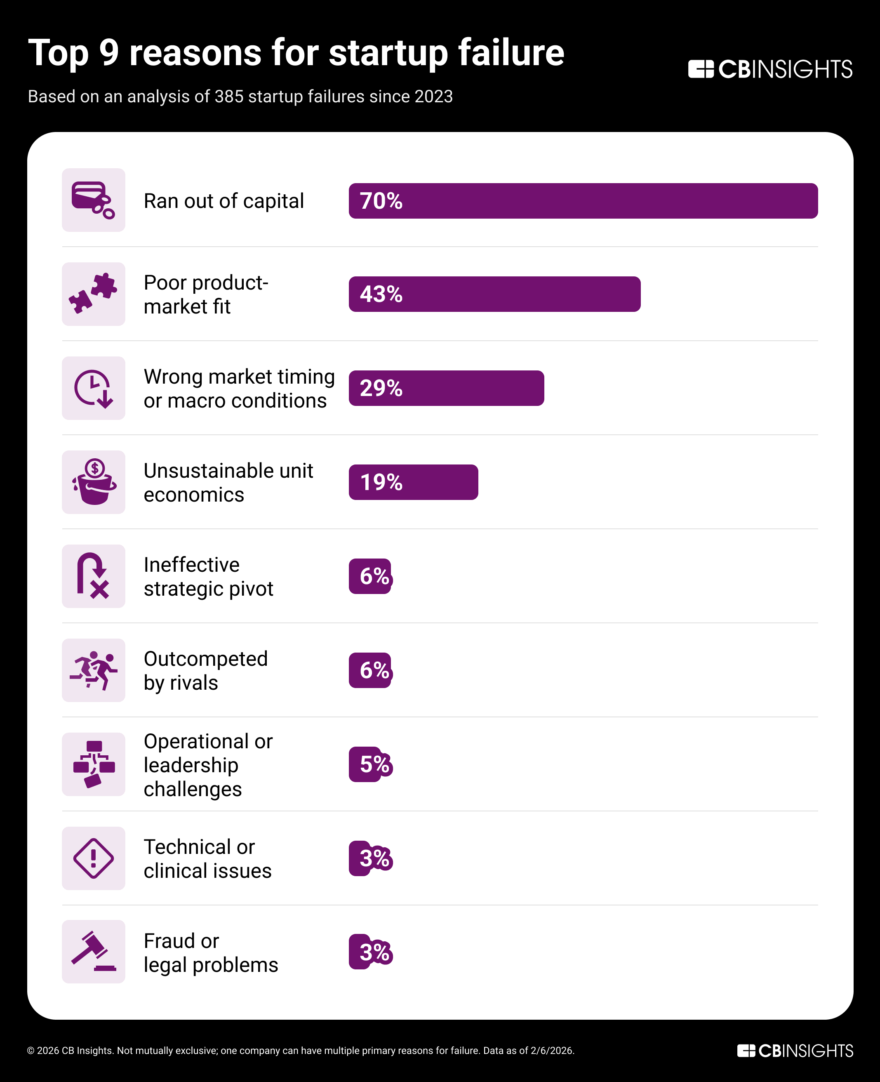
Closure counts do not explain why. CB Insights studied 431 venture-backed startups shut down since 2023 and found reasons for 385 of them, with many citing more than one. Seventy percent ran out of capital, 43% had poor product-market fit, 29% faced bad timing, and 19% had unsustainable unit economics. CB Insights treats the empty bank account as the final event and the other three as the reasons the money ran out.
I made this argument in my market research process guide in 2022. The evidence keeps stacking up on the same side.
The chain every sale runs on
Money comes from customers buying what you sell. Customers buy offers. Offers come from knowing the outcome your customer wants. The outcome itself comes from research.
How does AI market research for small business work in 2027?
Start with a decision. “Research the bookkeeping industry” produces a pile of facts. “Which kind of bookkeeping client should I build my next offer around?” gives the research a job.
Write a five-line research brief before you open any AI tool:
- Decision: What are you deciding?
- Assumption: What must be true for the decision to work?
- Evidence: What would support or contradict the assumption?
- Absent voices: Whose experience are you not hearing?
- Action: What will you do differently depending on the answer?
Then hand AI the brief and ask it to plan the research. Try this prompt:
I’m considering a monthly bookkeeping package for independent contractors. List the assumptions behind this offer. Separate questions about demand, customer selection, competition, pricing, and delivery costs. For each assumption, suggest a low-cost way to test it. Do not answer the questions without evidence.
This prompt makes AI a research planner. A business-plan generator would hand you confident answers with nothing behind them.
Which market research jobs does AI handle well?
AI earns its keep on sorting, summarizing, and drafting. Each job below ends with a check only you are able to do.
| Research job | How AI helps | What you verify |
|---|---|---|
| Industry and academic research | Perplexity or ChatGPT search gathers sources and summarizes them. | Open every source and check the date, sample, and definitions. |
| Reddit threads and reviews | AI groups comments into themes and pulls the exact phrases people use. | The counts, the dates, and the link to each original post. |
| Customer interviews and sales calls | AI sorts transcripts into buying triggers, objections, and alternatives. | Each theme against the customer’s exact words. |
| Competitor and price comparison | AI builds a dated table of offers, prices, and guarantees. | Current prices and what each competitor delivers. |
| Survey drafting | AI writes neutral questions and flags leading ones. | A test run with a few real people before you send it. |
| Pricing | AI models price against delivery and acquisition costs. | Willingness to pay from real buyers. |
Public conversations deserve extra care. Reddit threads and reviews show how people describe a problem in their own words, what they tried, and what made them switch. They do not show how common the problem is. Report the count you reviewed, such as “18 of the 60 comments mentioned scheduling.” Sixty comments do not describe all your customers.
How do you run AI market research in five days?
AI market research for small business starts with five questions answered this week. No 40-page report and no budget.
- Ask one question. Email your list or past customers a single question and invite a reply. Pick one: What result did you want most when you first came to me? What almost stopped you from buying? What were you trying to fix before you found me? Replies hand you exact phrases.
- Talk to five customers. Give each fifteen minutes by phone or video, ask the same three questions, then stay quiet and take notes. My five-conversation research method walks through the steps.
- Read Reddit. Find two or three subreddits where your customers talk about their problems. Sort by top posts of the year, copy the exact words people use, and ask your AI tool for themes with links and quotes. For more places to listen, see how to research your target market.
- Search Facebook groups. Search your topic in a group your customers join. Repeated questions show you what people want solved. Follow each group’s rules and keep your pitch out of the comments.
- Ask Perplexity for a starting list. Try this prompt: “What do [your customer] complain about most when [problem]? List the exact phrases people use and cite sources.” Open the sources and check them. Perplexity summarizes what the internet says, so treat the answer as questions to test with your real customers.
Here is the schedule:
- Day 1: Write your question and your Perplexity prompt. Send the email.
- Day 2: Read Reddit and two Facebook groups.
- Days 3 and 4: Hold your customer conversations, two or three each day.
- Day 5: Fill in the one-page summary and make one rewrite.
Next, put one real offer in front of real buyers. My guide to testing a marketing idea without wasting money shows how to measure buying behavior. A like or a vote costs the voter nothing, and a purchase does.
Which free tools collect survey and poll answers?
Use a poll when you have one narrow question. Several platforms include built-in polls: LinkedIn, Instagram Stories, X, Threads, Facebook Groups, and Reddit communities with polls enabled. Ask about a recent buying situation: “What stopped you from moving forward the last time you requested a quote?” A poll shows what people will click, so follow it with a conversation or a survey.
Use a survey when you need several questions, open-ended answers, or a way to connect someone’s situation with their answer. These four tools start free:
| Tool | What the free option gives you |
|---|---|
| QuestionPro | Essentials plan with up to 200 responses per survey and reports you view and share. |
| Google Forms | Free forms with answers sent to a Google Sheet. |
| Tally | Free form builder with conditional logic. |
| Microsoft Forms | Free surveys and polls with a Microsoft account. |
I use QuestionPro. QuestionPro also sells to large research teams, and its paid plans carry the advanced features. The free plan gives you what a small business needs to start: a real survey, real responses, and reporting.
Free software does not supply respondents. Reach people through your email list, your website, a QR code at your counter, or a partner’s newsletter. Add one screening question, such as “Have you hired a bookkeeper in the last 12 months?”, to separate recent buyers from people answering in theory.
Once the responses arrive, export them to Excel or CSV (check your plan’s export options first) and let AI help you analyze them. My guide to reading survey results like a marketer helps you judge what the numbers say.
- Keep the original export, work from a copy, and remove names and emails before you upload anything.
- Upload the questions with the answers.
- Ask for counts with the number of respondents behind every percentage.
- Ask AI to sort open-ended answers into themes with respondent IDs and exact quotes.
- Read a sample yourself and compare it with the AI’s version.
How do you keep AI from making up your research?
Treat AI as an assistant who needs supervision. These rules keep the evidence honest:
- Separate evidence, interpretation, and hypothesis. Evidence: “Four interviewees described delays getting quotes.” Interpretation: response speed might influence supplier choice. Hypothesis: a same-day quote improves conversion.
- Demand the source and the exact quote. Check each quote against the original, word for word.
- Check AI against a sample you coded yourself. Read 20 comments or two transcripts, categorize them, and compare your work with the AI’s.
- Ask for the strongest evidence against the answer. Include lost prospects and people who chose another provider.
- Protect private data. Remove names and identifying details, and check the tool’s data settings before you upload customer records.
Describe your sample honestly. “Among the 46 people who answered my LinkedIn poll” tells readers what you know. A claim about all small business owners needs a much larger, more representative sample.
What is the first step to start AI market research today?
Research feels like a luxury when cash is tight. It costs a few hours, and it tells you which offer deserves your limited money. AI market research for small business works best when you start small, so send the one-question email today.
Frequently asked questions about AI market research for small business
How do I do market research with AI for my small business?
Start with one decision, then use AI to plan, gather, and organize the evidence while real customers supply the answers. First, write the decision you face, such as which customer to serve or what to charge. Second, ask Perplexity or ChatGPT for industry context and open the sources to confirm them. Third, email your list one question about the result customers wanted when they bought. Fourth, talk to five customers for fifteen minutes each. Fifth, paste your notes into an AI tool and ask for phrases, objections, and buying triggers, with the exact quote behind each one. Finally, rewrite one headline, subject line, or offer and watch what people do. The whole cycle fits in a week, costs nothing beyond your time, and gives you evidence from real people, with AI doing the sorting.
How accurate is AI market research?
AI market research is as accurate as the sources and the checking behind it. AI tools summarize quickly, and they also misquote sources, invent details, and repeat the most common view on the internet. Treat every output as a lead to verify. Open the original source, confirm the date and sample size, and check each quote against the original, word for word. Compare the AI’s themes with a sample you categorize yourself. The American Association for Public Opinion Research’s 2026 task force report on responsible AI in survey research stresses validation, human oversight, and clear disclosure of how AI was used. Apply the same standard in your business. Report counts, such as 18 of 60 comments, and describe your sample honestly. Accuracy rises when you ask AI for evidence against its own conclusion and when you test every finding with real customers.
What is the best free tool for market research surveys?
The best free tool is the one you will use this week and the one with usable reports. I use QuestionPro. Its free Essentials plan collects up to 200 responses per survey and lets you view and share reports. Google Forms works well when you want answers in a Google Sheet. Tally offers a free form builder with conditional logic, and Microsoft Forms is free with a Microsoft account. Free software does not supply respondents, so plan how you will reach people through your email list, your website, a QR code at your counter, a partner’s newsletter, or a poll on LinkedIn or Instagram. Whichever tool you pick, ask about a recent buying situation, include an Other option, and test the survey on three people before you send it widely. Small, honest samples beat large, sloppy ones.
How much does market research cost for a small business?
Basic market research costs a few hours of your time and little or no money. A one-question email, five customer conversations, an afternoon reading Reddit and Facebook groups, and a free survey tool cost nothing beyond your time. Paid costs appear when you recruit respondents who are not already your customers, hire a research firm, or move up to a paid survey plan. Start free, and spend money only after a free test shows which question deserves a bigger sample. If a paid study costs more than the offer it informs would earn in a month, run a smaller free version first. Compare every research bill with the price of building an offer nobody buys. Research is the least expensive part of any launch, and even the cheapest version, five honest conversations, replaces a great deal of guessing.
Does AI replace customer interviews and surveys?
No. AI speeds up and organizes your research, and customers still supply the evidence. Use AI before a conversation to write neutral questions and prepare follow-up probes. Use it after a conversation to sort transcripts into themes, objections, and buying triggers. Real people stay essential for willingness to pay, because only real buyers show real buying behavior. An AI told to pretend to be 100 small business owners produces one model’s guess repeated 100 times, and the American Association for Public Opinion Research’s 2026 guidance treats synthetic responses as a different thing from a human sample. Treat AI as a fast assistant with a good memory, and keep the final judgment for yourself. Surveys add scale and interviews add depth, so use both when the decision carries real money. A handful of honest customer conversations will teach you more than any simulated survey ever will.
More DIYMarketers guides on research and pricing
- How to price a new product, and what the research says
- Should your small business invest in AI? The honest math
- Market research basics for better decisions
Want a Research Plan Built for Your Business?
Book a 30 to 60 minute Fix-It Session with Ivana. We will lay out your research strategy together: who to ask, what to ask, and how to turn the answers into one offer you test this month.