
In This Article

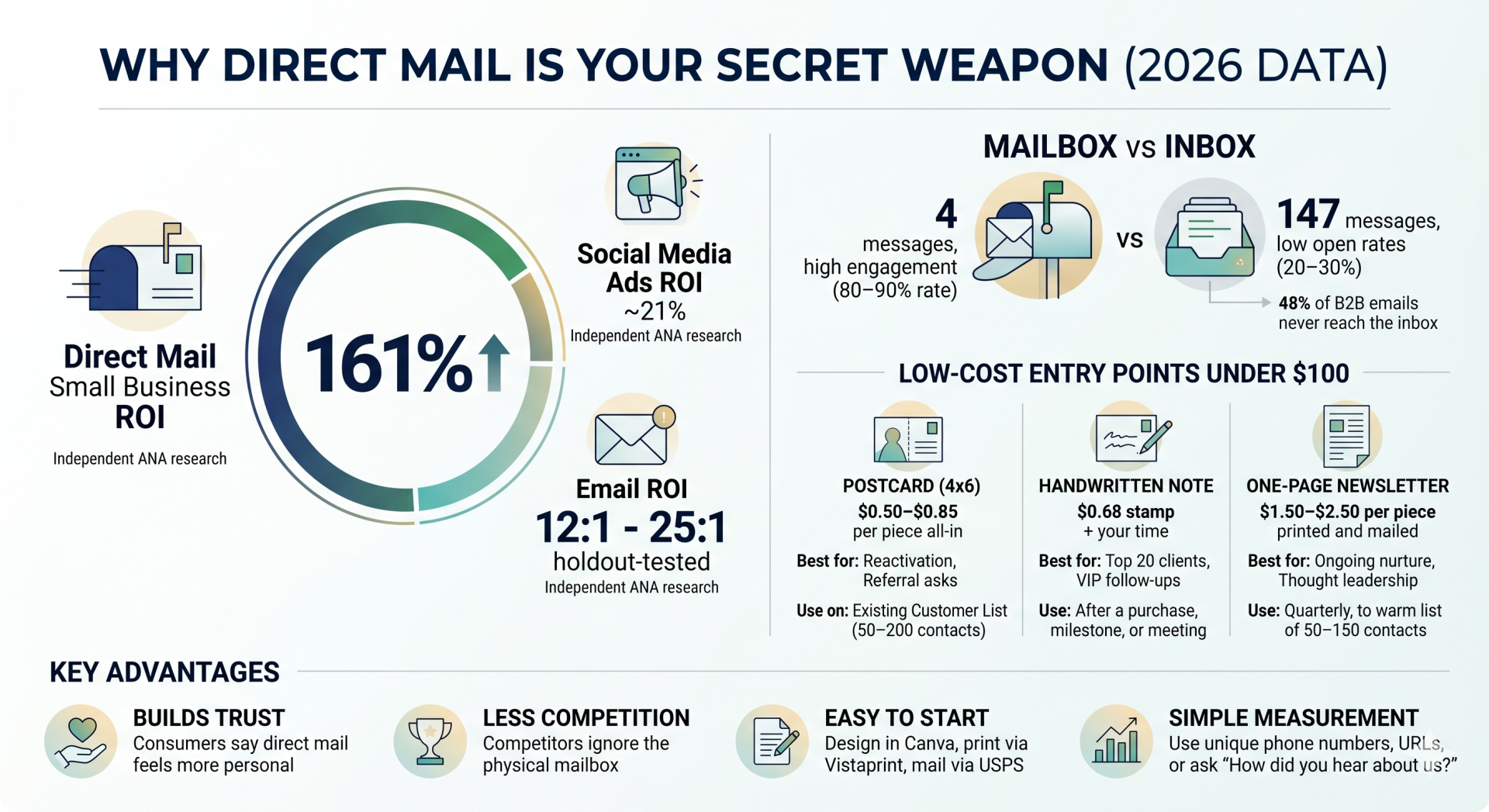
- Direct mail small business ROI clocks in at 161%—nearly 8 times higher than social media advertising’s 21%, according to independent ANA data.
- The “$42 for every $1 in email” statistic was invented by email platforms measuring their own results. Holdout-tested, the real number is closer to 12:1—and 48% of B2B emails never reach the inbox at all.
- After reading this, you’ll know the actual cost of a direct mail campaign, three entry points that work for under $50, and why your competitors won’t touch this channel (which is exactly your opportunity).
Direct mail small business ROI is one of those things the marketing industry keeps quietly burying—because the people selling you email software and social ads don’t benefit when you discover what the independent numbers actually show. So let me be the one to say it: the mailbox is outperforming the inbox, and it isn’t close.
In 2010, a Facebook click cost $0.45. Small business owners were telling each other this was the great equalizer — finally a way to compete with big brands on a fraction of the budget. They were right. For about eight years. Then the advertisers piled in, the platforms matured, and the economics of digital flipped. Facebook’s average cost per lead hit $27.66 in 2025 — up 21% in a single year. Google’s average cost per lead is now $70.11. What replaced them as the highest-ROI channel for small business? The one that’s been sitting in your mailbox the whole time.
Independent ANA data puts direct mail ROI at 161%. Social media ads, independently measured, deliver around 21%. That gap isn’t a rounding error — it’s the story the digital marketing industry doesn’t want to tell you.
Why Is Direct Mail ROI So High for Small Businesses?

Think about your own mailbox for a second. On a Tuesday afternoon, you get maybe four pieces of physical mail. Compare that to your email inbox, where 147 messages are waiting. Which one gets your full attention?
Physical mail has an 80–90% engagement rate, according to ANA (Association of National Advertisers) research. Email sits at 20–30% open rates on a good day—and deliverability is quietly getting worse. As of 2025, 48% of B2B emails never reach the intended inbox, and Office365 inbox placement dropped 26.7% in a single year.
Your postcard has no spam filter to beat. No algorithm to appease. No one is going to mark it as promotions.
There’s also a trust dimension that’s gotten more important in 2025–2026. UC Berkeley researcher Hany Farid found people are now equally likely to call something real “fake” as to call something fake “real” online. An NBC News report from January 2026 called it a “collapse” of trust in digital content. Your beautifully produced social ad is arriving into an inbox and a mindset primed for suspicion. A postcard with your handwriting on it? Nobody mistakes that for AI.
What Does Direct Mail Actually Cost for Small Business?
Here’s where the conversation usually dies. People hear “direct mail” and picture glossy catalog production, professional photographers, a design agency, and a printing bill that makes them nauseous. That’s large-company direct mail. Small business direct mail looks completely different.
Let’s break down three actual entry points:
| Format | Typical Cost | Best For | When to Use It |
|---|---|---|---|
| Postcard (4×6) | $0.50–$0.85 per piece all-in | Reactivation, seasonal promos, referral asks | Existing customer list, 50–200 contacts |
| Handwritten note | $0.68 stamp + your time | Top 20 clients, referral partners, VIP follow-ups | After a purchase, milestone, or meeting |
| One-page newsletter | $1.50–$2.50 per piece printed and mailed | Ongoing nurture, thought leadership, referral building | Quarterly, to warm list of 50–150 contacts |
A postcard campaign to 100 past customers costs you $50–$85 in printing and postage. If it brings back even one customer who spends $200 with you, you’ve made your money back four times over. That’s not hypothetical—that’s the math your competitors aren’t running because they’re too busy optimizing their email subject lines.
How Does Direct Mail ROI Compare to Facebook Ads and Email?
The numbers in this table are not from email platforms measuring their own results. They’re from independent research—ANA’s Response Rate Report, Nielsen’s cross-channel studies, and holdout-tested email analysis from independent researchers.
| Channel | Real-World ROI | Source | What the Number Hides |
|---|---|---|---|
| Direct mail (house list) | 161% | ANA Response Rate Report | Doesn’t include brand awareness lift |
| Email (holdout-tested) | 10:1 to 25:1 | Independent holdout analysis | Platform-reported figure inflated by last-click attribution |
| Social media ads | ~21% | Keen/Nielsen independent data | Costs rose 21% on Facebook alone in 2025 |
| Digital display | ~15% | ANA/Nielsen data | Banner blindness means most ads are never seen |
That 161% figure deserves a translation. If you spend $100 on a postcard mailing to your existing customer list, you can expect $261 back on average. Spend $100 on Facebook ads? The independent data says expect $21 back. That’s not a small gap—it’s the difference between a marketing tactic that pays for itself and one that doesn’t.
The email ROI story is even messier. The famous “$42 for every $1 spent” statistic comes almost entirely from surveys by Litmus (an email platform), Constant Contact (an email platform), and the DMA (a trade association funded by email marketers). When an independent researcher ran real holdout tests on a brand celebrating a 40:1 return, the actual incremental lift was 12:1—because 70% of that revenue was happening anyway. Email was showing up at the finish line and claiming the medal.
If you want to measure your own email honestly, the place to start is understanding how direct marketing attribution actually works—because last-click models are lying to you about what’s driving your sales.
Is Direct Mail Expensive for Small Business?
The expensive version of direct mail is the one Fortune 500 companies run: multi-panel mailers, professional photography, list rentals of 50,000 cold names, and fulfillment centers managing the whole operation. That version has a floor of several thousand dollars and is completely irrelevant to you.
Small business direct mail works on a completely different logic. You’re not trying to reach strangers—you’re trying to stay visible to people who already like you. That changes everything about cost and strategy.
Three cost-effective formats to start with, all under $100 for a small list:
Postcards from Canva + USPS Every Door Direct Mail: Design in Canva, print through Canva or Vistaprint, mail via USPS. A 4×6 postcard runs about $0.50–$0.85 all-in when you do the work yourself. For a list of 100 people, that’s $50–$85 total.
Handwritten notes to your top 20: A card, your handwriting, a first-class stamp. Total cost: under $25 for 20 people. Open rate: 100%. Nobody throws away a handwritten envelope without opening it.
A quarterly one-page newsletter: One page, front and back, printed at FedEx Office or Canva Print. Mail it quarterly to 50–100 people. Budget: $75–$150 per send. This is Gary Vaynerchuk’s actual recommendation for service businesses—he’s been saying since 2025 that physical newsletters are one of the highest-trust marketing tools available to a small brand.
Connecting this to your referral strategy makes it even more effective. The smartest way to ask for referrals isn’t an email or a social post—it’s a physical card that makes someone feel remembered.
What Types of Direct Mail Work Best for Small Business?
The format that works best depends on what stage of the relationship you’re in. Here’s a simple way to think about it:
Warming up an existing customer: Postcard or handwritten note. Keep it personal, keep it short. “We’re thinking of you” beats “20% off this weekend” almost every time for long-term retention.
Re-engaging someone who went quiet: A one-page letter. Physical paper feels more deliberate than email. It signals you put thought into reaching out. A client who hasn’t responded to your emails in six months will often respond to a letter in two weeks.
Staying top of mind with referral partners: A physical newsletter or resource card, quarterly. This is the referral marketing move most business owners skip—staying consistently visible to the people who can send you business without requiring them to do anything.
Converting a warm lead who’s been sitting on the fence: A personal note from you, by name, referencing something specific. The specificity is the point. Digital can’t do that at the individual level. You can.
How Do You Measure Direct Mail ROI for Small Business?
This is the part that scares people off direct mail, and it’s worth confronting directly. You cannot measure a postcard the way you measure a Google ad. There’s no click-through rate. No UTM parameter. No real-time dashboard.
Here’s what you can track, without any special technology:
Use a unique phone number or landing page URL. Forward it to your regular number or site. When someone calls that number or visits that URL, you know exactly where they came from. Google Voice numbers are free. A simple redirect page takes ten minutes to set up.
Ask new contacts how they heard about you. Simple, old-fashioned, and shockingly accurate when you actually do it. Build it into your intake process. Within 60 days of a mailing, you’ll have clear signal.
Track your reactivation rate. If you mail your dormant list and 8% of them reach out within 30 days, you have your answer. Customer retention strategy and direct mail measurement go hand in hand—the same list that drives retention drives your ROI calculation.
Run a simple A/B test. Mail 50 people in June, don’t mail the other 50 in your list. Compare revenue from each group in Q3. This is the same holdout methodology that exposed the inflated email ROI numbers—and it works at any scale.
The point isn’t perfect measurement. It’s directional measurement. You don’t need a dashboard—you need enough evidence to know whether to keep going. Most direct mail campaigns to warm lists give you that signal within 45–60 days.
Why Aren’t More Small Businesses Using Direct Mail?
Three reasons, and none of them are good ones.
It feels old. People associate direct mail with catalogs their parents got in the 1990s. That’s like saying email is dead because AOL used to mail CDs. The format evolves. The channel is alive.
It feels complicated. It isn’t. Canva, Vistaprint, and USPS have made it genuinely easy to design, print, and mail a postcard in under an hour. The “complexity” barrier evaporated years ago.
It doesn’t look like marketing. There’s no dashboard, no follower count, no vanity metric to screenshot and feel good about. Direct mail works quietly. That’s uncomfortable if you’ve been trained to optimize for visible numbers. It’s a competitive advantage if you can get past the discomfort.
Your competitors are staying away from it for these exact reasons. In the same way referral marketing breaks down when everyone stops investing in the relationship layer, direct mail is a relationship channel that works precisely because the digital channels have crowded it out. Empty space in a physical mailbox is your opportunity.
How to Start Your First Direct Mail Campaign This Week
This doesn’t require a vendor, an agency, or a budget meeting. Here’s the simplest possible version:
Step 1: Pull your list. Open your CRM, your email list, your invoicing software, or your contacts app. Find everyone who’s worked with you or expressed serious interest in the last two years. Aim for 50–150 names. Include their mailing address (or ask for it—most people will share it).
Step 2: Design a postcard in Canva. Use a 4×6 template. Put your face on it—not a logo, your actual face. Write one sentence about what you do, one sentence about a result you create, and a simple CTA: “Reply to this card and I’ll send you [something useful]” or just your phone number. Keep it simple.
Step 3: Print and mail. Upload to Canva Print, Vistaprint, or GotPrint. Postcard printing for 100 pieces runs $25–$45. Add first-class postage (about $0.53 each) and you’re all-in at $78–$98.
Step 4: Track it. Use a unique phone number from Google Voice, or add “mention this card” to your follow-up process. Give it 30–45 days and count the responses.
That’s it. No complicated technology. No agency. No ongoing subscription. And if it works—which the data says it should—you’ve just added a marketing channel that your competitors abandoned years ago and haven’t thought to reclaim.
This pairs directly with the work you’re doing on word-of-mouth marketing—because a postcard that shows up at the right moment is often the thing that turns a happy customer into an active referral source. The BNI members who get the most out of networking groups are the ones who follow up with physical touchpoints between meetings. The channel amplifies whatever relationship-building you’re already doing.
Frequently Asked Questions About Direct Mail for Small Business
What is a realistic direct mail ROI for a small business?
For a campaign sent to an existing customer list (people who already know you), independent ANA research puts direct mail ROI at 161%. That means for every $100 you spend on printing and postage, you can expect around $261 back on average. That figure assumes you’re mailing to a warm house list, not a rented cold list. Cold list ROI is significantly lower and harder to predict. If you’re starting out, mail exclusively to people who’ve already done business with you or expressed serious interest—that’s where the 161% figure applies.
Is direct mail too expensive for small businesses?
Not when you’re mailing a small house list. A postcard campaign to 100 contacts costs $50–$85 all-in for printing and postage. A batch of 20 handwritten notes runs under $25. A quarterly one-page newsletter to 75 people costs roughly $100–$150 per send. Compare that to the average cost per lead on Facebook ($27.66 in 2025) and Google ($70.11), and direct mail to warm contacts is actually one of the most cost-efficient channels available to a small business. The key is mailing to people who already know you, not buying cold lists.
How do I measure the ROI of a direct mail campaign without digital tracking?
Three methods work well for small business: First, use a unique phone number (Google Voice is free) that you put only on your mailer. Anyone who calls that number came from the mailer. Second, include a specific URL or offer code that’s exclusive to the campaign. Third, simply ask every new contact or returning customer how they heard about you—build it into your intake process. For reactivation campaigns, compare revenue from the mailed segment versus an equal-sized control group you didn’t mail. Most campaigns give you clear directional signal within 45–60 days.
What types of direct mail work best for small businesses?
Postcards work best for reactivation and seasonal offers to your existing list. Handwritten notes work best for high-value clients, referral partners, and personal follow-up after meetings or purchases. One-page physical newsletters work best for staying top of mind with a warm audience quarterly—think of it as a relationship-maintenance tool, not a sales pitch. For converting warm leads who’ve gone quiet, a personal letter referencing something specific to them outperforms any email you’d send to the same person. Start with whatever format matches the relationship stage, not whatever’s cheapest.
Should I use direct mail instead of email, or in addition to it?
In addition to it—but with clear eyes about what each channel does well. Email is fast, free, and good for time-sensitive announcements, content delivery, and regular nurture. Direct mail is slower, has a cost per piece, and is dramatically better for standing out, building trust, and reactivating relationships. The highest-performing small business marketing programs use both: email keeps you in front of your list regularly, and direct mail shows up physically two to four times a year to remind people you’re a real human being, not an automated sequence. Nielsen research shows that blending physical and digital touchpoints improves on-target reach by up to 5x compared to either channel alone.
Additional Reading
If direct mail is part of your strategy to build a more relationship-driven marketing approach, these articles will help you build out the full picture:
- BNI Review — Is It Worth the Cost? — Direct mail and BNI membership work together. The members who get the most from networking groups are the ones who follow up physically between meetings.
- Networking Groups Like BNI — What Are Your Options? — If you’re building a referral-driven business, these are the relationship channels worth your time and budget.
- Customer Retention Strategies That Actually Work — The same list you mail for retention is the list you measure for direct mail ROI.
- Word-of-Mouth Marketing for Small Business — Direct mail amplifies every word-of-mouth strategy by keeping you visible between interactions.