
In This Article
BotBouncing (noun): walking away from a purchase because you suspect the photo, review or testimonial you were relying on was made or altered by AI. Half of the shoppers we surveyed have done it.
You’ve got a new shopping behavior. It’s when you land on a webpage, check out the product, look at the reviews and then think to yourself “Is that AI? I bet it’s AI” Oh, and here’s my favorite. I have a question about a product or service, I try to reach customer service and I get an AI! Doesn’t matter if it’s phone or chat, I’m likely to bounce. It’s called BotBouncing
We’re all using AI to help us shop. And we’re getting pretty suspicious when businesses use it to sell to us. So I partnered with QuestionPro to survey 350 U.S. adults, and asked the question every small business owner should ask before hitting “generate”: do customers trust AI?
“BotBouncing is the walkaway. Fauxchecking is the extra work shoppers do to figure out what’s real. More and more, one leads to the other.”
Ivana Taylor, Publisher, DIYMarketers.com
What is BotBouncing, and how many shoppers do it?
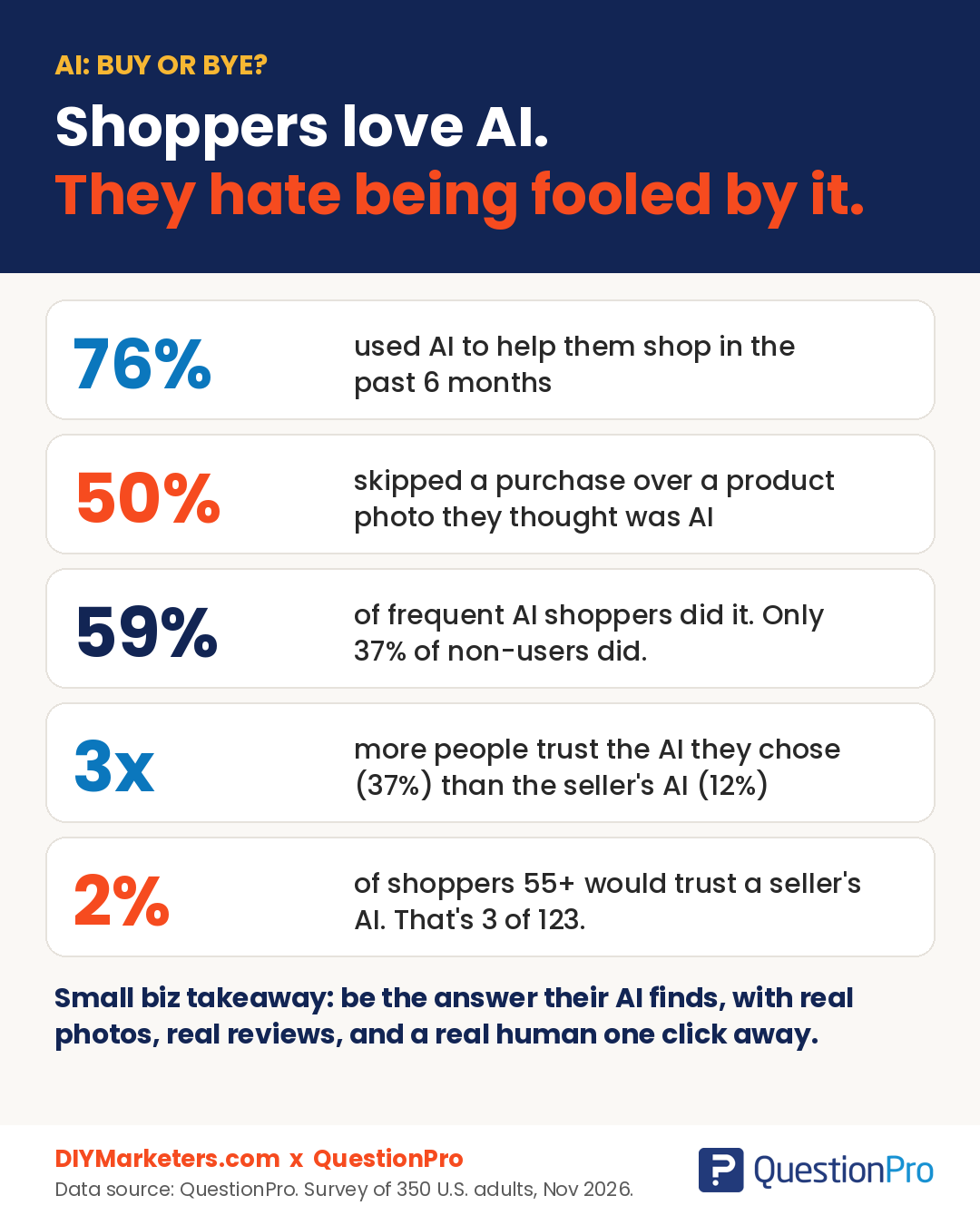
176 of the 350 shoppers we surveyed, or 50%, said they skipped a purchase in the past six months because they suspected a product photo was made or altered with AI. We call it BotBouncing.
The key word is suspected. The photo doesn’t have to be AI. The shopper only has to think so. The doubt alone costs the sale.
Here’s the part I didn’t expect. 145 people, 41% of everyone we surveyed, reported both: they use AI to help them shop, and they BotBounced over an AI-looking photo. The same people use AI to shop and walk away from AI-looking photos, possibly on different shopping trips.
- BotBouncing is common. 50% of 350 shoppers walked away over a product photo they suspected was AI.
- AI fans do it too. 59% of frequent AI shoppers reported BotBouncing, vs. 37% of people who never shop with AI.
- Shoppers want proof. 48% worry most whether the real thing will look like the photo. Only 13% object to businesses using AI at all.
- Real photos are at risk. In a separate 2026 study, people labeled 18.5% of genuine photos as AI-generated.
Is AI making shopping easier, or giving customers a new reason to leave?
Both, depending on whose AI it is. Do customers trust AI? Their own, yes. 76% of our respondents used AI to help them shop, mostly to find a lower price (57%) and compare products (47%). Yet 37% trust a recommendation from the AI they chose to ask, and only 11% trust the seller’s AI shopping assistant.
trust the AI tool they chose to ask. They use it to find prices, compare and sum up reviews.
trust the seller’s AI shopping assistant. Another 29% trust neither.
Other research backs up the first half of the story. In Adobe’s July 2026 survey of more than 5,000 U.S. consumers, 42% said they had used AI assistants for online shopping (Adobe AI Traffic Trends Report). The two surveys word the question differently, so read the numbers as pointing the same direction. And AI shoppers are good business: Adobe found visitors arriving from AI tools in July 2026 were 34% less likely to bounce and brought 53% more revenue per visit than other traffic (Chief Marketer).
AI gets shoppers to your door. Your product page decides whether they stay. AI helps them find you, and then your photo has to prove it’s what they’ll get.
Who BotBounces the most?
Frequent AI shoppers were the most likely to report it. 59% of people who often shop with AI said they BotBounced, compared with 37% of people who never shop with AI.
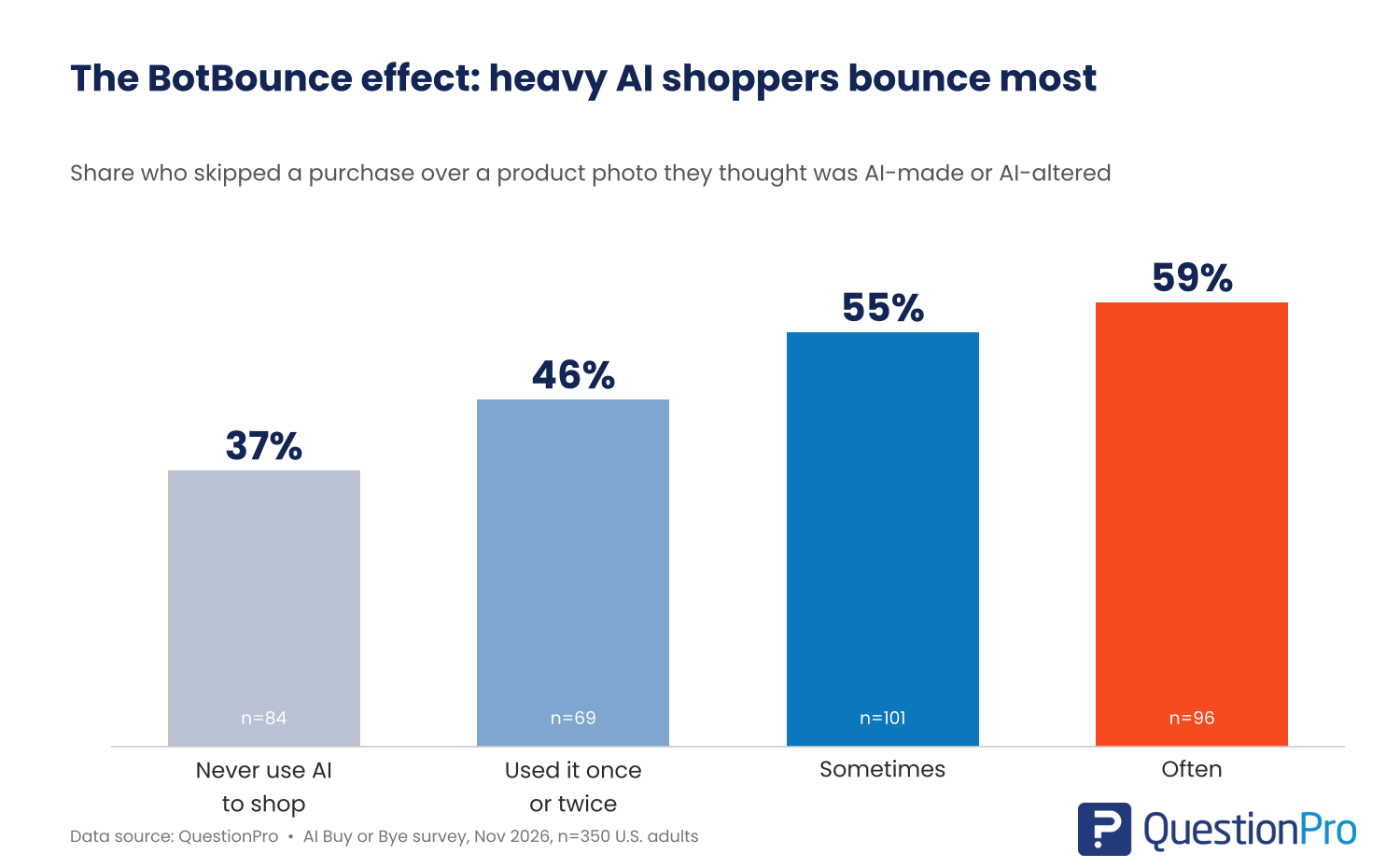
The pattern holds after we account for age and gender. Why? Two possibilities. Heavy AI users have seen plenty of AI images, so they notice them. They also shop more, so they meet more suspicious photos. Our survey doesn’t separate the two.
Age matters too. 65% of shoppers 18 to 34 reported BotBouncing, compared with 40% of shoppers 55 and up.
Why does “that looks AI” make shoppers walk away?
Because shoppers want proof of what will arrive. When we asked what worries people most about AI product photos, 48% said “Will the real thing look like this?” Only 13% said they don’t want to support businesses using AI.
The answer doesn’t prove why each BotBouncer left. It points to a better explanation for most of them: shoppers want to know whether the photo is honest evidence of what they’ll get.
Experiments show how much the suspicion itself matters. The Nuremberg Institute for Market Decisions showed people the same product ad, telling half it was a photo and half it was AI-generated. The “AI” version got a more negative reaction, especially on emotional measures (NIM). Same image. Different belief. Different response.
of adults in a 2026 Malwarebytes survey say it’s hard to tell scams apart from the real thing, up from 66% a year earlier. 22% say they’ve been misled by AI-generated photos or product reviews (Malwarebytes).
Do real photos get BotBounced too?
Odds say yes. In a July 2026 study of 252 people published in Clinical Oral Investigations, participants labeled 18.5% of genuine orthodontic result photos as AI-generated. They also mistook 63.2% of AI-enhanced images for real ones (Dentaltown).
of genuine photos were judged AI-generated.
of AI-enhanced photos passed as genuine.
The study looked at dental photos, so treat it as a warning sign for retail. But it raises the question every small business should sit with: would you lose a customer over a photo shot for real? Our survey didn’t check whether the photos people walked away from were AI-made. Polished and real now get the same squint.
What makes shoppers think a product is fake?
Anything a shopper treats as proof. 88% of our respondents named at least one AI fake as a dealbreaker, led by AI-written customer reviews (39%) and photos where the item looks better than it is (35%).
What sets off the fake alarm?
Source: DIYMarketers and QuestionPro survey, n=350, November 2026. Shoppers picked all dealbreakers.

Our walkaway question asked about product photos, so reviews and testimonials are a natural extension of BotBouncing. Other data says shoppers already question them. Accenture’s Life Trends 2025 research found 52.8% of consumers regularly question the authenticity of the reviews they read (via Trendwatching).
What is Fauxchecking?
Fauxchecking is the extra work shoppers do to figure out what’s real: zooming in on photos, reading reviews for repeated phrases, searching for the product somewhere else. BotBouncing is what happens when the fauxcheck fails and the shopper leaves.
The habit spreads well beyond shopping. Accenture describes people asking “Is this real?” across the platforms they use every day (Accenture Life Trends). Malwarebytes found 37% of adults say AI has changed how much they trust online reviews and content, rising to 47% among 18- to 22-year-olds.
Fauxchecking takes time and attention. Every second a shopper spends wondering if your photo is real is a second they aren’t thinking about buying.
How do I keep customers from BotBouncing off my website?
Pass the BotBounce Test: show the real thing, make it easy to check and give customers control. Do customers trust AI? They trust the AI they use to check you. So the win goes to the business whose proof holds up.
Show the real thing
From the data. 50% BotBounced over a suspected AI photo, and 48% worry the real thing won’t match.
Free fix: Reshoot your three best sellers on your phone, by a window, with something for scale. Show real clients by first name and date, with permission.
Make it easy to check
From the data. 57% use AI to find a lower price and 47% use it to compare.
Free fix: Post your price or a “starting at” number, real specs, reviews with customer photos and one honest comparison page. Match the facts on your Google Business Profile.
Give customers control
From the data. 20% bail when AI replaces a real person. Only 11% trust a seller’s AI assistant most.
Free fix: Put your phone number or booking link at the top of every page. If you run a chatbot, add a “talk to a human” button.
Count on a label alone
From the data. 45 of our 176 BotBouncers (26%) left even after the seller disclosed AI use. In a separate fashion e-commerce experiment, an AI label lowered perceived product quality modestly, with no significant effect on purchase intent (WR Publishing).
Free fix: If you show an edited image, put the unedited original right next to it.
This part is my interpretation, not a measured result: authenticity is a competitive edge for small businesses right now. You have what big brands struggle to fake: a real owner, real products, real customers and a phone someone answers. Put all of it on your website.
Take the BotBounce Test
Open your most important product or service page and answer three questions:
- Does anything here make a customer question what’s real? Too-perfect photos, generic reviews, stock smiles and claims without proof all set off the fake alarm.
- Is every photo, review, price and promise easy to verify? Real names, dates, photos and numbers win.
- Is there a clear next step for someone with a question? A phone number, a booking link or a real reply within a day.
Pick your weakest answer and fix it before lunch. Swap one product photo for a real phone shot, or add your phone number to the top of the page.
“Does your marketing help customers believe you, or make them wonder what’s real?”
Ivana Taylor, Publisher, DIYMarketers.com
Reporters and researchers: I’m happy to share the findings, cross-tabs and survey questions. Grab the full AI: Buy or Bye? survey report.
Frequently asked questions: do customers trust AI?
What is BotBouncing?
BotBouncing is a term DIYMarketers coined for walking away from a purchase because a shopper suspects the photo, review or testimonial was made or altered by AI. In a DIYMarketers and QuestionPro survey of 350 U.S. adults, 176 people (50%) said they skipped a purchase in the past six months over a product photo they suspected was AI.
What is Fauxchecking?
Fauxchecking is the extra work shoppers do to figure out what’s real, such as zooming in on photos, rereading reviews or searching for a product elsewhere. DIYMarketers uses the term for the habit underneath BotBouncing. BotBouncing is what happens when a fauxcheck ends with the shopper leaving.
Do customers trust AI?
Customers trust the AI they choose and distrust AI used by sellers. Among 350 surveyed shoppers, 37% trusted a recommendation from the AI tool they chose to ask, while only 11% trusted a seller’s AI shopping assistant. 76% used AI to help them shop in the past six months.
Do real product photos get mistaken for AI?
Real photos do get mistaken for AI. In a July 2026 study of 252 people in Clinical Oral Investigations, participants judged 18.5% of genuine orthodontic photos to be AI-generated. Small businesses should make real photos easy to verify with natural light, multiple angles, scale references and customer photos.
How do I pass the BotBounce Test?
The BotBounce Test asks three questions about a key web page: does anything look fake, is every claim easy to verify, and is there a clear way to reach a person? This is my suggestion, not a survey finding: fix the weakest answer first, starting with real photos and a visible phone number or booking link.
Want a second pair of eyes on your website?
Send me your page and I’ll record a 24-hour video audit of anything a customer might BotBounce off, plus what to fix first.
Methodology
DIYMarketers.com fielded this survey using QuestionPro in November 2026. We surveyed a general-population sample of U.S. adults balanced to census demographics. 356 people started the survey and 350 completed it. Respondents were 52% women and 47% men; 28% were 18 to 34, 36% were 35 to 54 and 35% were 55 and up. The margin of error is about plus or minus 5.2 points for the full sample and wider for subgroups.
Answers are self-reported. The survey asked whether shoppers suspected or were told a product photo was AI-made; it did not verify whether the images were AI-generated. The walkaway question covered product photos only. The AI-shopping question likely includes some people who saw AI answers in search results without opening a separate AI assistant. “BotBouncing” and “Fauxchecking” are names DIYMarketers proposes for the behaviors we observed, not established research categories. We tested differences with chi-square tests and a logistic regression accounting for age and gender. The results show associations, with no causal claims.
Outside research cited: Adobe AI Traffic Trends Report (August 2026; July 2026 survey of 5,000+ U.S. consumers); Malwarebytes “Face Value” report (June 2026; March 2026 survey of 1,500 adults in the U.S., UK and DACH region); Nuremberg Institute for Market Decisions, “Transparency Without Trust”; Clinical Oral Investigations (July 2026, n=252); Accenture Life Trends 2025 (survey of consumers in 22 markets); a 2026 fashion e-commerce image experiment published by WR Publishing (IJAAIB). Each source’s numbers come from its own methods and are not directly comparable with ours.