
In This Article

- An email list that stops converting isn’t dying — it’s telling you the offer changed but the audience didn’t. The list is fine. The mismatch is the problem.
- According to HubSpot’s Email Marketing Benchmarks, segmented emails generate 30% more opens and 50% more click-throughs than non-segmented sends — yet most small business owners keep blasting the same message to everyone and then wonder why nothing converts.
- After reading this, you’ll know exactly how to run three diagnostic tests on your list, decide whether to bridge or rebuild, and send emails your audience is actually waiting for.
When your email list not converting becomes the headline problem in your business, most owners blame their copy. They hire a copywriter, rewrite subject lines, test different send times. None of it works — because the list itself is fine. What’s dead is the match between the audience and the offer. Fix that alignment, and email becomes your lowest-cost, highest-return sales channel again.
Three years ago, a consultant I know built a gorgeous 4,800-person list around LinkedIn growth tips. Solid open rates. Real engagement. Then she pivoted to selling executive positioning strategy. Open rates went from 34% to 11% in six months. She hired a copywriter. She rewrote her subject lines. She tested send times. Nothing worked — because she was sending positioning strategy emails to people who signed up to learn how to get more LinkedIn followers. The list wasn’t the problem. She was.
Why your email list stops converting when your offer changes
Here’s what makes this so hard to catch: the drop doesn’t happen immediately. When you change your offer, your existing subscribers don’t mass-unsubscribe on day one. They just quietly stop clicking. Open rates drift down over weeks, sometimes months. By the time you notice, you’ve already convinced yourself the problem is your copy, your subject lines, or email marketing in general.
The real pattern looks like this: you solve one problem, build an audience around it, then start solving a different problem — usually for yourself, because you’ve grown. Your audience stays on the list. Your offer changes. Nobody announces the change. The audience keeps getting emails that feel increasingly irrelevant, and they stop opening. That’s when the phrase “email list not converting” starts appearing in your internal monologue and your conversations with other entrepreneurs.
Three tests when your email list not converting points to a mismatch
Before you spend another dollar on a new email tool, a copywriter, or a course on subject line psychology, run these three tests. They take about 45 minutes total, and they’ll tell you exactly what’s happening.
Test 1: The “who is this for?” audit
Pull your last five emails. For each one, complete this sentence: “This email assumes my reader is trying to solve [X problem] and wants [Y outcome].”
Then ask yourself: “Is that still who’s on my list?”
If your answers don’t match what your subscribers originally signed up for, you have an offer mismatch. This test requires no tools, no data, no dashboard. You’re checking intent alignment — whether what you’re sending matches what people came to your list for in the first place.
A retail shop owner who built her list around “quick visual merchandising tips” and is now selling a high-ticket store redesign consulting package will fail this test immediately. Her list signed up for free quick tips, not $3,000 consulting.
Test 2: The engagement cliff check
Open your email platform and look at your open rate trend for the last 12 months. You’re looking for one specific thing: did your open rates drop around the same time you changed your offer, repositioned your business, or started selling something new?
According to ConvertKit research on creator email lists, list disengagement typically shows up in open rate data within four to eight weeks of an offer pivot. If your engagement cliff lines up with your pivot, that’s not list decay — that’s mismatch.
According to email marketing research compiled by Mailmodo, the average small business email list loses 22% of its contacts annually to natural decay alone — meaning if your list is shrinking AND your conversions are dropping, you’re fighting two separate battles at once. The diagnostic tests below tell you which one is actually your problem.
Test 3: The original intent segment check
For each major segment or tag in your email list, ask: “Am I still talking to these people about their original problem?”
If you have a segment tagged “coaches” from a lead magnet you ran two years ago, and you’re now selling fractional executive services, are you sending those coaches content that connects to their world? Or are you sending them emails about executive positioning that they never signed up for?
This test exposes the gap between who’s on your list and what you’re actually saying. Most solopreneurs skip segmentation entirely and send everything to everyone — which is exactly why their email list stops converting when they pivot.
How to fix email list conversion when the offer doesn’t match
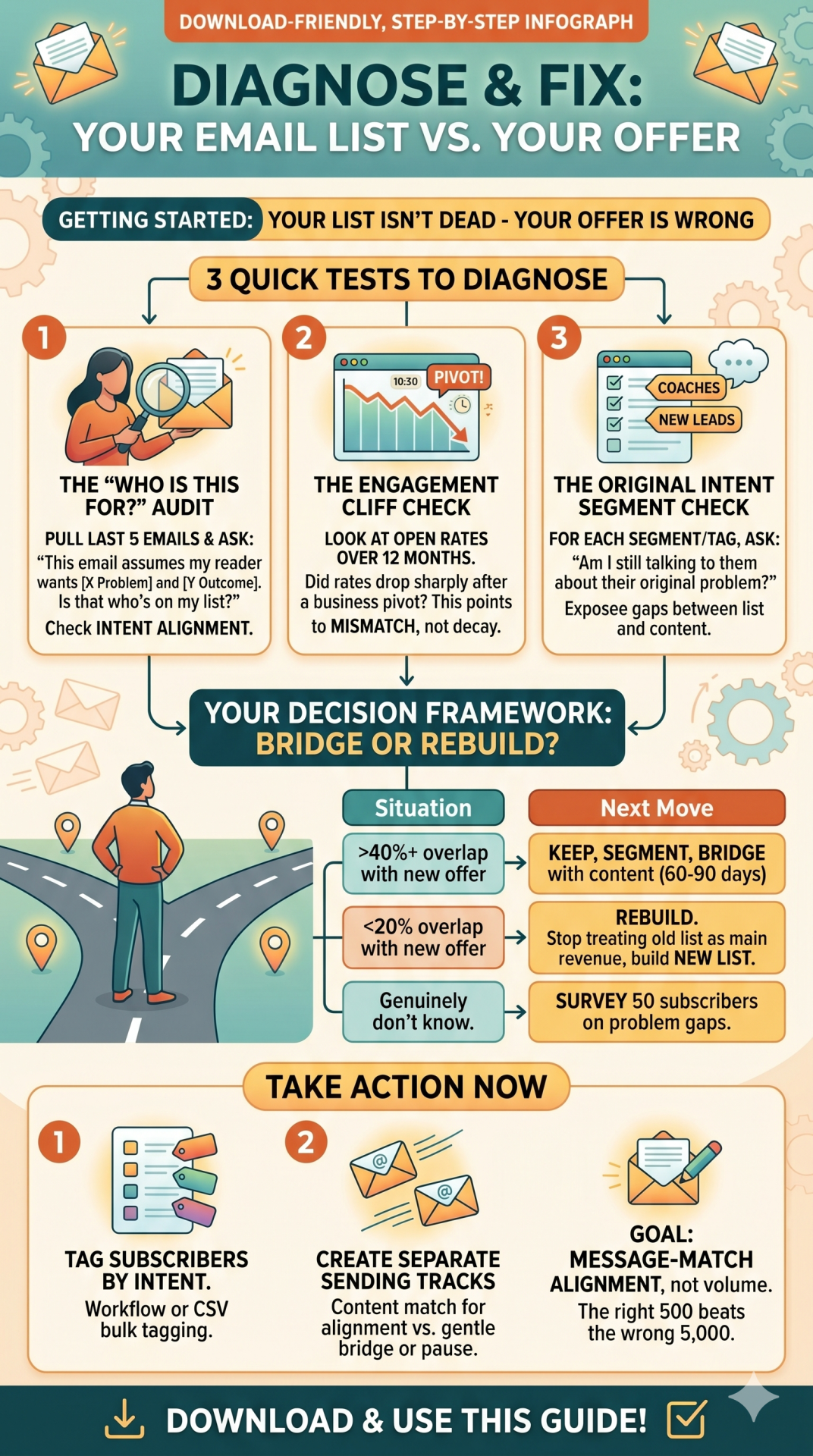
Once you know you have a mismatch, you have three moves. Pick the one that fits your situation.
Move 1: Segment by original intent
Go back to the lead magnet or opt-in that brought people to your list. Tag your subscribers by what they originally signed up for. In Zoho Campaigns or most email platforms, you can do this through a bulk tag workflow or a CSV import with a custom field.
One tag — “original intent: social media growth” or “original intent: restaurant marketing tips” — tells you everything you need to know about who’s on your list and what they expect from you. This is the foundational move that makes all the other fixes possible.
Move 2: Create separate sending tracks
Stop sending the same email to everyone. Segmented sends get 30% higher open rates and 50% higher click-through rates than broadcast sends, according to HubSpot’s marketing benchmarks. That gap is almost entirely explained by offer-audience fit.
For subscribers whose original intent still aligns with your current offer, send your full value — all your content, your offers, your CTAs. For subscribers whose original intent doesn’t match where you are now, you have two options: send them content about their original problem with a gentle bridge to your new positioning, or pause sends entirely and re-engage them with a new lead magnet that speaks to your current offer.
The bridge approach works when there’s genuine overlap. If you went from “LinkedIn growth tips” to “executive personal branding,” those audiences aren’t that far apart. You can write content that serves both. If you went from “DIY social media for restaurants” to “B2B SaaS positioning strategy,” the bridge is too long. Don’t force it.
Move 3: Decide between rebuild and bridge
Here’s the honest framework I use with consulting clients:
| Your situation | What it means | Your next move |
|---|---|---|
| 40%+ of your list could plausibly want your new offer | The overlap is real and worth developing | Keep the list, segment it, bridge over 60–90 days with educational content |
| Less than 20% match your new offer | You’re marketing to the wrong people | Rebuild. Stop treating the old list as a revenue source and focus on attracting the right audience |
| You genuinely don’t know | You need data before you decide | Survey 50 subscribers, compare original intent to current problem, then use the framework above |
Rebuilding feels like losing, but it’s often the faster path to revenue. A 500-person list full of exactly the right people outperforms a 5,000-person list full of people who don’t care about your offer every time. That’s not a guess — it’s just math. The owners reporting an email list not converting almost always have a size problem they’re treating as a copy problem.
What a working email list actually looks like
I want to reframe the goal here, because “fixing your email list” sounds like more work on top of the 47 other things you’re already doing. The real goal is simpler: get the right message to the right people. An email list not converting is never a list quality problem — it’s a message-match problem, and message-match problems are fast to fix once you know where to look.
An email list not converting doesn’t need a complete overhaul. It needs alignment. When your audience and your offer match, email is the most profitable marketing channel available to a small business owner — by a significant margin. You don’t need a huge list. You need the right list.
For context: a 1,200-person list with 30% open rates and strong offer-audience alignment generates more revenue than a 10,000-person list at 8% open rates with a mismatched offer. Every time. The owners with the 10,000-person list are usually the ones telling me email doesn’t work anymore.
Email works. The offer alignment is what stops working. That’s the fix — and it’s a fix that costs you time, not money, which makes it the most accessible marketing repair a small business owner can make.
How to prevent this from killing your next list

The best time to prevent an offer mismatch is before you build the list. The second-best time is now. Entrepreneurs who never face an email list not converting problem tend to do one specific thing differently: they document intent.
Document your list’s original intent in writing. Something this specific: “This list is for [specific audience] solving [specific problem] with [specific offer] at [specific price point].” Put it somewhere you’ll see it quarterly. Before you launch anything new or pivot your positioning, re-read that document and ask: “Am I still serving this audience, or am I serving a new audience that needs a new list?”
If the answer is “new audience,” start the new list now — even if it’s small. A list of 200 people who signed up for exactly what you’re selling beats 3,000 people who signed up for something you don’t offer anymore. See how to build loyalty and referrals on a small budget to start growing that new audience without paid ads.
Test new positioning before you roll it out to everyone. Take a segment of 500–1,000 subscribers, test the new offer or angle, and measure response. If it converts at or above your historical average, you have offer-audience alignment. If it tanks, you’ve learned something valuable with 10% of your list instead of 100%.
Test new positioning before you roll it out to everyone. Take a segment of 500–1,000 subscribers, test the new offer or angle, and measure response. If it converts at or above your historical average, you have offer-audience alignment. If it tanks, you’ve learned something valuable with 10% of your list instead of 100%.
The goal is to never be in a position where your email list stops converting because you changed what you sell without updating who you’re selling to. Keep those two things aligned, and email stays your most cost-effective marketing channel — bar none. Campaign Monitor’s email marketing research consistently shows that relevance, not frequency, drives revenue from email. For more on what email marketing ROI looks like for small business, that article breaks down the numbers in plain terms.
One more thing worth bookmarking: Klaviyo’s segmentation research shows that revenue per recipient jumps dramatically when you match message to audience segment. This isn’t a big-brand tactic. It works for a 500-person list as well as it works for 50,000. The mechanics are the same; the scale is just different.
Frequently asked questions about email list conversion
Why is my email list not converting even though my open rates are okay?
Open rates measure whether people are curious enough to click. Conversion rates measure whether your offer matches what they want. You can have a 35% open rate and zero sales if your offer doesn’t connect with why those subscribers joined your list in the first place. An email list not converting despite good open rates is almost always an offer-audience alignment problem, not a copy problem. Pull your last five emails and ask yourself honestly: are you sending messages that match the original promise of your opt-in? If the answer is no, that’s your fix. Start with segmentation before you touch subject lines or copy, because better copy on a mismatched offer still won’t convert. Subscribers open emails out of habit or recognition — they click and buy because the offer is relevant to their current problem.
How do I know if my email list is dead or just mismatched?
List decay and offer mismatch look similar on the surface but require different fixes. List decay is a slow, steady decline — open rates dropping 1-2 percentage points per quarter over 18-24 months as subscribers naturally go cold. Offer mismatch looks like a cliff: open rates fall sharply within 4-8 weeks of a pivot or repositioning. Pull your open rate trend from the last 12 months and look for the shape of the drop. A cliff means mismatch. A slope means decay. For mismatch, fix the offer alignment. For decay, run a re-engagement sequence — something like a simple email asking “are you still interested in [original problem]?” with a clear yes/no option. Anyone who doesn’t respond in two weeks can be safely removed without hurting your conversions. That cleanup alone often improves your deliverability enough to see measurable gains within 30 days.
What should I do if my entire list signed up for something I no longer sell?
Audit your list for any overlap between their original problem and your current offer. Survey 50 subscribers using two questions: “What problem brought you to my list?” and “What are you trying to solve right now?” If 40% or more show overlap with where you are today, you have a bridgeable audience — send educational content that connects their original problem to your current solution over 60-90 days. If fewer than 20% overlap, stop treating that list as a revenue source. Build a new list specifically for your current offer, even if it starts small. A 300-person list full of the right people outperforms a 6,000-person list of wrong people every time. This isn’t a failure — it’s a business evolution, and most successful businesses go through at least one of these transitions. The mistake is pretending the old list will eventually come around. It won’t.
How does segmentation fix an email list that isn’t converting?
Segmentation fixes the core problem — irrelevant messages going to people who don’t care about them. When you segment by original intent (why subscribers joined your list), you can send content that matches what each group actually wants. According to HubSpot’s marketing data, segmented email campaigns get 30% higher open rates and 50% higher click-through rates compared to broadcast sends. For a small business owner with a mismatched list, the practical approach is to tag subscribers by their original opt-in source, then create two tracks: one for people whose original problem still connects to your current offer, and one for people who need either a re-engagement sequence or a new lead magnet to attract them into your current world. In Zoho Campaigns, you can do this through custom fields and workflow automation. Most other platforms have similar functionality. The key is to stop sending the same message to everyone and start sending the right message to the right subset.
Is it worth rebuilding an email list after a major business pivot?
Yes, and the sooner you start, the better. Rebuilding doesn’t mean deleting your existing list — it means creating a new list that’s specifically designed for your current offer, and growing it while you manage your existing subscribers separately. Use your current platform (Zoho, ConvertKit, Klaviyo) to set up a separate sequence for new subscribers that is built around your current positioning from day one. Your old list can continue receiving value-based content if there’s any audience overlap, but stop counting it as your primary revenue asset until you’ve either re-engaged those subscribers around your new offer or accepted that it’s not going to happen. The fastest path to email revenue after a pivot is a 30-day focused effort to attract 200-300 new subscribers who fit your current offer exactly. That small, aligned list will convert better than the legacy list almost immediately.