Guarantee Examples for Small Business (5 Templates That Close Sales Without Backfiring)
5 guarantee templates that close sales without backfiring on you.
By Ivana Taylor
Published on April 28, 2026
In This Article
Most small business owners write their guarantee last — and it shows. They slap “satisfaction guaranteed” on the bottom of a sales page and wonder why people still hesitate. The guarantee examples for small business that actually move buyers off the fence are specific, conditional, and matched to the one thing the customer is most afraid of getting wrong.
Right now, that specificity matters more than it ever has. Conference Board data shows consumer confidence expectations have dropped to 70.9 — anything under 80 is recession-level thinking. Your customers are still spending. They just need to know they won’t regret it.
A client came to me last month with a simple frustration: she had a solid offer, a fair price, and a sales page that looked fine. Leads were visiting. Nobody was buying. When I asked what her commitment statement said, she pulled it up: “100% satisfaction guaranteed or your money back, no questions asked.” I knew immediately what was wrong. She wasn’t removing risk — she was advertising that her offer might fail.
🎯
Your Customers Aren’t Asking “Is It Worth It?” Anymore
They’re asking “What if I’m wrong?” That’s loss aversion — and it’s driving every purchase decision right now. A clear, specific risk reversal answers that question before they ask it. A vague one confirms their fear.
Why Does Your Business Guarantee Affect Buyer Confidence?
According to Conference Board consumer data, 53% of Americans had a household budget this year, up from 46% last year. Their #1 reason: covering food, rent, and bills first. Eighty-eight percent are using coupons. Restaurant visits are down — but when people do go out, they spend more per visit.
That last detail is the one to pay attention to. People aren’t cheap right now. They’re done with waste. Every dollar goes through one filter: “Will I regret this?” Your risk reversal is what answers that question before they click away.
Buyer confidence collapses the moment a customer imagines a scenario where they paid and got nothing. Your job is to make that scenario feel impossible — not by promising the moon, but by making the remedy explicit and fair. That’s why your risk reversal belongs inside your pricing strategy, not buried in fine print at the bottom of your sales page.
What’s the Biggest Small Business Guarantee Mistake?
The most common mistake I see in guarantee examples for small business is what I call the “blank check” problem: the business owner makes a promise so open-ended that it attracts the wrong buyers from the start.
A blanket “no-questions-asked, 30-day money-back” policy sounds generous. In practice, it does two things you don’t want: it attracts buyers with low commitment, and it signals that your offer is transactional — like a shirt from Target that might not fit.
If you’re selling a service, a coaching program, or any offer where your time is the delivery mechanism, that kind of open-ended policy isn’t confidence — it’s a liability with a 30-day fuse.
⚠️ REALITY CHECK
The Edelman Trust Barometer shows that a random business starts at a 45% trust baseline with new buyers. A specific, conditional risk reversal is one of the fastest ways to move that number — but only if it sounds deliberate, not defensive. Vague “satisfaction guaranteed” language doesn’t build trust. It just relocates the anxiety to your refund policy.
5 Guarantee Examples for Small Business (With Steal-Ready Templates)
The guarantee examples for small business below cover five distinct structures. Each one matches a different price point and delivery model — and each one is designed to close the sale, not just survive the refund conversation.
These aren’t hypothetical. They’re structured around the same principles documented in the Acquisition.com Unbeatable Guarantee Checklist and adapted for small business use — the goal is to carry the buyer’s risk without opening a blank refund window.
The research behind the psychology of money-back guarantees shows that specific, conditional commitments consistently outperform open-ended ones on conversion. The buyer doesn’t want an easy exit. They want confidence that the exit exists if they need it.
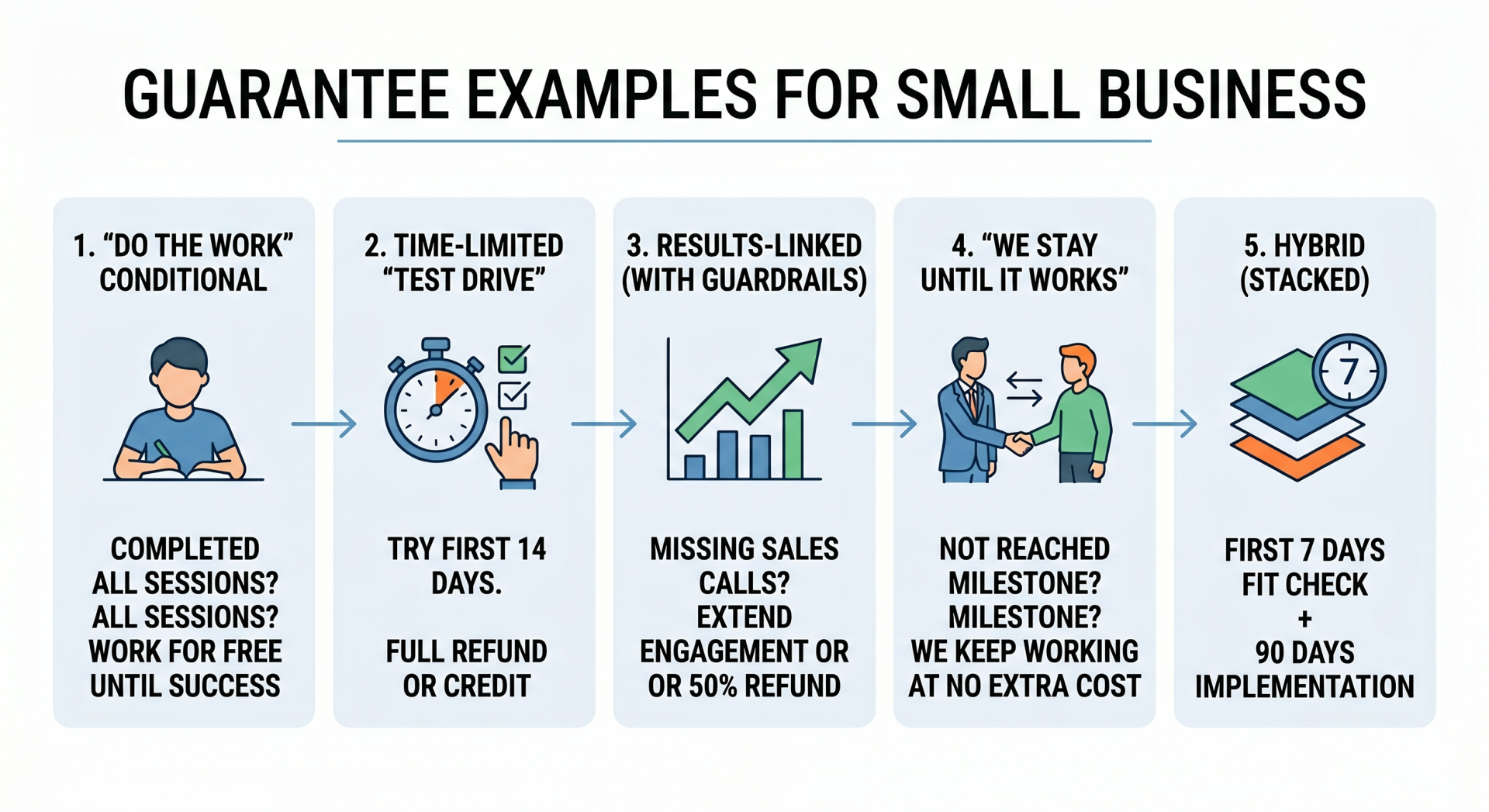
1. The “Do The Work” Conditional Guarantee
This is the most common of the guarantee examples for small business that involve coaching or service delivery. The refund is conditional on the buyer completing what you agreed to deliver.
Why it works: it filters out low-commitment buyers at the point of purchase, not after. Serious buyers read this and feel confident. Dabblers self-select out — which is exactly what you want.
Template:
“If you complete all [NUMBER] core sessions, submit your implementation checklist by [DATE], and still don’t achieve [SPECIFIC OUTCOME], we’ll work with you for free for another [TIMEFRAME] until you do.”
The remedy here is more service, not a refund. That’s deliberate. It communicates confidence and costs you time instead of cash — and serious buyers find that more reassuring than a money-back promise.
2. The Time-Limited “Test Drive” Guarantee
Best for courses, group programs, and anything with a defined onboarding window. Give buyers a short window to verify fit — with a light participation requirement built in.
The participation condition isn’t a hurdle. It’s a filter. People who complete two modules and attend one session are invested. Their refund rate drops dramatically.
Template:
“Join and experience the first 14 days. If you complete the first two modules and attend one live session but feel it’s not a fit, forward your completed exercises within 14 days and we’ll issue a full refund or program credit — your choice.”
3. The Results-Linked Guarantee (With Guardrails)
Results-linked commitments are magnetic on a sales page and dangerous without guardrails. The fix is to promise a specific milestone — not a business transformation — and require the inputs that make that milestone achievable.
Template:
“If you implement the outreach cadence we design together, send at least [NUMBER] messages in [TIMEFRAME], and haven’t booked [SPECIFIC NUMBER] qualified sales calls — send us your activity log and we’ll either extend the engagement at no charge or issue a 50% refund.”
💡 STRATEGY ALERT
Outputs vs. Outcomes — this distinction protects your business. An output is something your client controls: sending 200 emails, completing all modules, attending 8 calls. An outcome is what results from those actions: revenue, leads, signed clients. Build your conditional guarantee around outputs. A client who didn’t implement can’t claim it. A client who did implement has already done most of the work that makes your promised outcome likely.
4. The “We Stay Until It Works” Service Guarantee
This is the ideal structure for high-ticket consulting and done-with-you services where your time is the primary deliverable. No cash refund — just extended commitment. According to ConsultingSuccess.com, this is the most sustainable risk reversal approach for high-touch consulting engagements.
Template:
“If you complete the agreed actions each week and share your performance data on time, and we haven’t reached [MILESTONE] by [DATE] — we’ll keep working at no extra cost for up to [TIMEFRAME] until we get there.”
This lands differently than a refund because it communicates genuine investment in the outcome. The buyer hears: “This person isn’t going to take my money and disappear.” That’s exactly the trust gap the Edelman data identifies — and the gap your competitors aren’t filling.
5. The Hybrid (Stacked) Guarantee
For higher-ticket offers, stacking a short unconditional window with a longer conditional one gives you the conversion benefits of both without the full exposure of either.
Template:
“First 7 Days — Fit Check: If you complete the onboarding call and first module and decide it’s not right, email us within 7 days for a pro-rated refund minus the session cost.
Days 8–90 — Implementation Guarantee: Complete all modules, attend [X]% of calls, and implement the system. If you don’t reach [SPECIFIC MILESTONE], send your completed work by Day 90 and we’ll extend the engagement at no charge or refund 50% of your tuition.”
What Should a Small Business Guarantee Include?
A risk reversal is only as solid as its terms. Vague language causes more damage than no protection at all — it invites disputes you’ll lose.
Strong guarantee examples for small business all share the same four components. Every solid commitment should specify:
The window — 7 days, 30 days, 90 days from what event
The conditions — what the buyer must complete or submit to qualify
The remedy — extra support, partial refund, credit, or extended access
How to claim it — email address, form link, specific deadline
What to leave out: financial result promises tied to market conditions you don’t control. “Double your revenue in 90 days” is not a risk reversal — it’s a legal problem. For a deeper look at how your pricing structure affects buyer psychology, see this breakdown of service pricing math and what it means for your margins.
🛑 DON’T COPY BLINDLY
Avoid “risk-free” and “100% guaranteed results” as standalone phrases. They read as marketing desperation, not confidence. Replace them with specific language: exactly what you promise, the timeframe, and what happens if you don’t deliver it.
How Do You Choose the Right Guarantee Type for Your Offer?
The right structure depends on two things: your price point and what you’re actually delivering.
If Your Offer Is…
Use This Structure
Avoid This
Low-ticket course ($97–$497)
Time-limited Test Drive (7–14 days)
Open-ended no-questions-asked
Group program ($500–$2,500)
Do The Work + Hybrid stack
Full cash refund with no conditions
High-ticket consulting ($3K+)
We Stay Until It Works
Cash-based promise on delivered time
Done-for-you services
Results-Linked with Output Conditions
Outcome-only promises (revenue, rankings)
The guarantee examples for small business that work consistently are the ones that answer the buyer’s real question: “What happens to me if this doesn’t work?” Answer that clearly, and you’ve done most of the selling.
The throughline across all of these: you’re in the business of making buying feel safe, not making refunding feel easy. Those are different goals — and confusing them is why most small business risk reversals fail to convert.
This connects directly to how you price for value rather than for hours. When your pricing reflects your actual impact, your commitment backs up a specific promise, not a vague experience.
Where Should Your Guarantee Appear on Your Pricing Page?
Placement is as important as language. The guarantee examples for small business that convert the most consistently appear in one specific location: directly below the price.
Most small business owners bury their risk reversal in the FAQ or the fine print. That’s backwards. It should live immediately below the price — because that’s the moment the buyer’s fear peaks.
On a well-structured pricing page, the sequence is: what you get → what it costs → why it’s worth it → what happens if it’s not. That final statement completes the loop. It answers the question the buyer is already asking.
If trust is the bottleneck in your market (and per the Edelman data, that’s most markets right now), your risk reversal isn’t a line item in your terms — it’s part of your positioning. The marketing budget risk framework for 2026 puts risk reduction at the center of every buying decision. Your commitment statement is where that framework becomes visible to your buyer.
Frequently Asked Questions About Guarantee Examples for Small Business
What is a guarantee for a small business?
Guarantee examples for small business typically fall into five categories: conditional refunds, service extensions, test-drive windows, results-linked promises, and hybrid stacked structures. A guarantee for a small business is a formal commitment that if a customer doesn’t receive the promised result — or if the product or service isn’t a fit — they receive a defined remedy such as a refund, extra service, or account credit. The best versions are conditional: they require the buyer to meet specific participation requirements before claiming the remedy. This protects the business from abuse while still removing purchase risk for serious buyers.
Do I have to offer a money-back guarantee to compete?
No. A money-back guarantee is one option, not the only one. Service extension commitments, “we stay until it works” structures, and credit-based remedies all remove buyer risk without creating cash refund exposure. For high-ticket services where your time is the delivery, non-monetary risk reversals are often more compelling — and more sustainable — than full refunds.
How do I write a guarantee that doesn’t trigger a flood of refunds?
Tie your risk reversal to specific outputs — actions the buyer must take to qualify. Require them to complete modules, submit work, attend calls, or run campaigns. The conditions should be reasonable but explicit. When claiming a refund requires proof of implementation, you naturally filter out low-commitment buyers at the point of purchase rather than the point of disappointment.
What’s the difference between an output-based and outcome-based guarantee?
An output-based conditional guarantee ties eligibility to what the client does: sends 200 emails, completes all modules, attends 8 calls. An outcome-based version ties eligibility to a result: books 10 sales calls, increases revenue by $X. Output-based structures are safer because outputs are directly controllable by the client. Outcome-based versions are more compelling to buyers but create liability when market conditions or client behavior affects the result. The strongest structures combine both: require outputs, then promise a specific (not total) outcome.
Should my guarantee be the same for every offer I sell?
No. Your risk reversal should match the price point, delivery format, and risk profile of each offer. A 7-day test drive works for a $197 course. It makes no sense for a $5,000 done-with-you engagement where you’ve invested significant time by day two. Match the structure to what you’re actually delivering — and to the size of the decision your buyer is making.
Additional Reading on Guarantee Examples for Small Business
Book a Fix-It Session and I’ll review your current offer, your price point, and your sales page — then tell you exactly which risk reversal structure will close more sales without opening a refund flood. $150. 24-hour turnaround. No meetings required.