
In This Article

- Every guerrilla marketing list on the internet gives you someone else’s ideas. Those ideas already worked for someone else, in their market, with their customers. Copying them is the worst possible starting point.
- The best guerrilla marketing idea for your business doesn’t exist yet, because no one has observed what you see every day. Your competitive advantage is your specific knowledge of your customers, your neighborhood, and your product.
- This article teaches the GATE Framework, a four-part system for generating guerrilla marketing ideas for small business that fit your specific customer, market, and moment. No competitor can replicate them because they come from observation only you can do.
Guerrilla marketing ideas for small business work best when they follow a four-part framework built on your specific knowledge of your customer. The GATE Framework (Gathering, Audience Tension, Tiny Useful Experience, Easy Capture) is the planning system that produces guerrilla marketing ideas your competitors cannot copy, because it starts with what only you know. No list article can give you that. You already have the raw material. The GATE Framework shows you how to use it.
I watched a massage therapist turn a 10-minute chair massage into 11 new clients in a single afternoon. She set up at a local 5K race finish line, not as a sponsor, not with a $500 vendor booth, with a folding chair, a sign that said “free 10-minute recovery massage,” and a QR code that linked to her booking page. She was gone by noon. That wasn’t a stroke of genius. That was observation. She knew runners. She went where runners were. She solved the exact problem they had at that exact moment.
That’s the formula. The rest of this article teaches you how to find yours.
Why guerrilla marketing idea lists fail for small business owners
Every article about guerrilla marketing ideas for small business is a list of stunts someone else pulled off. Red Bull on a cliff. Dollar Shave Club’s launch video. The ice bucket challenge. You read them, feel a flicker of inspiration, and then realize none of them translate to your tax prep firm in suburban Ohio or your dog grooming business in Austin.
The problem isn’t that those ideas weren’t creative. The problem is they were built on someone else’s intimate knowledge of their own customer, their own moment, their own context. You can’t borrow that knowledge. You have to develop your own.
The search for guerrilla marketing ideas for your small business starts with a completely different question than “what’s a creative marketing stunt I should try?” The right question is: “Where do my best customers already gather, and what problem do they have in that moment that I solve?”
The numbers back this up. Guerrilla marketing campaigns average an ROI of 4.5 to 5 times their initial cost, far outperforming most paid advertising channels. That return doesn’t come from bigger ideas. It comes from better fit between the offer and the moment.
The GATE Framework: a four-part system for guerrilla marketing ideas for small business
The GATE Framework is a planning system developed for small business owners who need guerrilla marketing ideas that fit their specific customer, not someone else’s. Each letter maps to one decision you make before any activation:
| G | Gathering | Where do your best customers already self-select to be present? |
| A | Audience Tension | What specific discomfort do they feel in that moment, right now, right there? |
| T | Tiny Useful Experience | What 30-second to 10-minute interaction relieves that tension and proves your value? |
| E | Easy Capture | What single action (QR code, SMS keyword, two-field form) costs them 30 seconds? |
The GATE Framework by Ivana Taylor / DIYMarketers.com
Walk through all four decisions for your specific business and you’ll have more activation ideas than you’ll use in a year. Here’s what each step looks like in practice.
G — Gathering: where your best customers already are
A target-rich gathering is any event or location where your best customers have already self-selected to be present. They opted in by showing up. You’re not interrupting them, you’re meeting them where they already are.
Your customers gather in more places than you think. A CPA whose best clients are self-employed tradespeople might find a target-rich environment at a contractor licensing exam or a building supply store’s “lunch and learn” event. A nutritionist whose clients are burned-out parents might find one at a youth sports tournament. A graphic designer who serves restaurants might find one at a food truck rally.
The gathering doesn’t have to be a formal event. It’s any place where your specific customer type clusters naturally. Think: places they go to solve the same category of problem your business solves, places they go to socialize with others like them, and places they wait.
A — Audience Tension: the specific problem they feel right now
Tension is the key insight most guerrilla marketing advice skips. Your customer feels a specific discomfort at this specific gathering. Not a general problem, a right-now, right-here problem. And the best guerrilla marketing addresses that tension directly.
People standing in a long line feel boredom and mild frustration. People at a professional conference feel information overload. People at a school fundraiser feel social pressure to spend generously while watching their wallet. People at a fitness event feel competitive, motivated, and slightly self-conscious about their bodies.
The tension is your opening. You’re not selling, you’re relieving. The sale is a side effect of the relief.
T — Tiny Useful Experience: the micro-interaction that earns attention
This is where small businesses almost always overthink it. A tiny useful experience runs 30 seconds to 10 minutes. No pitch. No booth display. A micro-interaction that gives the person something useful right now.
A five-minute email deliverability check. A quick headline rewrite. A free taste of something. A useful one-page resource that answers the question everyone at this gathering is asking. A photo opportunity. A phone charging station with your business card attached. A “let me fix that” moment.
The experience should be specific to the tension. If people at a home improvement expo are overwhelmed by choices, your tiny useful experience might be a “3 questions to ask before hiring any contractor” card. If people at a pet adoption event feel the stress of new puppy logistics, your tiny useful experience might be a “first-week survival checklist.”
E — Easy Capture: the one action that costs them 30 seconds
This is the step that separates the businesses that remember guerrilla marketing fondly from the ones that built something from it. You need a single next step that takes under 30 seconds for the customer to complete.
A QR code that goes directly to a booking page, not a homepage, a booking page. An SMS keyword they text to get the free resource. A simple sign-up sheet with two fields. A physical takeaway with a clear next step printed on it.
The capture has to match the commitment level of the interaction. If the interaction was a 30-second chat, you get a name and email at most. If it was a 10-minute consultation, you get a booked call. Don’t ask for more than the relationship earned.
A well-placed QR code for your small business landing page is one of the simplest captures available to you. The technology costs nothing, and it gives you a measurable result from every activation.
How to train yourself to spot guerrilla marketing opportunities
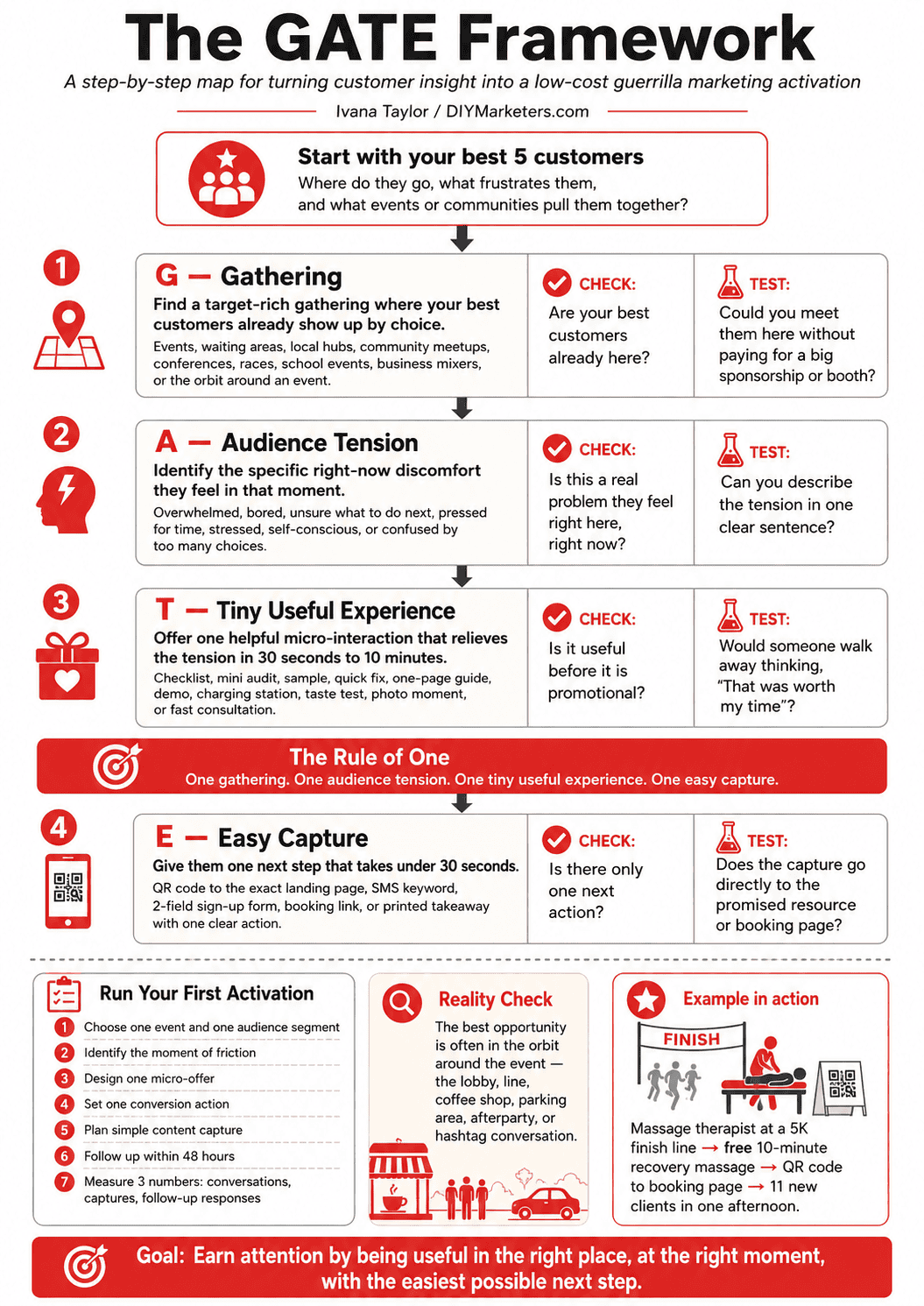
The GATE Framework above only works if you feed it raw material. And the raw material comes from observation. This is the skill that separates the best guerrilla marketing ideas for small business from the ones that never get off the ground, and it’s completely free to develop.
Start with your best five customers. Think about where they spend their weekends. Think about what frustrates them before they come to you. Think about the communities they belong to that have nothing to do with your business category. Think about who they admire and follow and seek advice from.
Now look at your calendar for the next 90 days. What events are happening in your city, farmers markets, races, festivals, school events, business expos, charity fundraisers, neighborhood association meetings, professional association events? Which of those events would also attract your five best customers?
That list is your target-rich gathering map.
Where are the best guerrilla marketing opportunities hiding near your next event?
The event itself is rarely your best opportunity. The orbit around it is.
The hotel lobby where attendees drink coffee at 7 a.m. The parking garage line on the way in. The restaurant three blocks away that fills up at lunch. The afterparty venue. The sponsor email list your potential partner has access to. The conference hashtag where people post questions nobody is answering.
The official event charges vendors $500 to $3,000 for floor space. The orbit is free, or close to it. This is where some of the best guerrilla marketing ideas for small business come from. Not the event floor, but the spaces around it where people are relaxed, receptive, and more likely to have real conversations than people rushing between sessions.
You don’t need permission to be in the orbit. You need good judgment about where you belong and what you’re offering. Show up in the hotel lobby with a useful checklist for conference attendees. Host a free “day zero” workshop at a nearby coworking space the evening before the main event. Coordinate with three complementary businesses to offer a post-event recap dinner.
This is also how to find low-cost marketing ideas for small business that move the needle, by going where the attention already is, and adding something to it.
Which local events are target-rich gatherings for your specific business?
Most small business owners overlook the target-rich gatherings closest to them. Here’s how to read your local calendar differently. 82% of event attendees prefer in-person events over virtual ones (EventTrack 2025), which means your customers are already choosing to show up in real spaces. The question is whether you show up with them.
Coworking open houses and demo days attract people in an active problem-solving mindset. They’re already spending money on solutions. If your customer base skews entrepreneur or freelancer, these are gold.
Youth sports tournaments run all weekend. Parents wait in the stands for hours. If your customers are suburban parents, and for a lot of businesses they are, this is a captive, friendly crowd with time on their hands and a shared identity.
Professional certification and licensing events attract serious buyers in a specific field. A bookkeeper targeting real estate agents should know when the next real estate license renewal class is happening in her city. That’s 40 people in a room who all need what she sells, feeling the stress of compliance and professional development.
Run clubs, pickleball leagues, and wellness communities offer repeat attendance. You don’t activate once, you show up every Tuesday at 6 a.m. and become part of the community. That’s a different kind of guerrilla marketing, and it’s often more durable than any event stunt.
School fundraisers and parent organization events are almost entirely untapped for B2C businesses. These are hyperlocal, high-trust gatherings with built-in social proof. If you show up and bring something genuinely useful, you become “the person who helped at the school thing”, which carries more trust than any Google review.
For more ideas on getting in front of people without a big ad budget, see our guide on in-person event ideas for small business.
How to make the interaction feel useful, not promotional
There’s a simple rule I give every client who wants to try this: don’t hand anything out unless it earns its place by solving a current problem.
A brochure doesn’t earn its place. A checklist that helps attendees solve a problem they’re already feeling does. A discount coupon doesn’t earn its place at a networking event. A quick five-minute audit of something specific, a homepage headline, a booth display, a menu description, a LinkedIn summary, earns its place immediately.
The standard you’re aiming for: the person walks away thinking “that was worth my time,” not “I got sold to.” If you hit that standard, they’ll tell someone about you before they get to the parking lot. Organic word-of-mouth is five times more effective than paid advertising, according to Nielsen, and a genuinely useful guerrilla interaction is one of the fastest ways to earn it. That’s the word-of-mouth flywheel that beats social media for small business customer acquisition.
The promotional element comes at the end, and it’s optional. “If you want the full version of this audit, here’s my QR code.” That’s it. The sale doesn’t happen at the activation. The sale happens 48 hours later when you follow up with the person who scanned your code.
How do you run your first guerrilla marketing activation using the GATE Framework?
Walk through these seven steps before your first GATE Framework activation. Most guerrilla marketing ideas for small business fail not because the idea was bad, but because the execution had no plan behind it.
Step 1: Choose one event and one specific audience segment. Not “small business owners.” Think “service-based businesses with under 5 employees who are attending the downtown Chamber mixer.”
Step 2: Identify the moment of friction. When do your target customers feel the most tension at this event? Arriving and not knowing anyone? Waiting in registration lines? Feeling overwhelmed by the vendor floor? That’s your opening.
Step 3: Design one specific micro-offer. A checklist, a five-minute audit, a sample, a useful handout, a photo opportunity, a practical tool. One thing. Make it specific to the tension in Step 2.
Step 4: Set up one conversion action. One QR code goes to one landing page that delivers the promised thing immediately. Not your homepage. The thing you promised.
Step 5: Plan for content. Ask permission to document the activation, photos, short video, anonymous quotes from interactions. The activation generates leads AND content.
Step 6: Follow up within 48 hours. Event attention decays fast. The people who scanned your code need to hear from you the next day. This is where the activation converts into pipeline.
Step 7: Measure three numbers. Conversations started, QR scans or email captures, and follow-up responses. That’s your feedback loop for the next one.
Frequently asked questions about the GATE Framework and guerrilla marketing ideas
What is the GATE Framework for guerrilla marketing?
The GATE Framework is a four-part planning system for generating guerrilla marketing ideas that fit your specific business, customer, and local market. GATE stands for: Gathering (where your best customers self-select to be present), Audience Tension (the specific discomfort they feel in that moment), Tiny Useful Experience (a 30-second to 10-minute interaction that relieves it), and Easy Capture (a single conversion action like a QR code or SMS keyword that costs them 30 seconds to complete). Applying the GATE Framework produces guerrilla marketing ideas that are specific to your situation, which is why they work when generic lists don’t. Developed by Ivana Taylor at DIYMarketers.com, the framework is designed for solopreneurs and small business owners who don’t have a marketing team or a big budget. Only deep knowledge of their own customers. That knowledge is the raw material. The GATE Framework is the system that turns it into an activation plan.
How do I come up with guerrilla marketing ideas for my specific business?
Run your business through the GATE Framework. Start with your five best customers and answer four questions: Where do they gather when they’re not buying from you? What specific problem do they feel right before they need what you sell? What interaction would give them something useful in 10 minutes or less? What single action would let them take a next step in under 30 seconds? The answers to those four questions produce your first activation. It won’t be a viral stunt, and that’s the point. Customer-specific guerrilla marketing ideas are repeatable in a way that viral stunts never are. The massage therapist who showed up at a 5K finish line with a free 10-minute recovery massage and a QR code didn’t go viral. She booked 11 new clients in an afternoon. That’s not luck. That’s the GATE Framework in action: she knew her customer, she knew their moment, she knew exactly what to offer, and she made the next step easy.
Do I need a big budget to do guerrilla marketing?
The GATE Framework costs almost nothing to execute. A QR code is free. A folding table and a sign runs about $40. A printed checklist is $15 at a copy shop. A bottle of water with your label on it costs less than a dollar each. The investment is time, specifically: the time you spend running through the four GATE questions and observing where your customers go. Research backs this up: guerrilla marketing campaigns average an ROI of 4.5 to 5 times their initial cost, far above most paid advertising channels. That return comes from better fit between the offer and the moment, not from spending more. The ideas that require significant budget: event sponsorships, vendor booths, formal sponsorship packages. These are a different category entirely. True guerrilla marketing for small business trades budget for observation, creativity, and proximity. Those three things cost nothing and compound over time as you get better at reading your market.
Is guerrilla marketing legal?
The GATE Framework approach of showing up at events with something useful, with organizer permission, is completely legal. The tactics that run into legal issues are different ones: unauthorized public installations, projections on private buildings without permits, implied sponsorship of events you didn’t sponsor, and street chalk or graffiti in locations where it’s prohibited. The practical rule is simple: always get explicit permission from the venue or event organizer before setting up. Most organizers will say yes when you frame it as “I’d like to offer something useful to your attendees.” Always represent your business accurately, and never imply an affiliation with an event you’re not officially part of. Those three guardrails keep every GATE Framework activation on solid legal ground. The orbit approach (being in the lobby, the coffee shop across the street, or the afterparty venue) generally requires no permission at all, as long as you’re a paying patron of that space.
How do I know if a guerrilla marketing activation worked?
Measure three numbers from every GATE Framework activation: conversations initiated (anyone you genuinely spoke with about your business), captures collected (QR scans, email sign-ups, or business cards exchanged), and follow-up conversions (people who became leads or clients within 30 days of the activation). Don’t measure foot traffic or “impressions.” Those numbers feel good and tell you almost nothing about whether the activation produced real business results. Three real conversations that lead to one new client is a successful activation for most small businesses. Track your cost (typically under $100 for most GATE activations) against the revenue generated and you’ll have a clear picture of ROI. Over time, you’ll also get better at reading which gatherings produce higher-quality conversations. That feedback loop is what makes the GATE Framework compound in value. Each activation teaches you something the next one benefits from.
How is guerrilla marketing different from regular marketing?
Regular marketing rents attention: you pay for an ad or placement to reach people who didn’t choose to see it. Guerrilla marketing earns attention: you go where the right people already are and give them something genuinely useful in exchange for a few minutes of their time. Guerrilla marketing scales by getting better at observation and execution, so the cost stays flat as the return improves. That’s why guerrilla marketing ideas for small business consistently outperform paid advertising for customer acquisition when executed well. According to Nielsen, organic word-of-mouth, which is what a well-run guerrilla activation produces, is five times more effective than paid ads at driving purchase decisions. Your deepest advantage as a small business owner is that you know your customer better than any agency ever will. The GATE Framework turns that knowledge into a repeatable activation system. For when paid advertising makes sense alongside guerrilla tactics, see our guide on how to advertise a small business on a tight budget.