
In This Article

⚡ THE GIST
Deals are stalling because your buying process has friction — here’s how to remove it.
- Inquiries are up in 2026, but close rates are falling — the gap lives inside your process, not your price
- The DIYMarketers Decision Friction Audit maps four stages where deals go silent: discovery, proposal, decision, and follow-up
- Surfacing other decision-makers in your discovery call eliminates the “let me check with my partner” stall before it starts
- A one-sentence value rationale anchored in outcomes — not hours — removes most price hesitation
- A three-touch follow-up sequence (same day, 48 hours, 5–7 days) gets real answers instead of silence
If you want to know how to speed up the sale you’ll want to design a buying process where the decision becomes obvious before the conversation ends. Sales cycles have stretched roughly 22% since 2022 — most of that drag traces back to unanswered questions buyers carry into your conversations. Map where your process creates hesitation, address those friction points, and deals close faster.
Right now, sales are stalling and I’ll be you want to know how to speed up the sale.
Here’s what this article covers:
- Why buyers who used to say yes on the same day are now going silent
- The DIYMarketers Decision Friction Audit — a four-stage map of exactly where your sale stalls
- Three micro-fixes you can run this week without changing your price
- A decoder for the stall phrases your prospects use (and what they signal)
- A designed three-touch follow-up sequence that gets real answers
In 2026, deals are stalling because the path from “this sounds good” to “here’s my card” has too many unanswered questions. Sales cycles have stretched roughly 22% since 2022, and most of that drag lives inside the seller’s process.
A thread on Reddit in May 2026 — “So uhhh, is business slowing down?” — hit 847 upvotes in a few days. The most common story in the comments: “Inquiries are up, but people who used to say yes on the same day are now saying ‘let me check with my partner’ and then disappearing.” This is a decision friction problem — one with a specific fix.
Why deals are stalling in 2026
The conventional diagnosis is wrong. Most small business owners see a stalled deal and assume one of three things: the price is too high, the timing is bad, or the prospect was never serious. Sometimes those are true. Those three assumptions increasingly miss what’s driving the stall.
What’s happening is a decision friction problem. Buyers in 2026 have done 70–90% of their research before they ever speak with you. Gartner research shows B2B buyers spend only 17% of their total buying journey in conversations with sales reps — the rest is independent research, internal discussions, and building stakeholder consensus. When buyers get to you, they’re in validation mode. Validation requires very different things from your process than discovery does.
Add to this: buyers are trading down and stress-testing every purchase right now. The “check with my partner” response signals that the decision feels risky, or that your value story didn’t land clearly enough to stand on its own when the prospect retells it to someone else at 10pm.
The gap lives between what your prospect understood in your conversation and what they’re able to clearly explain to whoever holds the veto. If your offer requires you in the room to make sense, you have a friction problem you can solve. Start with why customers stop buying even when the economy looks fine for the bigger picture on buyer hesitation.
How to speed up the sale: map your buying journey before you fix it
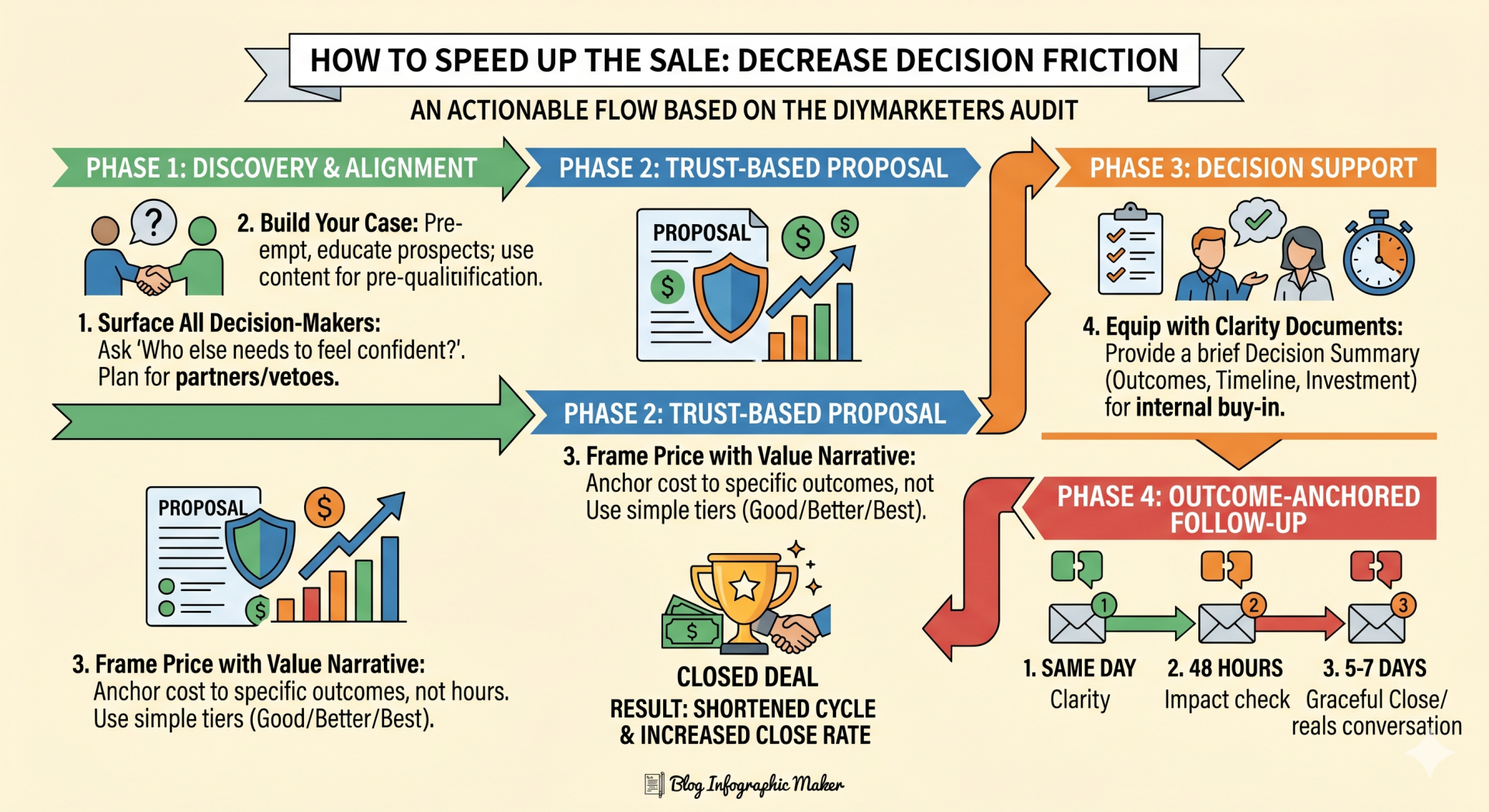
How to speed up the sale means designing your buyer’s experience so the decision becomes obvious — before the conversation is over.
Before you fix anything, you need to know where the stall is happening. I call this the DIYMarketers Decision Friction Audit — a four-stage review of your current buying process that identifies where buyers are dropping off or going silent.
Here are the four stages to audit:
Stage 1: Discovery. Are you asking who else is involved in this decision? If you go straight to pitch without surfacing other stakeholders, you’re setting up every deal for a late-stage veto. One question changes this completely: “Who else needs to feel confident about this before you move forward?”
Stage 2: Proposal. Is your price showing up as a trust signal or a puzzle? A number without a value story creates hesitation. A number anchored in outcomes creates forward motion. If your proposal reads as a line-item list with no value story, this is your biggest stall point.
Stage 3: Decision. Does your buyer have what they need to say yes internally? This is the stage most service providers completely ignore. Your prospect needs to be able to resell your offer to their partner, co-founder, or themselves at 11pm — without you in the room. If you haven’t equipped them with a clear “why this, why now” story, the decision stalls.
Stage 4: Follow-up. Generic “just checking in” emails create avoidance. Behavior-based, outcome-anchored follow-up gives your prospect a specific reason to respond. Most solopreneurs are only running the first type.
How to speed up the sale without discounting: three micro-fixes that work right now
Each one addresses a specific stage in the Decision Friction Audit. Pick the stage where your deals most often go quiet and start there.
Micro-fix 1: pre-empt the partner check before it happens
The time to surface other decision-makers is in your discovery call, before the proposal goes out. When you ask “who else needs to feel good about this?” early, you either learn there’s a second stakeholder (and you plan for them) or you confirm you’re talking to the only decision-maker (and your follow-up gets simpler).
If a partner is involved, give them a concrete way to participate: a 15-minute call, a forwarded summary document, or a one-page Decision Brief that covers outcomes, timeline, investment, and one risk-mitigating point. This removes the biggest stall in service-based selling — the prospect who genuinely wants to hire you but can’t get their partner to a decision without dragging them into a full sales call.
Research on multi-threaded deals shows they close at 68% versus 23% for single-contact deals — and faster. For solopreneurs, multi-threading means knowing who else matters and giving them what they need to say yes.
Micro-fix 2: turn your price into a trust narrative
When a buyer sees your price, they run a split-second internal calculation: “Does this match what I believe about their value and their fairness?” If the answer is unclear, they delay. If the answer is yes, they move forward.
A one-sentence “why this price is fair” explainer, built into your proposal, eliminates a significant amount of hesitation. Anchor the explanation in outcomes. “This investment reflects X weeks of focused strategy that typically produces [specific result] for clients in your situation” lands very differently than “$X for 20 hours of consulting.”
Simple tiering helps too. A Good / Better / Best structure with a clearly marked “most popular” option gives your buyer a comfort level they can say yes to — one that still protects your margins. If you’re presenting a single price with no context, you’re making the decision harder than it has to be. See how to structure this in how to create a pricing page that converts and how to set value-based pricing for services.
Micro-fix 3: design a three-touch follow-up sequence
Most solopreneurs follow up with some version of “just wanted to check in.” That message creates nothing except a reminder that you’re waiting. Designed follow-up creates a specific reason to respond.
Here’s a simple three-touch sequence that works:
- Same day you send the proposal: A short email with outcomes, investment, and a Decision Summary — one paragraph they can copy-paste to a partner or revisit late at night. A clarity document — everything they need to make a decision.
- 48 hours later: An impact-anchored check-in: “I want to make sure you don’t miss the window to have [specific outcome] in place by [date]. Is this more of a ‘now’ or ‘later’ project for you?” That question invites a real answer — including no — which is more useful than silence.
- 5–7 days later: The graceful close: “No hard feelings if the timing isn’t right. I wanted to check one more time before I move to my next available slot in [month]. Happy either way.” This closes the loop, creates gentle urgency, and gives them permission to say no — which often prompts a yes or a real conversation instead of continued avoidance.
Learn how to build a qualification system that feeds this process in qualifying leads: the key to sales success.
How to decipher your customer’s stall phrases
Before you can remove friction, you need to figure out where it’s coming from. Most stall phrases carry a different meaning underneath.
| What They Say | What They Mean | Your Next Move |
|---|---|---|
| “Let me check with my partner” | I’m not fully sold and don’t want to say no directly | “Great — what will they care about most?” |
| “I need to think about it” | Value/price mismatch or fear of the unknown | “Which part feels risky or unclear right now?” |
| “Send samples or a proposal.” | I want to delay the decision | “Sure — what specifically should it help you decide?” |
| [Silence after proposal] | Overwhelm, competing priorities, or low urgency | Send impact-anchored follow-up with a clear yes/no question |
These micro-responses are clarity moves — designed to help your prospect reach a decision faster, in either direction. A fast no is worth far more than a three-month maybe. Read more about addressing price objections directly in how to eliminate the “your price is too high” objection and your customers still want to buy — you’re just packaging it wrong.
The pull marketing connection: convert hand-raisers into decisions faster
If you’ve been using pull marketing strategies to attract inbound leads, you’re already solving the top-of-funnel problem. Pull gets people raising their hands. The Decision Friction Audit handles what happens next.
The bridge between pull and fast decisions is pre-qualification. Your content should do the early-stage education so that by the time someone contacts you, they’ve already answered the basic questions: What is this? Is it for me? Is it worth the investment? That shifts your discovery call from orientation to decision — and cuts your sales cycle significantly.
A simple way to build this: create a short “Is this right for you?” page or video sequence that lives between your lead magnet and your booking link. Anyone who reaches your calendar has cleared a basic qualification bar. Your close rate improves. Your sales cycle shrinks. Your time-per-deal drops. That’s process design — and that’s what’s missing from most small business selling systems right now.
How to build a frictionless buying system without expensive tools
Four things working together remove decision friction from your sales process — and none of them require a CRM upgrade, a sales team, or a complicated automation stack:
- A clear buying path — Defined stages from first conversation to signed agreement, with exit criteria for each stage (what has to happen before you move forward)
- A value narrative at every price point — A proposal template that anchors price to outcomes, includes simple tiers, and has a one-sentence “why this is fair” statement built in
- A stakeholder plan — The habit of asking “who else is involved?” in every discovery call, and a Decision Brief document your buyer can forward to whoever needs to sign off
- A designed three-touch follow-up sequence — Same day, 48 hours, five to seven days. Each touch serves a different purpose: clarity, impact, and graceful close. No generic check-ins.
That’s it. Four elements. Most solopreneurs are missing two or three of them, which is why good leads go quiet and deals that should close in a week drag into a month. See the full checklist for making it easy to buy from you. And if you want to build trust before the sale even starts, begin with these seven ways to build customer trust without spending a dime.
Frequently asked questions about how to speed up the sale
Why are more prospects saying “let me think about it” right now?
This is happening because buyers in 2026 are operating with higher risk awareness and tighter budget scrutiny. The macroeconomic uncertainty of the past few years has made buyers more careful about service purchases, where the outcome isn’t tangible before the commitment. Buyers are also entering conversations later in their decision process — they’ve already researched options, compared prices, and have a rough budget in mind. When they say “let me think about it,” they usually mean: “I’m not yet confident this is the best use of our limited money right now, and I don’t feel safe saying no directly.” The solution is to address that confidence gap during the conversation. Surface objections early, provide a clear value narrative, and equip your buyer with a summary they can use to make the case internally without you in the room. That one change addresses the majority of stall situations.
How do I speed up the sale without making my prospect feel pressured?
Specificity separates a clear next step from a pressure move. Outcome-anchored framing — “if we start on [date], you’ll have [specific outcome] by [date]” — ties the decision to a real benefit and a specific timeline. Ask for a real decision at the end of every conversation. Confirm a specific next step with a time and communication method attached: “I’ll send the proposal today. Is Thursday or Friday a better day for a quick yes or no from you?” That one small change closes more deals than most closing techniques because it creates a clear decision moment. Buyers experience it as professionalism, and they respond to it. The habit is simple: anchor every next step to an outcome and a date, then ask for a specific answer on a specific day.
What should I do when a prospect goes silent after I send a proposal?
Send an impact-anchored follow-up within 48 hours. Make it a specific reason to respond — a concrete outcome to consider, a clear question to answer. A strong 48-hour message might say: “I want to make sure you don’t miss the window to have [specific outcome] in place before [season or timing event]. Is this more of a ‘now’ or ‘later’ project for you?” That question invites a real answer, including no, which is more valuable than continued silence. If there’s no response after that, send a no-pressure close at five to seven days: “No hard feelings if the timing isn’t right — I want to check one more time before I fill my next available slot in [month]. Happy either way.” This respects their autonomy while keeping the door open. The majority of deal reactivations happen in this window, and a clean close-the-loop message often prompts a real conversation about what’s holding the decision back.
How do I handle the “let me check with my partner” stall?
Pre-empt it in discovery, before the proposal is out. In your initial conversation, ask: “Who else needs to feel confident about this decision before you move forward?” If a partner, spouse, or co-founder is involved, plan for them from the start. Offer a 15-minute joint call or create a two-paragraph Decision Brief they can forward — covering outcomes, investment, timeline, and one key risk-mitigating point. This turns the partner from an invisible veto into an active participant. When the partner comes in before the proposal stage, you’ve addressed their concerns by the time the prospect makes the decision. When “let me check with my partner” shows up after the proposal, it’s usually a signal that the prospect needs more clarity or confidence to advocate internally. A short Decision Brief document — written for the partner, addressed to the partner, separate from your regular follow-up — often resolves this faster than a follow-up call.
Do I need expensive tools or software to remove friction from my sales process?
No. The most effective friction-reduction changes are behavioral and structural While simple tools help, they don’t need to be expensive. A basic CRM tracks where deals stall so you can see which stage loses the most prospects. A simple email automation tool handles timed follow-up so deals don’t go cold because of a dropped ball on your end. The system works before any tool is added. The tools make the system repeatable. Start with the behavioral changes, measure what improves, then automate what’s working. That’s the order that delivers results without creating a new set of tools to manage.