
In This Article

A marketing audit small business owners run themselves is a structured review of what you’re doing, what results each activity produces, and where the gaps are. It covers four areas: traffic sources, conversion rates, customer retention, and marketing spend. Most small business owners can complete a solid diagnostic version in two to three hours—no agency, no expensive software, no outside help required. You need honest data and the willingness to look at it.
Your marketing probably isn’t broken. Your ability to diagnose it is.
Fix-It Session · $150
Too close to your own marketing to see what’s broken?
Send me one page, email, or offer. Within 24 hours you get a recorded video review, a one-page priority plan, and an example of your top fix applied. No call needed.
That’s the uncomfortable pattern I’ve watched play out over and over. A business owner comes to me frustrated—they’ve tried Instagram, email campaigns, Google Ads, maybe a new website—and revenue is still flat. When I ask them to walk me through their funnel, they can’t. They know which platforms they’re on. They don’t know which ones are working or what “working” even means for each one.
What a Marketing Audit for a Small Business Is (and Isn’t)
A marketing evaluation is a diagnostic tool, the equivalent of a blood panel for your business. You’re not looking for what to do next. You’re looking at what is happening right now. You’re not looking for what to do next. You’re looking at what is happening right now.

The distinction matters because most struggling small businesses don’t have a tactics problem. They have a clarity problem. They’re doing plenty. They don’t know what’s working or why—and they’ve never mapped which activity is supposed to do what.
The marketing audit essentials that small business owners need cover four key areas. Think of it as the DIYMarketers Four-Area Audit—a framework simple enough to run yourself in a morning:
- Where leads are coming from (and which sources are invisible to you)
- How many visitors become inquiries, and how many inquiries become customers
- How long customers stay and what causes them to leave
- What you’re spending—in time and money—versus what you’re getting back
What it’s not: a list of new tactics to add. If your audit ends with “we should try TikTok,” something went wrong.
How to Run a Marketing Audit Small Business Step-by-Step
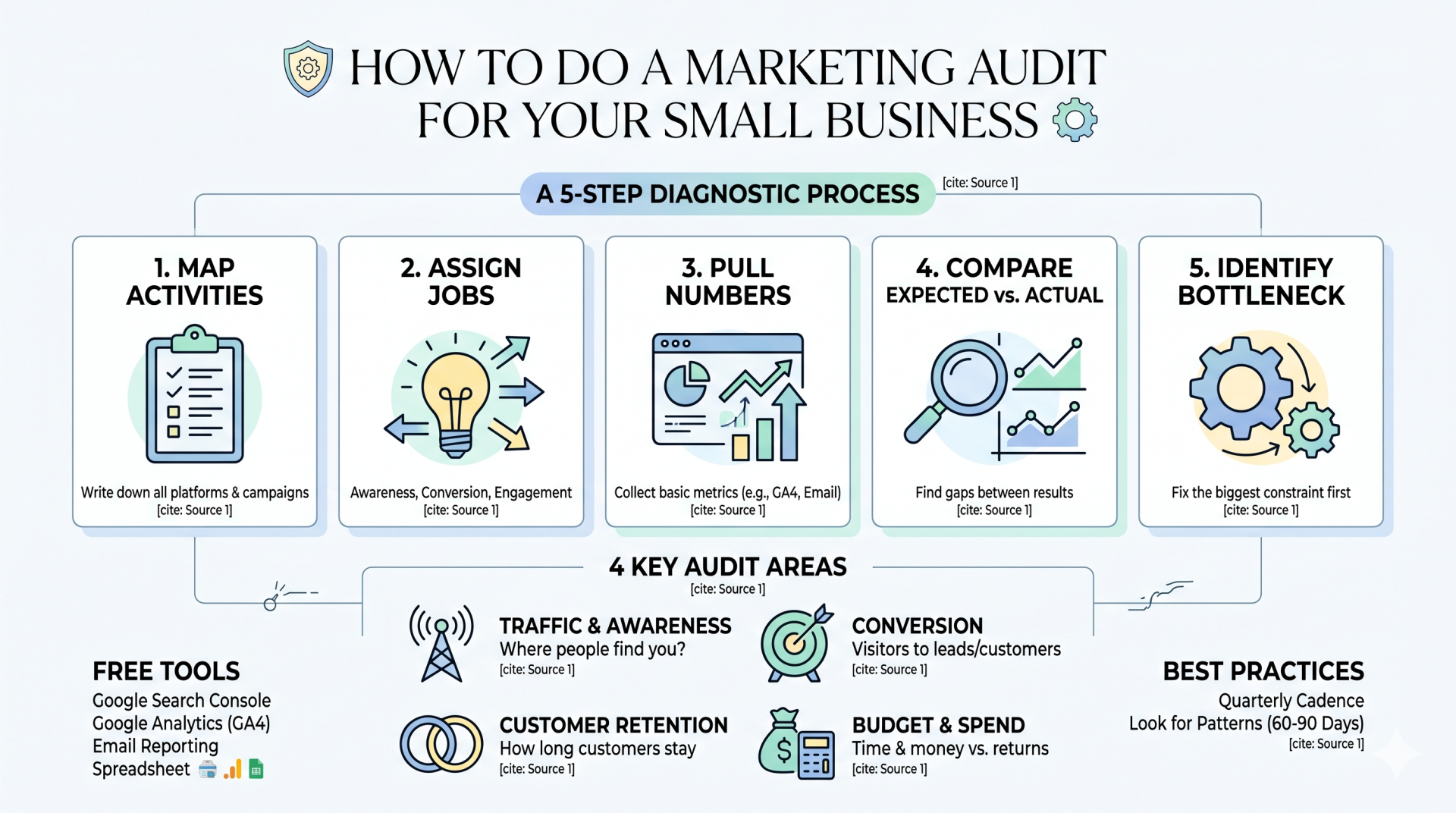
This is a five-step process. Each step builds on the last. Don’t skip ahead—the sequence matters.
Step 1: Map every marketing activity you’re running.
Write down every platform, every campaign, every tactic, every networking group. Email newsletters, social media accounts, paid ads, SEO content, referral programs, local events—everything. Don’t evaluate yet. Just list it.
This step alone is revealing. Most small business owners discover they’re running eight to fourteen separate activities with no clear relationship between them.
Step 2: Assign each activity a job.
Every marketing activity should have one of three roles: generating awareness, converting interest into leads, or keeping existing customers engaged. Write the job next to each activity on your list.
If you can’t name the job, the activity probably doesn’t have one. That’s a finding.
Step 3: Pull the numbers.
For each activity, collect the basic metrics. You don’t need a sophisticated marketing dashboard. You need these:
- Traffic sources (Google Analytics or Search Console)
- Email open rates and click-through rates
- Social media reach versus website visits from social
- Ad spend versus confirmed leads generated
- Revenue per customer and average customer lifespan
Two things will happen when you do this. You’ll find activities that produce great results you’ve been underinvesting in. And you’ll find activities you’ve been loyal to that have produced nothing in months. Both are valuable findings.
Step 4: Compare what you expected versus what happened.
Set a baseline expectation for each activity, then compare it to actual results. Industry benchmarks help here. According to HubSpot’s marketing benchmarks, average email open rates across industries hover around 20–22%. If yours is 9%, that’s a finding. If your content marketing is bringing in traffic but nobody clicks to a second page, that’s a finding.
Write down every gap between expected and actual. That list becomes your audit report.
Step 5: Identify the single biggest bottleneck.
Look at your findings and ask one question: where does the most potential revenue fall off? That’s your constraint. Fix that first—not the ten other things on the list.
The Four Areas Every Marketing Audit Should Cover
Most marketing diagnoses for small business skip at least one of these four areas. Each one tells you something different. All four together give you the complete picture.
1. Traffic and Awareness
Where are people finding you? If 80% of your traffic comes from organic search and you’ve never touched your SEO, you’re one algorithm update away from a revenue crisis. Diversification is risk management, not a luxury. A solid look at why your marketing keeps failing often starts right here—single-source dependency.
2. Conversion
Traffic that doesn’t convert is an expense with a nice chart. Review your landing pages, your offers, and your calls to action. The core question: do people who find you know exactly what to do next?
According to SCORE’s small business marketing data, most small business websites convert at less than 2%. If yours is lower, the problem is almost always message clarity—not design, not traffic volume.
3. Customer Retention
This is the most ignored section of every small business marketing audit—and the most expensive oversight. Research from Harvard Business Review puts the cost of acquiring a new customer at five to twenty-five times the cost of retaining one.
If your customer retention strategy is “do good work and hope they come back,” you’re rebuilding your revenue base from scratch every quarter. That’s an exhausting way to run a business.
4. Budget and Spend
Map what you’re spending—in both time and money—against what you’re getting back. This isn’t about justifying the spend. It’s about seeing if the math makes sense. If your Facebook ads cost $200/month and haven’t produced a confirmed lead in 90 days, that’s a decision, not a budget problem.
What to Do When Your Marketing Audit Reveals Multiple Problems
It will. That’s normal. The question is: which one do you fix first?
Use this table to translate your findings into priorities:
| If Your Audit Shows… | It Means… | Your First Move |
|---|---|---|
| Traffic but low conversions | Message-offer mismatch | Rewrite your headline and primary CTA |
| Low traffic, high conversion rate | Discovery gap | Invest in SEO, referrals, or paid traffic |
| High social engagement, zero website clicks | Platform dependency with no asset | Build an email list and SEO presence |
| Good leads, low close rate | Sales process or follow-up gap | Audit your follow-up sequence and offer clarity |
| Customers buy once, never return | Retention strategy missing | Build a post-purchase email sequence |
If you’re dealing with the scenario in row three—strong social presence, no website traffic—this is one of the most common findings I see. Your social content is working as entertainment. It’s not working as marketing. Read more on what to do when your marketing isn’t producing results for the deeper fix.
What Free Tools Do You Need to Run a Marketing Audit for Small Business?
Nothing expensive. Here’s what to use:
- Google Search Console — shows what people search to find you, which pages rank, and where you’re losing impressions to competitors
- Google Analytics (GA4) — shows where visitors go, how long they stay, where they leave, and which traffic sources convert
- Your email platform’s built-in reporting — open rates, click rates, and list growth tell you whether your message is landing
- A spreadsheet — map everything manually if needed. The act of forcing yourself to fill it in produces clarity on its own
The goal of a marketing audit small business owners run without outside help is to get off autopilot. You don’t need perfection. You need an accurate snapshot of what is and isn’t working.
How to Turn Your Marketing Audit Into a Marketing Diagnosis
Collecting data is step one. Turning that data into a diagnosis is where most small business marketing audits break down.
A diagnosis means: you know which constraint is causing the most damage, and you’ve ranked your fixes in order of impact. Without that, your audit is a list of observations that sits in a spreadsheet and changes nothing.
Here’s the diagnostic question to ask about every finding: if I fix only this one thing, does revenue go up? If the answer is no, it’s not your highest-priority problem. Keep looking.
The Mistake That Keeps Most Small Business Marketing Audits From Working
The most expensive audit mistake: reviewing tactics instead of the system. You can have a technically excellent email campaign running to completely the wrong audience. Fixing the subject line won’t help. Fixing the list targeting will.
The second most common mistake: stopping at data collection. Numbers without interpretation are just noise. Every data point needs a “so what.” Open rate dropped 40%? What does that mean about your message, your list health, or your send frequency? Data without a conclusion is not an audit. It’s a report nobody acts on.
If referral marketing has been your primary source of business and it’s slowing down, that’s worth a dedicated look—not a mention in a spreadsheet. Read more about why referral marketing stops working and what the data usually shows.
The third mistake is the subtlest: auditing what you’re comfortable with and skipping what makes you uncomfortable. I’ve seen business owners produce detailed social media analytics and zero data on their close rate. The comfortable data is rarely where the problem lives.
Frequently Asked Questions About Marketing Audits for Small Business
How long does a marketing audit for a small business take?
A basic marketing audit small business owners run themselves takes two to four hours when your data is accessible. Block a morning, pull your Google Analytics and email platform reports, and work through the four areas systematically: traffic sources, conversion rates, customer retention, and marketing spend. A more thorough audit that includes customer lifetime value analysis and retention metrics takes longer—but starting with a two-hour pass gives you enough to act on immediately. The goal is not a perfect audit. The goal is a clear enough picture to identify your single biggest constraint. Once you have that, you stop guessing and start making decisions. If you have no analytics set up yet, add 30-60 minutes for a basic GA4 and Search Console review before you begin the audit itself.
What’s the difference between a marketing audit and a marketing plan?
A marketing plan tells you where you’re going. A marketing audit tells you where you are. Most small businesses need the audit first, because you cannot set a realistic plan without knowing your current baseline. A plan built on assumptions produces activities that feel productive but don’t move revenue. The audit is the diagnostic that shapes the plan—skip it and you’re guessing at solutions before you’ve confirmed the problem. Think of it this way: a marketing plan is the roadmap, and a marketing audit for small business is the GPS recalculation that tells you your actual starting point. Without the GPS reading, you’re navigating with outdated information and wondering why you keep ending up somewhere unexpected.
What’s included in a marketing self-assessment for a solopreneur?
A marketing self-assessment for a solopreneur covers the same four areas as a full audit—traffic sources, conversion rates, customer retention, and budget-to-result ratios—but scaled to what one person can manage. The goal is to identify which one or two activities are producing the most return, and which activities are consuming time without producing leads or revenue.
What should I fix first after completing a marketing audit?
Fix the single biggest bottleneck—not the longest list. Most marketing audits for small business reveal five or six problems. Fixing all of them at once is how you end up back in overwhelm with nothing completed. Pick the one gap with the highest impact on revenue: usually that’s conversion if traffic is healthy, or traffic if conversion rates are solid but nobody is finding you.
How often should a small business run a marketing audit?
Quarterly is the right cadence. Annual at a minimum. The businesses that grow consistently treat marketing as a system to manage—not a set of campaigns to run and forget. A 90-day audit cycle keeps you from drifting for too long before catching problems. It also gives you enough data to see patterns instead of reacting to noise.
Additional Reading
- Why Your Marketing Keeps Failing (And What to Do About It) — a review of all the things that can go wrong in your marketing
- What to Do When Your Marketing Stops Working — practical triage for when the audit surfaces a systemic gap
- Why Referral Marketing Stops Working — one of the most common audit findings for service businesses