
In This Article


Your network is a real market. Here is how to sell to friends and family when everyone watches their budget.
I have told small business owners for 35 years to put relationships ahead of funnels, and 400 Americans gave me the numbers to back it up.
To sell to friends and family means offering your product or service to people who already know you. The friendship premium is the extra money a buyer pays to buy from someone they know, even when a cheaper option sits one click away. DIYMarketers and QuestionPro surveyed 400 Americans to learn how often people pay it, who pays it, and what keeps the sale feeling like a choice.
- 74% have paid the friendship premium. Three in four chose someone they know over a cheaper option, and 38% did it several times.
- A tight budget does not stop it. 72% of households under $50K paid, against 71% of households at $100K and up.
- 72% of premiums stay under $50. When you sell to friends and family, a small price gap is easy for a relationship to close.
- Who pays more depends on the buyer. 40% of men paid $50 or more extra, against 17% of women, and 83% of people under 55 paid, against 60% of people 55 and older.
Will your friends and family pay more to buy from you?
Yes. When you sell to friends and family, expect most to say yes: 74% of the people we surveyed have paid more to buy from someone they know, and 38% did it several times. For many people it is a habit.
Have you ever bought from someone you know when you could have gotten it cheaper elsewhere?
Source: DIYMarketers and QuestionPro survey, n=400, November 2026
Three in four is bigger than I expected. When you sell to friends and family, you begin ahead of every funnel, and now I have a number for it.
Finding 2
Does a tight budget stop friends and family from paying extra?
No. Households under $50K paid the friendship premium at the same rate as households earning $100K or more: 72% against 71%. The differences across the three income groups are too small to trust (p=.35).
Did you ever pay more to buy from someone you know? Share who said yes, by household income
Source: DIYMarketers and QuestionPro survey, n=400, November 2026
Lower-income households keep the extra small. 77% of households under $50K paid less than $50 extra, against 68% of everyone else.
The survey measured income and skipped financial stress, so read this as a lower-income finding. When you sell to friends and family, expect the sale even when money is tight.
How much extra will friends and family pay?
A little. Of the 326 people who named an amount, 72% paid less than $50 extra. When you sell to friends and family, expect a small premium.
of friendship premiums come in under $50. Five people in the survey paid $500 or more.
Compare your price with two competitors. When you sell to friends and family, stay within a few dollars of the market, and explain any gap in one sentence.
Finding 4
Why do friends and family choose you over a cheaper option?
They choose the person. 62% bought mainly to support someone they know. Those buyers regret the purchase at the same rate as everyone else (58% against 53%), so when you sell to friends and family, goodwill holds up after the sale.
Obligation changes the picture. 35% bought because they felt guilty saying no, and those buyers regret it 68% of the time, against 49% of other buyers.
wish they hadn’t bought from someone they know.
wish they hadn’t bought from someone they know.
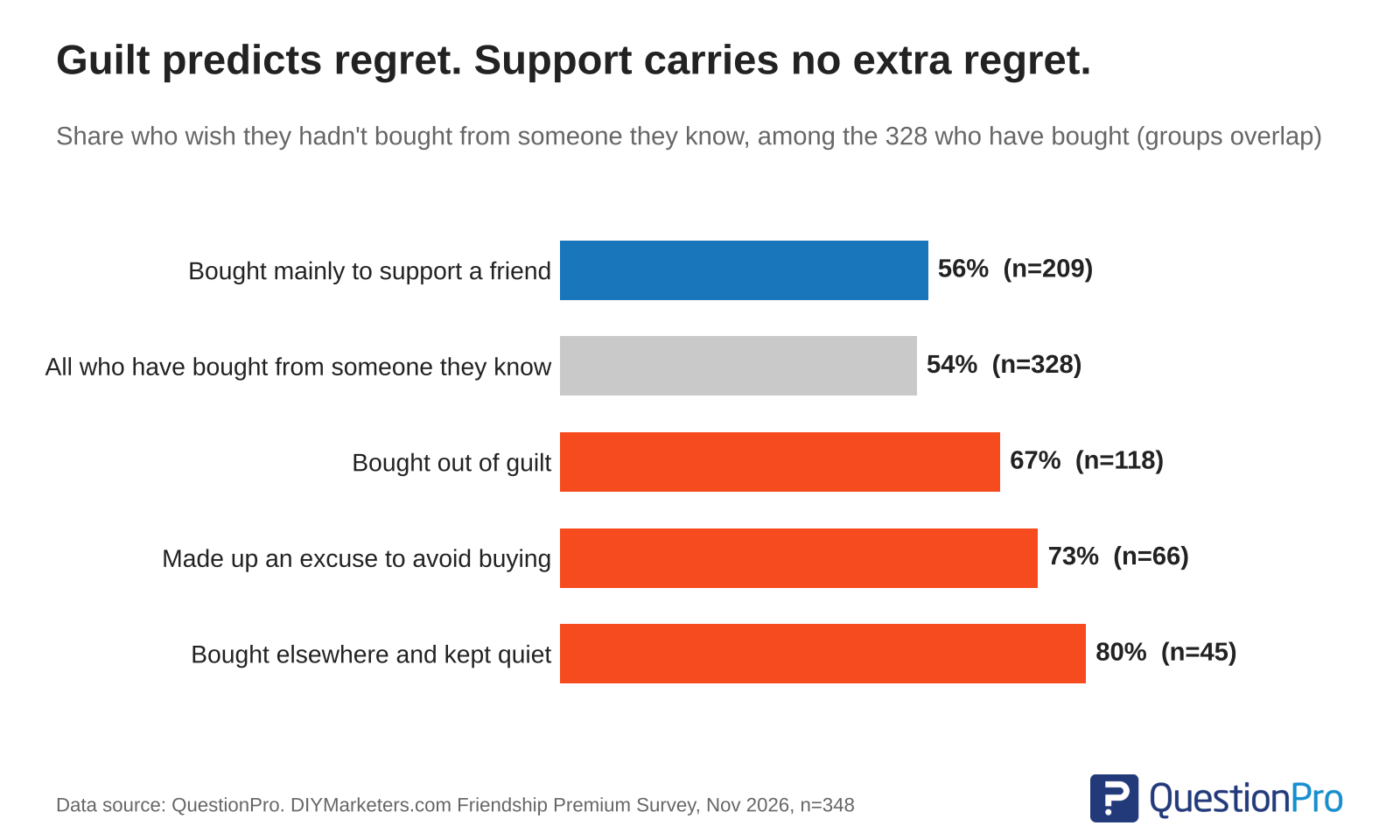
This shows a pattern in what people report. It does not prove cause. The survey asks whether the buyer felt guilty, and it does not ask who caused the feeling.
Guilt does not need your help to show up, so never add to it. When you sell to friends and family, make saying no easy. A yes means more when it was a choice.
Do men and women pay the same friendship premium?
When you sell to friends and family, women say yes about as often as men, and men pay more when they do. 79% of women and 70% of men paid extra, a gap too small to trust once we corrected for running many comparisons. Among the 323 people who named an amount, 40% of men paid $50 or more, against 17% of women. The gap holds in every age group and after we account for age, income, and selling experience.
paid $50 or more extra the last time.
paid $50 or more extra the last time.
The two groups also say they would pay extra for different things. 33% of women named small things like candles and cosmetics, against 16% of men. 35% of men named personal services, against 24% of women, and 12% of men named professional services, against 4% of women.
When you sell to friends and family, build a starter product for the small-things buyer and a full package for the service buyer. Offer both to everyone. I inferred the match between offer and buyer from what each group says it would pay extra for, so test it.
Finding 6
Who says yes most when you sell to friends and family?
People under 55. 83% of them paid the friendship premium, against 60% of people 55 and older. Half of the under-35s (49%) did it several times, against 22% of the 55-and-older group.
Fellow business owners say yes too. 47 of the 51 owners in the survey (92%) paid the premium, against 61% of people who never sold to friends.
When you sell to friends and family aged 55 or older, pair the friendship with proof: a testimonial, a clear guarantee, a named result. 15% of people 55 and older said they would pay extra for nothing, against 4% of people under 35.
Where does the friendship premium stop?
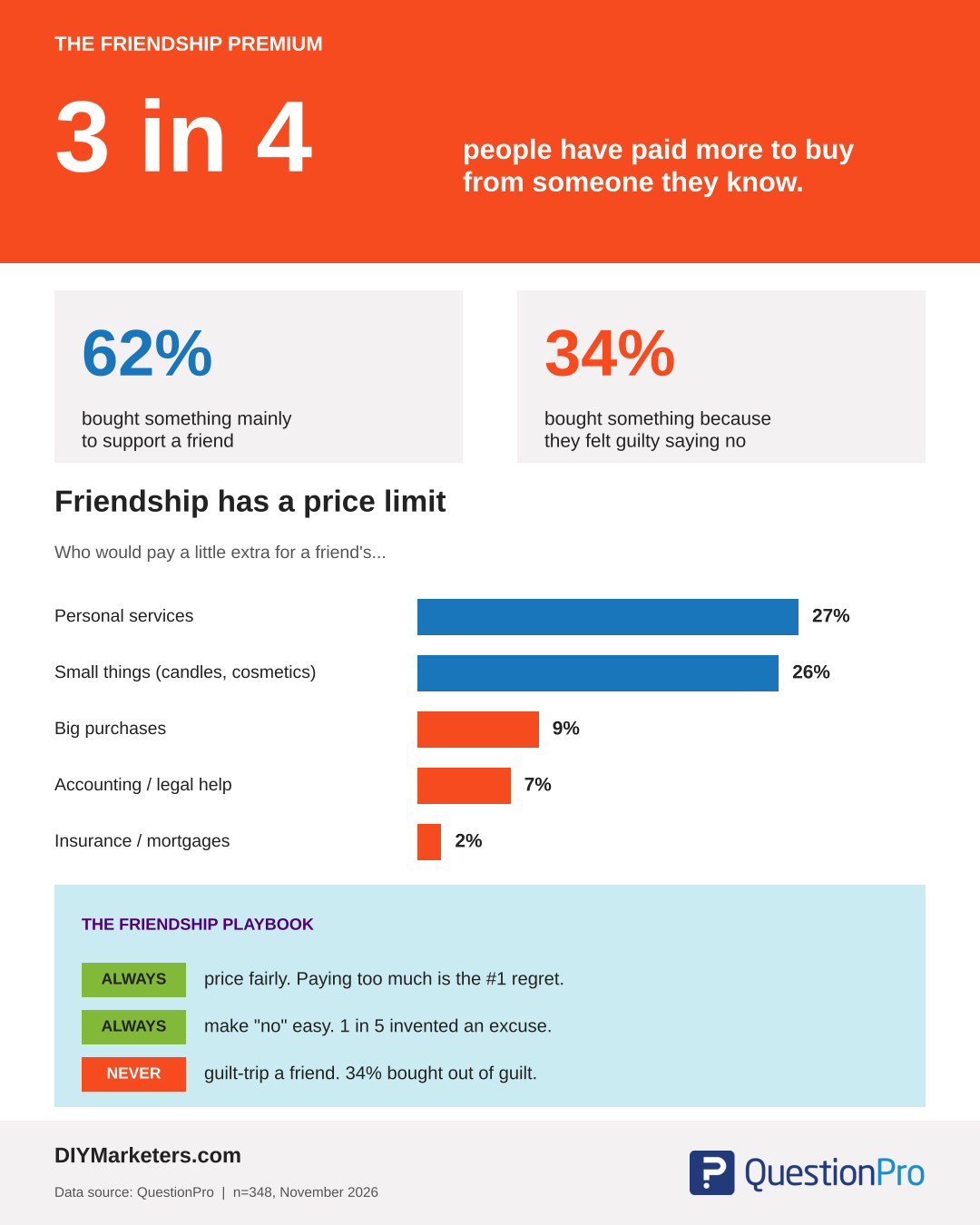
At the big purchases. Small things and personal services lead the list. Only 2% would pay extra for a friend’s insurance or mortgage, and 18% would pay extra for big purchases, professional services, or financial products combined. You sell to friends and family easily on candles and haircuts, and you need more proof on big purchases.
What would you pay a little extra for if someone you know was selling it?
Source: DIYMarketers and QuestionPro survey, n=400, November 2026
If you sell something big, like coaching or accounting, put three testimonials, one credential, and a clear guarantee next to the offer. Not sure how to package your proof? A Fix-It Session shows you in 24 hours.
What are the ALWAYS and NEVER rules when you sell to friends and family?
The survey shows what friends do. These rules are my take on what to do about it.
Ask your network
From the data. 74% have paid the premium, and only 8% skipped a purchase to protect a relationship.
Try this: Message ten people this week with one clear offer and one link.
Price within $50 of the market
From the data. 72% of premiums came in under $50, and 77% of households under $50K paid less than $50 extra.
Try this: Compare your price with two competitors and explain any gap in one sentence.
Match the offer to the buyer
From the data. Women lean toward small things (33% against 16% of men). Men pay bigger premiums (40% against 17% paid $50 or more).
Try this: Offer a starter product and a full package to everyone, and watch which one each person picks.
Make “no” easy
From the data. 35% bought out of guilt, and those buyers regret it 68% of the time, against 49% of other buyers.
Try this: Add one line to your pitch: “No pressure. If it isn’t a fit, I’d rather hear it from you.”
Lean on friendship alone
From the data. Only 18% would pay extra for big purchases, professional services, or financial products, and 60% of people 55 and older paid extra at all.
Try this: Put three testimonials, one credential, and a clear guarantee next to every high-ticket offer.
Mistake a guilty yes for loyalty
From the data. 35% bought out of guilt, and 20% stayed quiet about a problem with a purchase because they knew the seller.
Try this: Two weeks after every friend sale, ask one question: “What would you change?”
How do you sell to friends and family without losing the friendship?
Run this five-step plan over the next two weeks to sell to friends and family. Steps 3 and 5 come from me, not the survey. The other three follow the numbers above.
- Post the story. Share why you built the offer and who it helps. One post, one link. Let friends choose to support you.
- Set two price points. Offer a starter option under $50 and a full package. Friends pick their own level.
- Invite 10 friends to a founding round. Do it two weeks before the public launch. Fix what they flag, then ask for a testimonial.
- Add a no-pressure line. Put it on your offer page: “No pressure. If it isn’t a fit, tell me and I’ll point you to someone who is.”
- Ask the two-week question. “What would you change?” Fix the issue, then ask permission to share the praise. Proof is what bigger offers need.
Read my guides on how to ask for referrals and how to get referrals, and see networking groups like BNI for places to meet buyers. For pricing, start with my price increase strategy for small business.
Frequently asked questions about selling to friends and family
Is it OK to sell to friends and family?
Yes. 74% of 400 Americans have paid extra to buy from someone they know, and only 8% have skipped a purchase to protect a relationship. Price fairly and make “no” easy.
Will friends and family still pay more when money is tight?
Yes. 72% of households under $50K have paid more to buy from someone they know, against 71% of households earning $100K or more. Lower-income buyers keep the extra smaller, with 77% paying under $50.
Do men and women pay different amounts?
Yes. 40% of men paid $50 or more extra, against 17% of women. Women say yes about as often (79% against 70%), so when you sell to friends and family, ask everyone and shape the offer.
Will friends regret buying from me?
53% wish they had skipped at least one friend purchase, mostly because of price (21%) or an unhappy result (15%). Only 17% trace regret to awkwardness or pressure (8.5% each).
The bottom line: relationships win the close calls
Friendship carries more sales than most of us expect. When you sell to friends and family, 74% of buyers will pay a little extra, 62% do it mainly to support you, and a tight budget does not change it.
The survey also shows the limits. The friendship premium stays small, fades on big purchases, and turns to regret when the buyer feels obligated or the price or product disappoints. Treat those limits as your to-do list. Go to the events. Send the check-in texts. Share what you are building. When you sell to friends and family, deliver so well your friends tell their friends.
Want help turning your network into customers?
If you sell to friends and family, a Fix-It Session is a $150, 24-hour video audit of your marketing. I show you what to fix first.
Methodology
DIYMarketers.com fielded this survey using QuestionPro on November 4, 2026. 400 adults completed it, with a median completion time of about 90 seconds. We surveyed the general population. At 95% confidence, the margin of error for the full sample is about ±4.9 points, and wider for subgroups.
The fine print, because I like honest marketing: responses are unweighted. The sample skews South (35%) and lower income (44% under $50K household income), and includes few 18-to-24-year-olds (n=37), so I group ages as 18-34, 35-54, and 55+ and income as under $50K, $50K to $99K, and $100K and up. When we reweighted by age and gender, headline figures moved by less than 1 point. When I removed the 13 respondents who finished in under 30 seconds, they moved by less than 2 points. We compared 114 segment-by-outcome pairs and corrected for multiple tests. The 4 respondents who chose “nonbinary” or “prefer not to say” for gender appear only in totals. Age-by-gender groups hold 39 to 85 people each, so read those as direction. The income finding is a lack of difference (p=.35), and each income group is small. People told us what they remember and what they would pay, so treat the numbers as attitudes, not sales data.
“Paid the premium” counts people who answered “Yes, several times” or “Yes, once or twice.” Differences called out in the text passed chi-square tests at p<.01 (Fisher’s exact for small groups). Subgroups under 50 respondents are flagged.