
In This Article

Small business owner stress in 2026 is no longer a wellness topic, it’s an economic one.
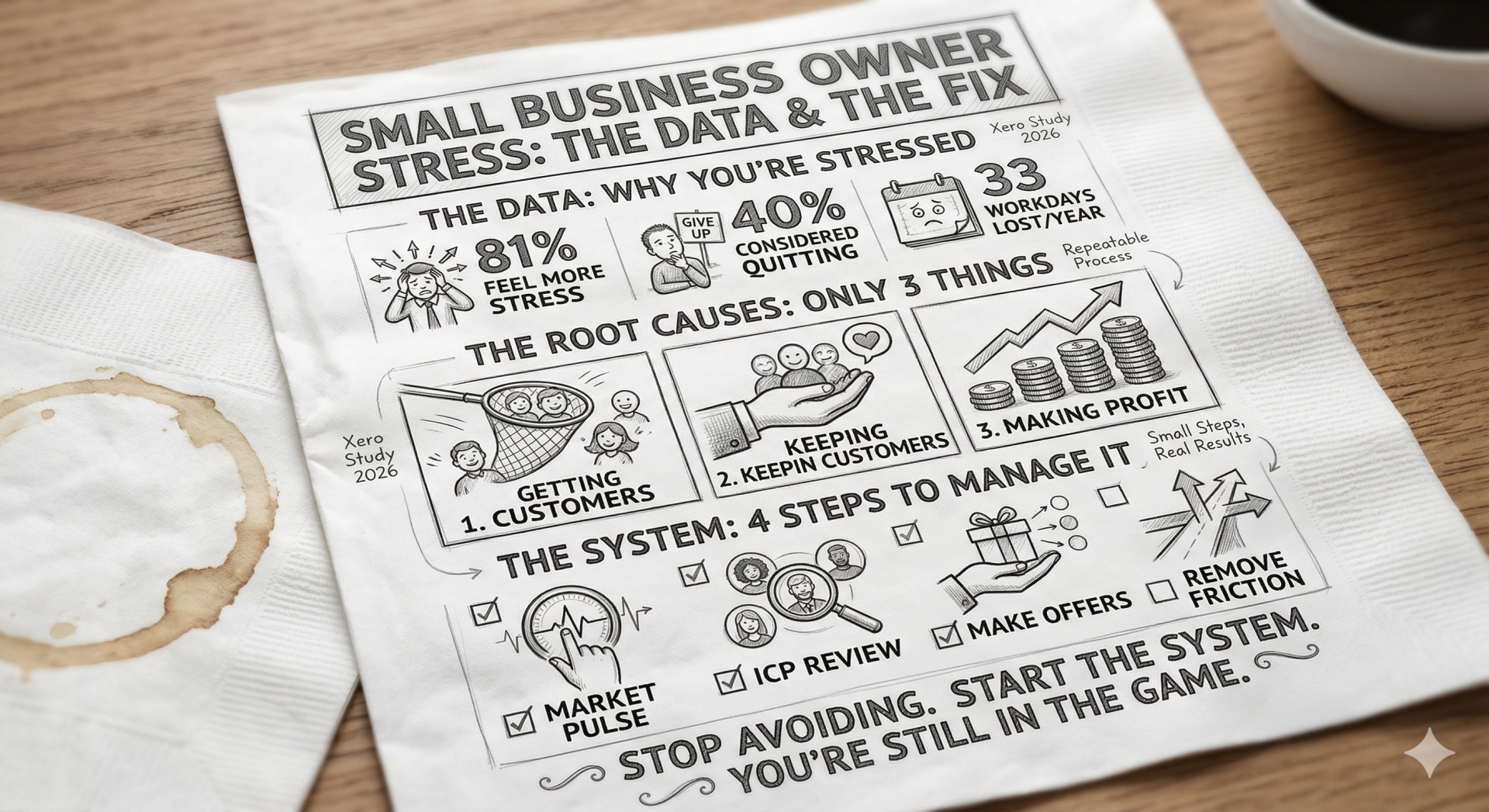
According to Xero’s 2026 Emotional Tax Return report, 81% of small business owners say work is more stressful than in prior years. Forty percent have seriously considered giving up. They lose 33 workdays a year to financial worry alone — more than a month of productive time, gone. And yet 94% say running their business is still worth it. That paradox is the most important number in this entire article.
I’ve never met a business owner who was stressed because things were going too well. Every single time I sit down with someone who’s exhausted and close to the edge, the stress traces back to exactly three things: not enough new customers coming in, not enough existing customers staying, and not enough money left at the end of the month. Everything else — the sleepless nights, the anxiety spirals, the 3am spreadsheet sessions — is a symptom of one of those three problems. The good news? All three are fixable with a system.
10 minutes a week. Every economic signal your business needs.
I read a dozen economic reports each week so you don’t have to. SIGNALS gives you the numbers that matter, what they mean for your business, and one action step you finish before lunch. Free, every week.
What small business owner stress really looks like in 2026
The Xero data reads like a confessional nobody asked for. Sixty-one percent of small business owners sleep less than they did before starting their business. Seventy-four percent say stress has actively hurt their work performance. Forty-three percent have hidden their business stress from their family. And 34% have missed real opportunities — stress caused enough paralysis to stop capable people cold.
That last number deserves a moment. Capable, experienced people froze when they should have moved. That’s what happens when the weight of uncertainty becomes bigger than any single action you can take. Call it overwhelm, call it paralysis — the result is the same. Opportunities pass. Revenue stalls. The stress compounds.
The Conference Board calls what consumers are doing right now “cheap thrills and necessary services.” People are still spending — but they’re calculating every purchase more carefully. They’re scared about six months from now even when today feels manageable. Consumer sentiment hit 53.3 in early 2026, near record lows, while inflation expectations jumped to 3.8% in a single month. Your customers are under pressure. And you’re trying to sell to them while carrying your own.
The 3 Real Reasons Behind Small Business Owner Stress
Strip away all the noise and small business owner stress comes from exactly three places: not getting enough new customers, not keeping the ones you have, and not generating enough profit from either. Everything else — inflation anxiety, competition fears, the dread of opening your bank app — is downstream of one of those three.
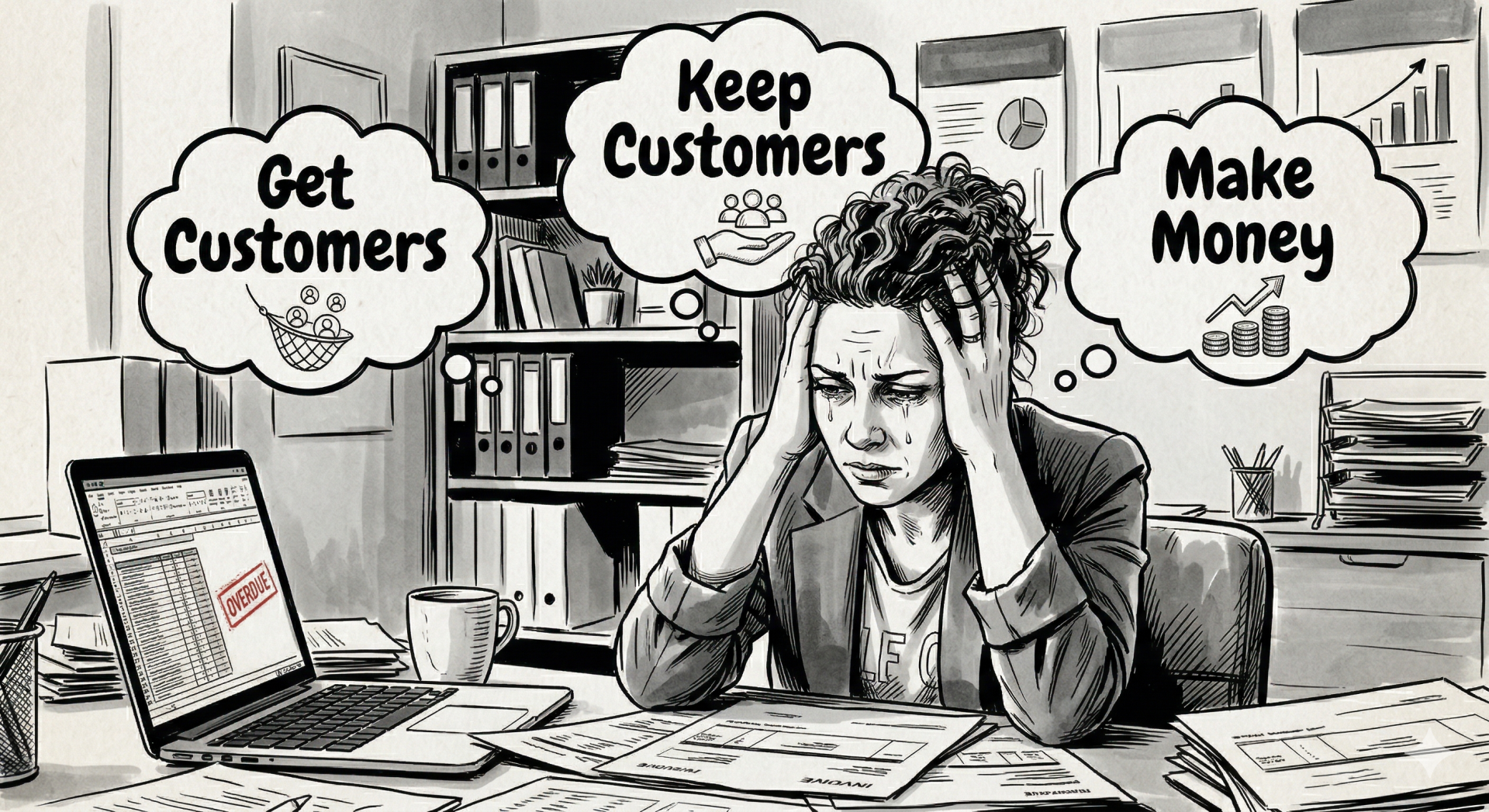
When you’re in the thick of it, stress feels like a hundred different fires. Every fire has one of three fuel sources. Identify which one is burning hottest and you have a starting point. Starting points cut through overwhelm. That’s the whole point of the framework.
Xero’s data confirms this directly: when asked what changed most heading into 2026, the most common answer from small business owners was “cash flow became the whole game.” Getting customers, keeping customers, making money. That’s always been the game. It’s just harder to ignore when the margin for error shrinks.
The hidden trap: why you’re doing admin instead of marketing
Here’s something nobody talks about, but every small business owner knows in their bones. When you don’t know what to do to get customers, keep customers, or make more money — you clean the office. You reorganize the filing system. You update the spreadsheet that nobody looks at. You answer emails that could wait a week.
Administrative tasks are seductive when the important work feels impossible. You do them, you finish them, you get the hit of completion. The inbox goes from 47 to 12. The files are labeled. You feel productive. And nothing about your revenue situation changed.
There’s a rational explanation for this. Marketing — the work of getting and keeping customers — involves people. People are unpredictable. You can write the perfect email and get silence. You can run a referral program and have no one participate. You can post consistently for six weeks and watch your reach flatline. The feedback loop is slow and uncertain. Filing a document gives you instant, guaranteed results.
Engineer the work so each step has a visible result. Break a big marketing goal — “get 10 new clients this quarter” — into weekly actions with measurable outputs. Monday: send 5 personal follow-up messages. Tuesday: ask 2 clients for a referral. Wednesday: update your Google Business profile. Each of those has a finish line. Each one gives you the completion signal your brain is looking for.
Don’t run away from the hard stuff. Lean on the process. The process is what makes the unpredictable feel manageable.
How to manage small business owner stress with a repeatable system
The businesses that handle small business owner stress best aren’t doing extraordinary things. They’re doing ordinary things consistently. They have a process — a touchstone — they return to when uncertainty spikes. That process keeps the three core metrics in view: customers in, customers retained, money flowing.
Here’s the version of that process worth building into your week.
Step 1 — Take the pulse of your market regularly
Consumer sentiment dropped to 53.3 in early 2026. Inflation expectations jumped nearly a full point in a single month. These numbers tell you something specific: your customers are calculating every purchase more carefully than they were a year ago. If you don’t know that, you’re writing offers for a customer who no longer exists in quite the same form.
Set a monthly 30-minute block to read one industry report, review your analytics, and check in with two or three customers informally. Not a survey. A conversation. “What’s changed for you lately?” is one of the most valuable questions in your marketing toolkit. The market shifts constantly. Your job is to shift with it, not chase it.
Step 2 — Revisit your ideal customer profile every quarter
The customer who hired you 18 months ago may have different priorities now. Their budget tightened. Their boss changed. Their business model evolved. The language they use to describe their problems shifted. If your messaging is still written for who they were, you’re speaking to a ghost.
A quarterly ICP review doesn’t have to be a major production. Fifteen minutes looking at your last 10 clients: who converted fastest, who referred someone, who was a pain. Look for the pattern. Adjust your messaging to match what you find. This one habit keeps your marketing anchored to reality instead of assumption.
Step 3 — Make new offers more often than feels comfortable
Most small business owners create an offer and run with it until it stops working — at which point they panic. The smarter approach is to treat your offer as something you revisit regularly, not annually. Monthly is not too often. The goal is to make it progressively easier for your customer to say yes.
Right now, that means looking at entry points. When everyone is watching their cash flow, a $1,500 engagement is a harder sell than it was two years ago. The same value at $500/month lands differently — even when the math is identical over time. The briefing framing applies here: “$17/day” feels manageable in a way “$500/month” doesn’t, even though one is just the daily equivalent of the other.
And here’s the part that costs you nothing to implement. The things customers are willing to pay for when they’re under pressure are often things that are essentially free for you to deliver: showing up on time, finishing on budget, being easy to reach, following through without being chased. Reliability is a luxury good right now. Businesses that deliver it consistently — without charging extra for it — are winning on word of mouth alone.
One more note on offers: 95% of purchase decisions happen in the subconscious mind, according to the Journal of Consumer Research. That means the features list on your sales page is working on only 5% of the actual decision. The feeling your offer creates — the relief, the sense of control, the confidence that someone capable is handling this — is doing the other 95%. If your offer leads with features and deliverables instead of outcomes and emotions, that’s worth fixing.
Step 4 — Remove every friction point between your customer and a purchase
Your customer has already decided they’re interested. Now they’re trying to buy and something is in the way. No phone number on the website. No way to book without emailing first. A checkout process that requires three steps too many. A proposal that takes two weeks to arrive. Each of these is a revenue leak disguised as an administrative detail.
Go through your customer journey from the moment someone finds you to the moment money lands in your account. Map every step. Look for the places where you’re asking your customer to do work. Then eliminate those steps one at a time. Online booking. Mobile-friendly checkout. Phone number in the header and footer of every page. A clear, simple price on the services page. The businesses that make it easiest to buy win a disproportionate share of customers who are already under pressure and have no patience for friction.
What small business owners who manage the stress well have in common
The business owners who don’t get flattened by uncertainty aren’t immune to it. They feel the same pressure. They lose the same sleep. The difference is that they have something to return to when the anxiety spikes. A process. A checklist. A weekly rhythm that keeps the three core numbers in view.
They know their cash flow number. Knowing is less exhausting than not knowing. The Xero research shows that most of the stress comes from avoiding the number, not from what you actually find when you look.
They adjust their offers when the market shifts, instead of waiting until revenue drops to crisis levels. They check in with existing customers regularly, not just when it’s time to renew. They make it easy to buy, because they know their customer is already tired.
None of these things are complicated. All of them require consistency. And consistency is far easier to maintain when you have a process than when you’re making it up week to week.
Frequently asked questions about small business owner stress
Is it normal for a small business owner to think about quitting?
Yes — and more common than most people admit publicly. Xero’s 2026 survey found that 40% of small business owners have seriously considered giving up. At the same time, 94% of those same owners say running their business is still worth it. The two feelings aren’t contradictory. They reflect the reality of building something meaningful under constant pressure. The owners who push through are typically the ones with a system, not necessarily more resilience.
How do small business owners deal with financial stress?
The most effective approach is replacing avoidance with visibility. Most financial stress among small business owners comes from not looking at the numbers, not from what the numbers actually show. A weekly 30-minute cash flow review — knowing your current balance, your receivables, and your next 30 days of obligations — reduces anxiety more reliably than any mindset practice. Pair that with a system for consistently filling your pipeline and you address the root cause, not just the symptom.
Why do small business owners avoid marketing when stressed?
Marketing involves people, and people are unpredictable. Administrative tasks offer immediate, guaranteed results — you complete them, they’re done. Marketing efforts often have slow, uncertain feedback loops, which makes them psychologically harder to start when you’re already under pressure. The fix is breaking marketing into smaller tasks with visible outputs at each step. Sending five follow-up messages has a clear finish line. “Grow my customer base” does not.
What is the most important thing a small business owner can do when revenue drops?
Revisit your offer before you cut your price. When revenue drops, the instinct is to discount — but the problem is often packaging, not pricing. Ask whether your offer is easy for a cautious buyer to say yes to. Consider smaller entry points, shorter commitments, or unbundled versions of your core service. Then look at your existing customers: re-engagement and referrals from people who already trust you will always convert faster and cheaper than cold outreach to new prospects.
What causes the most small business owner stress?
The three primary causes of small business owner stress are insufficient new customer acquisition, poor customer retention, and inconsistent cash flow. According to Xero’s 2026 Emotional Tax Return report, 81% of small business owners say work is more stressful than prior years, with financial worry accounting for 33 lost workdays per year. When these three core business functions are working, stress levels drop significantly regardless of broader economic conditions.