
In This Article

- Google deletes about 2% of new reviews within seven days, and most positive deletions land on day 6 or 7.
- The firm behind the data tells owners to ask customers to name staff. Its own product pages say Google flags those reviews more often.
- You will know what to check on day 8, which questions to ask any vendor study, and where Google’s rule draws the line.
Why are my Google reviews disappearing? Google removes reviews through policy filters, deleted reviewer accounts, temporary anti-abuse pauses, and the occasional bug. A study of 4.9 million reviews found Google deleted 1.95% of new ones within seven days, and most of those deletions follow a schedule: negative reviews go on days 2 and 3, positive ones on days 6 and 7.
I had no idea Google reviews disappear. I assumed a review stayed up until the reviewer or the business took it down. Then I read Google’s own Business Profile community, and the thread titles stopped me: “20 reviews disappeared suddenly.” “130+ Reviews Missing!!” “All of our reviews have disappeared.” One owner reports all 1,200+ reviews vanished after a temporary restriction.
This happens often enough to make news. In late June and early July 2026, Search Engine Roundtable documented a flood of complaints, including one profile reportedly dropping from about 4,651 reviews to 63 in roughly a day. Google said suspicious activity triggers removal and a temporary pause on new reviews. It said it was investigating and would restore reviews removed by mistake, and the issue was later reported resolved.
In February 2025, many owners saw their review counts drop while the reviews stayed visible. Google called it a known issue. By October 2026, owners filing appeals reportedly waited longer than usual because of high volume. Disappearing reviews are a recurring problem for small business owners.
Owner stories show the problem. A tracking study shows the pattern. So when Reviewflowz and Cartelis published a daily-tracking study of 9,048 Google profiles, I read it twice before writing a word, because the firm behind it sells review software. Then I opened its product pages and found advice at odds with its own research. The contradiction teaches more than the statistics do.
How many Google reviews disappear in a typical week?
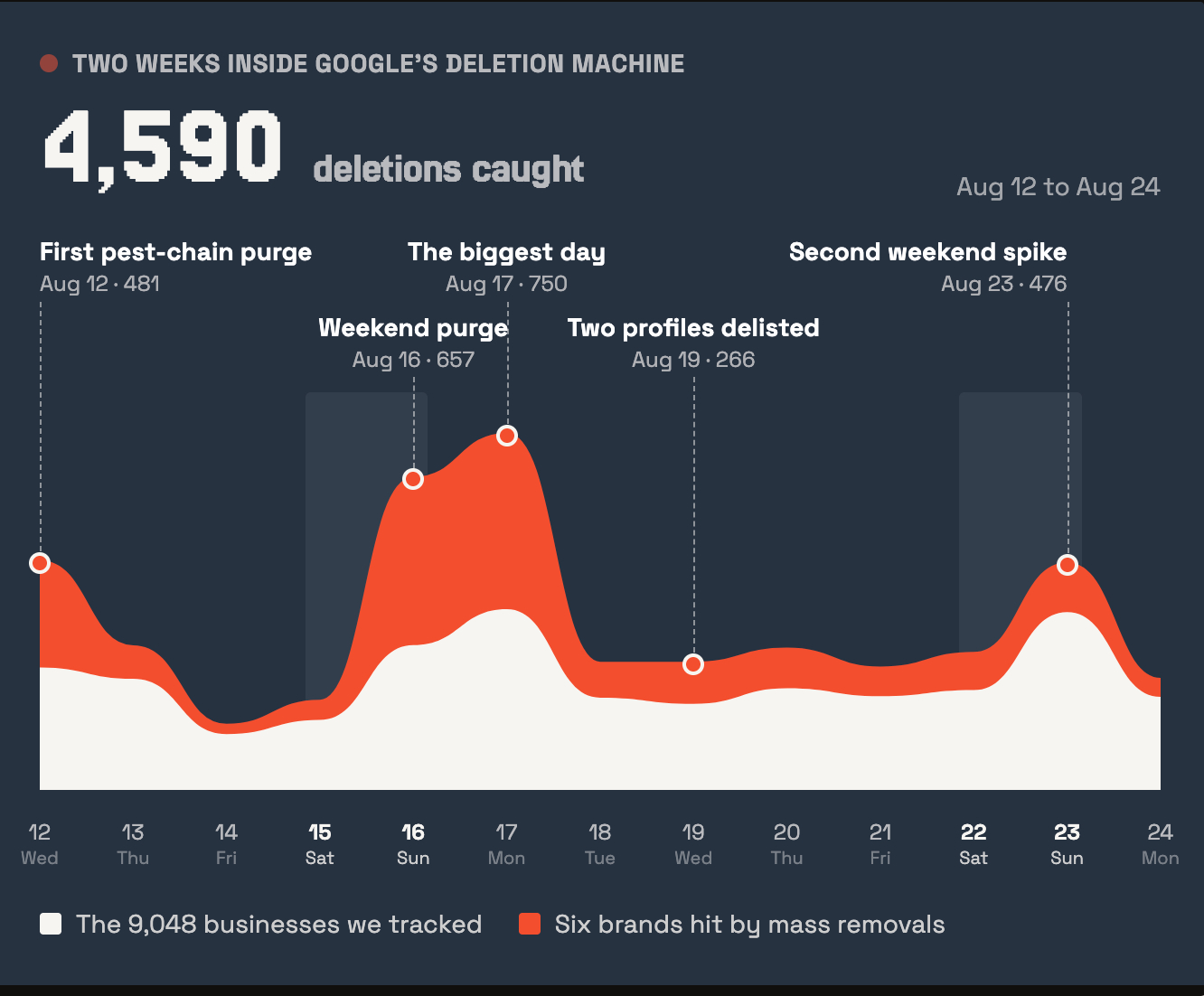
Reviewflowz and Cartelis crawled 9,048 Google Maps profiles in 41 countries every day from August 11 to 24, 2026. They caught 4,590 deletions among 4.9 million reviews. Their headline figure: 1.95% of new reviews were gone within seven days.
The damage to ratings stayed small. For businesses losing five or more reviews, the average rating moved 0.01 star. Deletions also cluster. 13% of businesses lost at least one review, and 1% of businesses account for half of all deletions.
Where you operate matters. In the first week, Google deleted 4.1% of new positive reviews for US home-services businesses and 3.4% for US healthcare, against 0.4% for US hotels.
Is my Google review deleted, delayed or a display bug?
“Disappeared” covers six different situations. Owners fix nothing until they know which one they face, and the study measures only one of them: reviews which went live and then vanished. Google’s own guidance on missing and delayed reviews says Google checks reviews for compliance, delays them for several days, and does not restore reviews removed for policy violations.
| If You See This… | It Means… | Your Next Move |
|---|---|---|
| A new review never appears | Google is still checking it, or filtered it before publishing. | Wait several days. Publication is not guaranteed. |
| A review you saw earlier vanishes | A policy filter, a deleted reviewer account, or the reviewer removed it. | Save the reviewer name and date. Policy removals stay removed. |
| The count drops while the reviews still show | A display or counting bug, like the one in February 2025. | Recheck the count after a few days. |
| Hundreds or thousands vanish at once | A technical problem or a profile-level anti-abuse restriction, especially if new reviews stop too. | Contact Business Profile support right away. Google said it would restore wrongful removals in the 2026 incident. |
| Reviews vanish after a suspension or reinstatement | Google acknowledges this scenario. | Contact support and file a missing-reviews request. |
| Reviews lag after you merge profiles | Google says merged-profile reviews take several days to display. | Wait several days before you file anything. |
Why are my Google reviews disappearing on days 6 and 7?
Google does not screen a new review the moment someone posts it. The study found a pattern in the first seven days. Negative reviews face a first pass on days 2 and 3, and positive reviews face theirs on days 6 and 7, whatever day of the week they were posted.
One-star reviews go most often. 5.7% of new one-star reviews were gone within a week, against about 1% for three- and four-star reviews. One- and two-star reviews make up 9% of all reviews and 20% of deletions.
| If You See This… | It Means… | Your Next Move |
|---|---|---|
| A negative review vanishes on day 2 or 3 | Google screens negative reviews first. 4.7% of new negative reviews are gone by day 7. | Wait until day 8 before you contact anyone. |
| A positive review vanishes on day 6 or 7 | This is the peak window. 1.7% of new positive reviews are gone by day 7. | Count your campaign results on day 8. |
| Several reviews from one busy day disappear | A day with at least 3 positive reviews and 4x your usual volume carries 1.8x the deletion risk. | Spread review requests across weeks. |
| A first-time reviewer’s review disappears | First reviews are deleted 5.6x more often than reviews from top Local Guides. | Ask customers who already review places on Google Maps. |
| Your 4.9 profile keeps losing reviews | Profiles with 85% or more five-star reviews lose 2.2x more, at equal sector, size and volume. | Reply to reviews and welcome honest mixed ratings. |
Does replying to a review stop Google from deleting it?
The study found an association. Among new five-star reviews, 1.5% were deleted between day 3 and day 7 when the owner replied within two days, against 2.4% with no reply. Same-day, next-day and day-two replies performed alike. One-star reviews showed no measurable change.
The researchers call this an association, and I agree. Google does not show which reviews it flagged, so nobody knows whether a reply protects a review. A second explanation fits the numbers equally well: owners reply to reviews from customers they recognize, and the reviews nobody recognizes go unanswered.
Should you ask customers to name staff in their Google review?
Google’s Maps policy says merchants should not request specific content in a review. Its examples include staff soliciting a set number of reviews and requests for “specific content, including content that identifies a staff member.” Search Engine Roundtable and PPC Land both date the change to April 2026.
The study reports no penalty. Inside the same business, a review naming a person was deleted at 1.01x the rate of one without a name, across 2.7 million positive reviews. Businesses whose reviews name staff also gained 2.7x more reviews per year than similar businesses. The report tells owners to ask customers to name who served them.
Now check the vendor’s own pages. On its retail page and its STORIS integration page, Reviewflowz tells owners Google flags name-mentioning reviews more often, and it sells a tool to credit staff without customers naming anyone. I read both on October 22, 2026.
Two statements from one company point in opposite directions. Either the pages predate the study, or the study’s finding does not match what the company believes. Ask them which.
What explains a policy ban with no measurable deletions?
I found five explanations worth testing. None is confirmed, so treat each one as a hypothesis.
- The rule covers what merchants request, and the study measures what reviews contain. The report found names in 38% of US positive reviews, so customers volunteer most of them. The data does not separate a scripted “ask for Mike” from a customer who offered a name unprompted.
- Enforcement might lag the policy. The rule arrived in April and the crawl ran for two weeks in August. The study recorded mass purges, including 1,199 reviews removed from four US pest-control chains, so Google enforces in waves and two weeks might miss the next one.
- Google might look for patterns, and one name is not a pattern. Several agency articles claim a name repeated across many reviews on one profile reads as coordination. I found no confirmation from Google.
- The crawl sees only reviews which went live. A review held back at submission never shows up in the data, and the report says it is unable to observe those. If name-heavy reviews get held back more often, the study misses it.
- “No evidence of a difference” is weaker than “no difference.” At equal industry, region, size and review pace, name-heavy businesses lost reviews at 1.26x the rate of others, with a margin of error from 0.79x to 2.01x. The range includes no effect and also double.
What questions should you ask about any vendor study?
Run these six questions on any statistic a software company hands you. I call this the Contradiction Compass in my guide to reading surveys like a marketing pro.
- Who ran it, and what do they sell? Here, a review-management vendor.
- What did they measure, and what is invisible to them? Deletions of live reviews. Held-back reviews and the reasons for deletion stay hidden.
- How big, how long, and when? 9,048 profiles, two weeks, August, no UK.
- Association or cause? The report calls its own findings associations.
- Does the vendor’s own site agree? In this case, it does not.
- Who profits if you believe it? Anyone selling monitoring, reply automation or staff attribution gains when owners worry.
What should you do about disappearing Google reviews this week?
- Count on day 8. Record what stayed live, and measure each campaign against this number.
- Spread your asks. Request reviews from a few customers each week. The study found a busy month safe and a single burst day risky.
- Reply to positive reviews within two days. Do it for the customers who read your profile.
- Ask customers who already review on Google. My step-by-step on how to get more Google reviews covers the ask, the link and the timing.
- Request an honest review with no script. Skip the staff-name request and any other requested content.
- Keep proof you own. Treat Google reviews as rented media. Save review notification emails and reviewer names, check your public count every week, and collect feedback through your CRM, survey tool or testimonial permissions. Reviews live on Google’s platform. A success story on your own site stays on your site, and my guide to getting positive reviews and testimonials shows how to collect one.
- Document a vanished review before you panic. Check Search and Maps while signed out, note the old and new count, screenshot the change, list the affected reviewers, and file a “Missing reviews” request through Business Profile support.
- Hold off on asking many customers to repost. A sudden burst looks abnormal while your case is open.
Why are my Google reviews disappearing? Most of the answer sits in the first seven days. Plan around day 8, reply fast, spread your asks, and question every vendor statistic before you rebuild your process around it.
Frequently asked questions about disappearing Google reviews
Why is my Google review not showing?
Google checks reviews for compliance and delays some for several days. It filters others before publication, and a merged profile also delays reviews. The study measured only reviews which went live and then vanished, so it says nothing about a review never published. Google’s page on removed and rejected content explains its side.
When is a new Google review safe from deletion?
After day 8, the daily deletion risk drops to about 0.1%, a tenth of the day-7 peak. No review is permanently safe. The study found existing reviews lose about 1.4% a year.
Does replying to a Google review keep it from disappearing?
A reply within two days went with half the deletion risk for new five-star reviews: 1.5% against 2.4%. The researchers call it an association, and it showed no measurable effect on one-star reviews.
Why are my 5 star Google reviews disappearing?
Google deleted 1.8% of new five-star reviews within a week, and the researchers call the gap with four-star reviews too small to be sure of. Four factors raised the risk: profiles with 85% or more five-star reviews lose 2.2x more, a burst of reviews on one day carries 1.8x the risk, first-time reviewers carry 5.6x, and US home services and healthcare see the highest rates.
Is it against Google’s rules to ask customers to name a staff member?
Yes, when the merchant makes the request. Google’s policy bars merchants from requesting reviews with specific content, including content naming a staff member. The rule targets the request. A customer who names someone unprompted is a different situation, and the policy text I read does not address it directly.
Additional reading
- Testimonials vs reviews: what is the difference?
- Zero testimonials? Build social proof from scratch
- How to ask for referrals without feeling awkward
Research credit: Reviewflowz and Cartelis (2026), Gone in 7 Days: the Google review deletion study. Google policy text read on October 22, 2026.