
In This Article

- Why marketing feels overwhelming has nothing to do with your work ethic or intelligence — it’s because 99% of marketing advice skips the first step entirely and drops you into tactics before you know who you’re talking to.
- Every tactic you’ve tried — social media, email, content, ads — rests on assumptions about your customer. Without research, you’re testing those assumptions with real time and real money.
- After reading this, you’ll know the exact reason you’ve been spinning your wheels, a five-step marketing process that grounds every decision, and a one-day reset you can start tomorrow morning.
Why marketing feels overwhelming is a question every small business owner eventually asks — usually after spending hours on advice that didn’t work. The answer is this: you’re being dropped into tactics before you have the one thing that makes tactics make sense. That one thing is customer understanding. Without it, every marketing decision becomes a guess, every tool becomes another obligation, and every expert who says “this worked for me” sounds like a personal accusation.
I hear some version of this almost every week. A business owner — smart, motivated, genuinely trying — comes to me buried in marketing overwhelm. They’ve tried posting on Instagram. They took the email course. They updated their website. Nothing moved. And when I ask what they know about their customers’ biggest frustration, they go quiet. Not because they’re bad at business. Because nobody told them that’s where marketing starts.
Overwhelm and confusion are absolutely normal. They’ll happen, and they’ll happen often. But the way to ground yourself is to return to the marketing process — and that process begins not with choosing a channel, but with understanding the person on the other side of whatever you’re selling.
Why marketing feels overwhelming even when you follow every piece of advice
Here’s something that rarely gets said out loud: most marketing advice is written for an audience that already has customer clarity. The expert who grew their business with LinkedIn is implicitly telling you what worked for their specific customer, with their specific offer, at their specific moment in time. When you copy the tactic without the context, you get a different result.
This is not a failure on your part. It’s a filtering problem. You have tactics — more than you need. What you’re missing is a decision rule that tells you which tactics apply to your situation.
That decision rule is market research. Not the big-budget agency version. The simple, free-to-low-cost process of learning enough about your customer to make better decisions faster.
Philip Kotler, whose Principles of Marketing is the standard text in most university business programs, put it plainly:
“Marketing is managing profitable customer relationships.”
— Philip Kotler & Gary Armstrong, Principles of Marketing
Read that again. Managing a profitable customer relationship is impossible when you don’t know who you’re in a relationship with. The entire marketing process — strategy, channels, messaging, offers — flows from customer understanding. When you skip that step, every tactic that follows is guesswork with a branded color palette.
If you’ve been wondering why your marketing keeps failing even when you follow expert advice to the letter, this is why.
What the marketing process looks like (before tactics enter the picture)
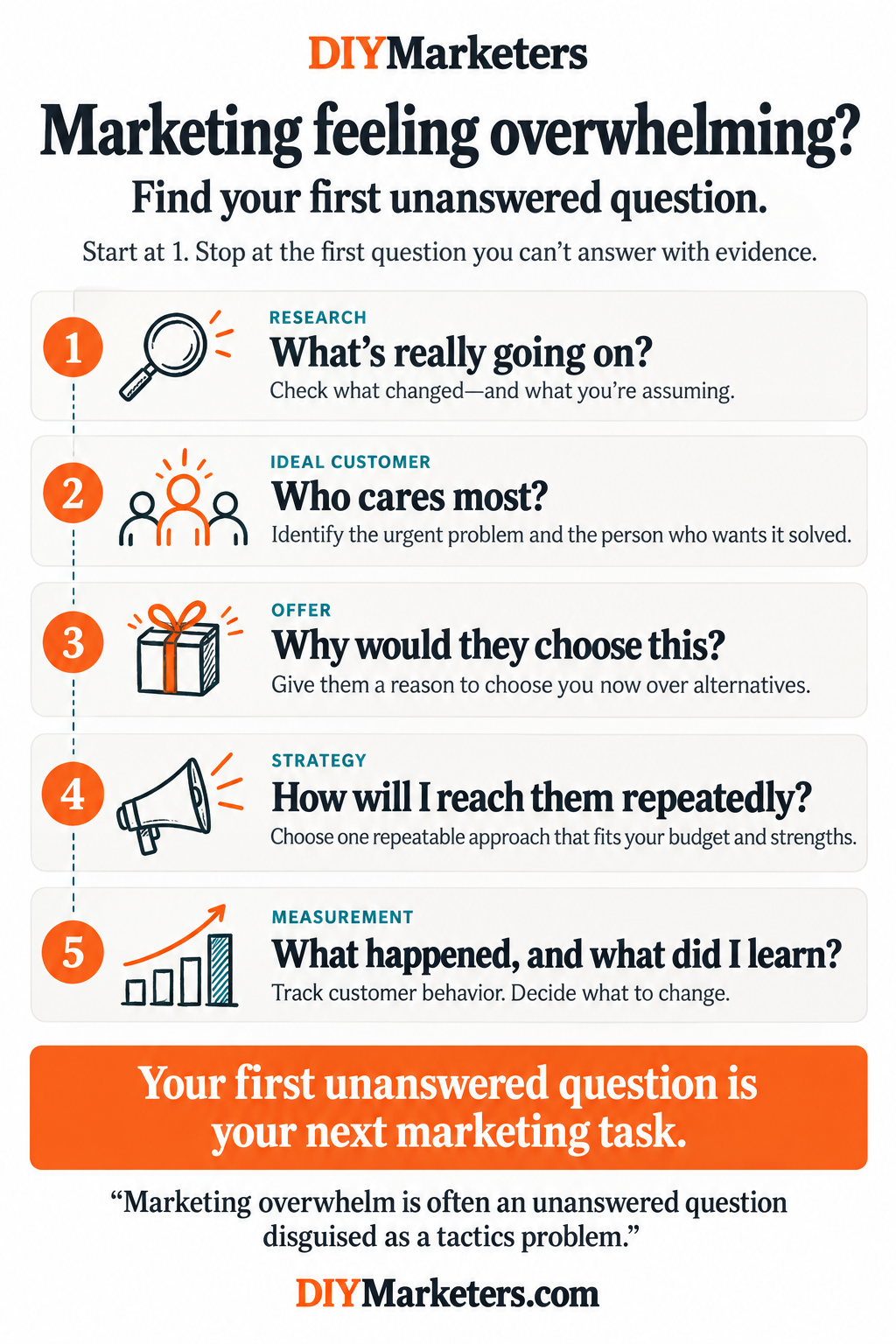
The reason why marketing feels overwhelming for most small business owners is that we’re handed step four before we’ve done steps one through three. Here’s the simple marketing process that makes every decision downstream easier:
- Research the market and customer — Who are they, what do they want, what’s getting in the way?
- Choose your customer and their problem — Narrow before you go broad. One customer, one problem, one promise.
- Develop and test the offer — Build something that matches what you learned in step one.
- Select the marketing strategy and tactics — Now, and only now, choose your channels and content.
- Measure behavior and improve — Track what changes, not only what you posted.
Most of the advice you’re drowning in lives in step four. Experts who’ve already done steps one through three don’t realize they’re showing you the output of a process, not the process itself.
The difference between data, information, and a customer insight
A 2024 study published in the Journal of the Academy of Marketing Science reviewed 284 articles, interviewed 12 senior research executives, and surveyed 305 U.S. managers. Their definition of a customer insight is “a reasoned understanding of customers’ attitudes and behaviors that firms can innovate upon.”
Here’s what that means in practice:
| Level | Example | What it tells you |
|---|---|---|
| Data | 8 of 12 clients abandoned their email automation setup | A recorded fact |
| Information | Most abandonment happened during tagging and workflow design | An organized pattern |
| Insight | They weren’t rejecting automation — they were avoiding setup decisions they didn’t feel qualified to make | An explanation that tells you what to build |
That insight leads to a completely different offer: not another email marketing course, but a guided “Build Your First Workflow” session that holds their hand through the part that’s stopping them. You can’t get there from data alone. You need to interpret it. That’s what market research basics teach you to do.
Why research is different for B2B and B2C businesses
One of the fastest ways to waste a research effort is to apply consumer-focused thinking to a B2B sale, or vice versa. The surface looks similar — you’re still trying to understand a human being with a problem. But the decision-making process is entirely different.
In a consumer purchase, the buyer, the user, the payer, and the decision-maker are often the same person. In a B2B sale, you’re typically selling to a buying network: users, influencers, technical evaluators, budget owners, procurement staff, and sometimes an executive who signs without ever seeing a demo.
Forrester’s 2025 Buyers’ Journey Survey found that 73% of B2B purchases involved at least three departments, with an average of 13 people inside the buying organization influencing the decision. Gartner’s research on B2B buying found that 61% of B2B buyers preferred a rep-free experience for general information — but they still valued seller input when figuring out whether a solution fit their specific situation.
The key principle for B2B research is this:
“Do not research only the person who signed the contract. Research how the organization achieved enough confidence and internal agreement to sign it.”
| Dimension | B2C emphasis | B2B emphasis |
|---|---|---|
| Customer unit | Individual or household | Account, users, buying group, and gatekeepers |
| What triggers buying | Life event, desire, inconvenience, or immediate need | Missed target, cost pressure, regulation, system failure, or leadership mandate |
| Risk felt by buyer | Wasted money, disappointment, or social embarrassment | Career risk, implementation disruption, security concerns, or vendor viability |
| Evidence they need | Reviews, trial, demonstration, social proof, return policy | Business case, references, ROI model, implementation plan, security documentation |
Before you choose Instagram or LinkedIn or email or anything else, you need to know which column describes your customer. Getting this wrong costs months, not days.
Where you can get real customer information for free
You don’t need a research budget. You need a framework and a few consistent habits. Here’s where to start, depending on whether your business sells to consumers or other businesses.
For B2C businesses: Read the one-star and two-star reviews of your competitors on Amazon, Yelp, Google, and App Stores. This is where customers tell the truth — not in focus groups, but in reviews they leave when they’re frustrated. Copy the exact phrases they use. You’ll find out what your target market wants faster here than anywhere else.
For B2B businesses: Read reviews on G2, Capterra, and Trustpilot for your competitors’ tools or services. Look at LinkedIn comments on posts about the problem you solve. Search Reddit threads in your industry subreddit for the exact words people use when they’re struggling. These conversations are a goldmine for messaging that sounds like the reader wrote it themselves.
For both: Ask three customers one question this week — not “did you like working with me?” but “what was going through your mind right before you decided to work with me?” The answer to that question is your positioning statement.
If you want a structured approach, the market research process doesn’t have to be complicated — it has to be consistent.
“Research is not a report. It is the cheapest way to replace a costly assumption with a better decision.”
— Ivana Taylor, DIYMarketers.com
The causal chain: what research improves at every step
Every time you skip research, you’re making an implicit assumption about your customer. Those assumptions compound. Here’s what research makes better — and what breaks down without it:
| Research reveals | Decision improved | Risk without it |
|---|---|---|
| A recurring, consequential problem | Market opportunity | Solving an interesting but low-priority problem |
| Who experiences the problem most intensely | Ideal customer targeting | Generic messaging that resonates with nobody |
| Trigger, desired outcome, and current workaround | Positioning and promise | Describing features instead of outcomes |
| What they’re already using instead | Differentiation | Comparing only against direct competitors |
| Their language and vocabulary | Copy, SEO, and sales conversations | Using your industry jargon, not their words |
| Their objections and perceived risk | Proof and guarantee design | Sending traffic to an offer people don’t trust |
Notice that “choose your social media channel” doesn’t appear on that list. Channel selection is step four — and it only makes sense once you know your customer well enough to know where they spend time looking for solutions like yours.
If you’re wondering why marketing overwhelm hits so hard, it’s because you’re making all six of those decisions simultaneously, with no data, under time pressure. Research doesn’t eliminate uncertainty. It reduces the number of things you’re guessing about at once.
Your one-day marketing reset
You don’t need a week to get grounded. One focused day — even half a day — produces a better hypothesis and a smaller, safer next decision. Here’s how to structure it:
- Morning (1–2 hours): Read 20 low-star competitor reviews across Google, Amazon, Yelp, G2, or Capterra. Write down the exact phrases customers use when they describe their frustration. Don’t paraphrase — copy verbatim. These words are your future headlines.
- Mid-morning (1 hour): Check Google Trends for your main topic, look at Google Search Console if you have it set up, and spend 30 minutes on Reddit in your niche. You’re looking for questions people ask before they buy something like what you sell.
- Afternoon (2–3 hours): Call or message three customers — past, current, or lost. Ask them one thing: “What was going on in your life or business right before you decided to look for something like this?” Listen for the trigger, not the feature list.
- Late afternoon (1 hour): Write one problem statement and one narrow customer description. Not a paragraph — two sentences. “My customer is [specific person] who is experiencing [specific problem] because [specific reason] and they’ve already tried [specific alternative] without success.”
One day won’t give you certainty. It will give you something far more useful: a better question to ask next. And a much shorter list of tactics worth trying — because you’ll know which ones your specific customer responds to. You can explore more $0 research methods that reveal what customers really want when you’re ready to go deeper.
How to stop the overwhelm from coming back
Overwhelm returns every time you encounter new advice without a filter. The filter is your customer research. When someone tells you to post daily on LinkedIn, your filter asks: “Is my customer on LinkedIn, and do they use it to find solutions like mine?” If yes, test it. If no, ignore it entirely — without guilt.
This is how you go from collecting tactics to choosing tactics. The difference is enormous. A collected tactic adds weight. A chosen tactic adds direction.
If you find yourself drowning again, return to the same question every time: “What do I know about my customer’s specific situation, and where did I learn it?” If the answer is “I assumed,” go back to research. It takes a day, not a month. And it saves months of trying things that were never going to work for your specific customer with your specific offer.
Once you’ve done the research, you’ll see why marketing burnout is almost always a symptom of working without customer clarity, not a sign you’re doing too much. And if you want to understand where things tend to break down for most small businesses, the buyer persona generator is a fast way to turn what you’ve learned into a working customer profile.
The question is never “which tactic should I try?” The question is always “who am I talking to, what do they need, and what’s the cheapest way to find out if I’m right?”
Start there. Everything else follows.
Frequently asked questions about marketing overwhelm and research
Why does marketing feel so overwhelming for small business owners?
Marketing feels overwhelming for small business owners because most advice skips the foundational step of customer research and starts with tactics. Without knowing who your customer is, what triggers their decision to buy, and what they’ve already tried, every tactic requires a separate guess. When you’re making dozens of guesses simultaneously under time pressure, overwhelm is the natural result — not a reflection of your ability.
Where should I start with marketing when I have no idea what to do first?
Start with customer research before any tactic. The first step is identifying one specific type of customer and one specific problem they need solved. Read competitor reviews, ask three existing customers what was happening in their life or business right before they bought something like yours, and write a two-sentence customer description. That work takes one focused day and prevents weeks of misdirected effort.
Is market research necessary for a one-person business or solopreneur?
Market research is especially important for small businesses and solopreneurs because you have fewer resources to waste on guesses. You don’t need an agency or a budget. Reading 20 competitor reviews, checking Google Trends, and talking to three customers takes one day and gives you more useful direction than most paid marketing courses. For a solopreneur, research is the highest-ROI activity you can do before spending on any tactic.
How is marketing research different for B2B versus B2C businesses?
In B2C, your research focuses on one person’s trigger, desired outcome, and decision process. In B2B, you need to understand an entire buying network — the person who experiences the problem, the person who controls the budget, the person who can veto the decision, and what each of them needs to feel confident moving forward. Forrester’s 2025 Buyers’ Journey Survey found that 73% of B2B purchases involved at least three departments. Research the consensus process, not only the contact person.
How do I know when I have enough research to start marketing?
You have enough research to start marketing when you can write two sentences describing your specific customer and their specific problem without using the word “everyone.” The goal isn’t certainty — it’s a testable hypothesis. When you can describe who you’re talking to, what triggers their search for a solution, and what they’ve already tried that didn’t work, you have enough to choose one tactic, run it for 30 days, and measure whether customer behavior changes.
Keep reading
- Market Research Process Explained — And it Won’t Melt Your Brain
- Simple Marketing Process for Small Business: 5 Steps That Stop the Overwhelm
- How to Find Out What Customers Really Want: Try This $0 Research Hack
- How to Research Your Target Market in 5 Quick Coffee Break Moves
- Why Your Marketing Keeps Failing When You Keep Trying Different Tactics