
In This Article
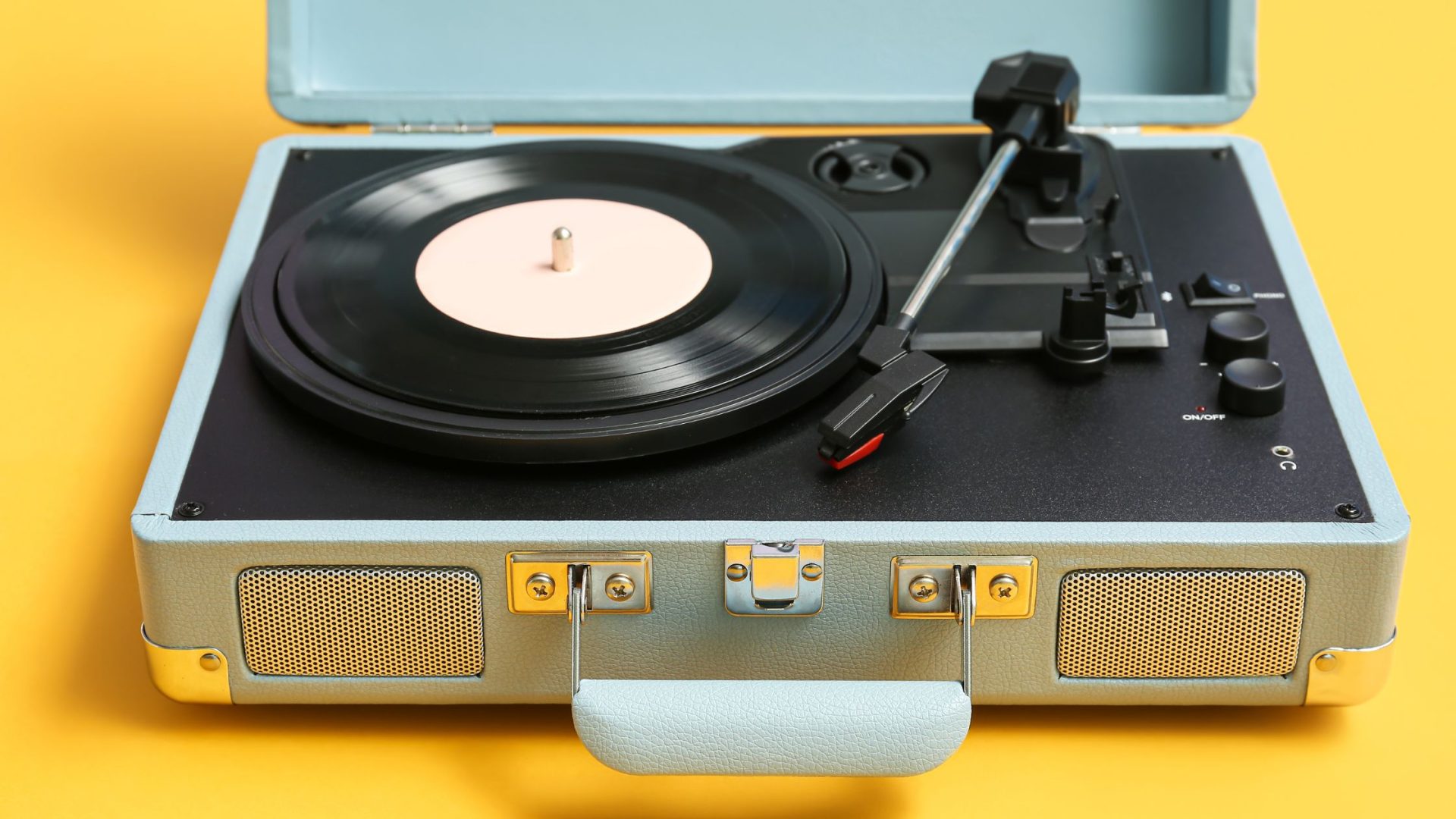
- The fastest-growing consumer generation is actively spending money to get off their phones, on vinyl records, handmade goods, in-person events, and physical community. Offline marketing strategies for small business have never had a bigger tailwind.
- Fortune pegs the Gen Z analog economy at over $5 billion and growing fast. Meanwhile, Facebook’s average cost per lead hit $27.66 in 2025 and direct mail now outperforms social ads by nearly 8 to 1 in independent ROI studies.
- This article covers exactly what is driving the shift, why small businesses have a structural advantage over big brands in capturing it, and six specific analog tactics you can run this week on a shoestring budget.
Offline marketing strategies for small business are having their moment, and the data behind it is genuinely exciting. The generation with the fastest-growing spending power in the U.S. is going offline on purpose. Direct mail now delivers a 161% ROI versus social media advertising’s 21%. In-person events are being called “the last trusted space” in an AI-saturated world. The businesses positioned to win this shift are not the big brands with eight-figure ad budgets. They are local shops, consultants, solopreneurs, and service providers who have been doing this kind of marketing all along without a fancy name for it.
A nail salon owner in Phoenix sent handwritten postcards to her top 80 clients. She spent about $60 on postage and an afternoon writing names. Within two weeks, she had booked 23 appointments, including four clients she hadn’t seen in over a year. She told me the responses were the most enthusiastic she’d gotten from any marketing she’d ever done. That is what the analog economy looks like at street level. And it is available to every small business reading this right now.
Why the digital marketing window closed and what opened in its place
Look, for about a decade, every piece of marketing advice pointed in one direction: go digital, go faster, go louder. Facebook ads, Instagram Reels, email sequences, Google campaigns. Yeah, the pitch made sense at the time. Back in 2010, a Facebook ad cost $0.45 per click. You could reach thousands of people for almost nothing. Email inboxes were uncrowded, organic social reach was real, and Google would rank you if you wrote decent content.
That window lasted roughly from 2010 to 2018. Then (of course) the platforms matured. Of course everyone and their mother jumped on the digital ad bandwagon, and the economics of supply and demand took over. More advertisers bidding on the same eyeballs means higher prices. More content flooding every feed means lower organic reach. More emails in every inbox means lower open rates. Facebook’s average cost per lead jumped 21% in a single year, hitting $27.66 in 2025. Google’s average cost per lead now sits at $70.11, with cost-per-click rising 12.9% year-over-year, faster than general inflation. Customer acquisition costs rose across every single industry from 2023 to 2024.
At the same time, something significant started happening on the consumer side. The audience you are spending all that money to reach stopped trusting what they see. UC Berkeley researcher Hany Farid found people are now equally likely to call something real “fake” as to call something fake “real.” Over 53% of people already struggle to distinguish AI-generated content from human content. Deepfake files hit an estimated 8 million in 2025, up from 500,000 in 2023. That is a 900% annual growth rate.
Your beautifully produced video ad, your polished social post, your carefully crafted email, all of it lands in an inbox and a mindset primed for suspicion. The distrust is spreading to all digital content. Your real photo looks fake. Your honest testimonial looks generated. Your genuine video looks like it could be AI-produced.
This is the environment your digital marketing budget is competing in. And it explains exactly why the shift to analog is accelerating. For a complete picture of low-cost marketing channels that sidestep algorithms entirely, see our guide to low-cost marketing ideas for small business.
Why Gen Z is spending billions to get offline
The oldest Gen Zers were 23 during the COVID lockdowns. The youngest were 8. Proms got canceled. College move-ins went virtual. First jobs were Zoom boxes, and first friendships, first relationships, first everything got either digitized or simply canceled. COVID didn’t inconvenience this generation. It forced the most human milestones of their lives through a screen and called it a substitute.
Millennials processed their version of this with revenge spending, the 2022-2023 boom in travel, concerts, and bucket-list experiences. Gen Z’s response is quieter, more local, and more lasting. They know in their bones what screens cannot replace: touch, presence, shared meals, spontaneous laughter, belonging. And now that they have spending power, they are voting with their wallets. Fortune calls the Gen Z analog economy a $5 billion-plus market, and it is growing fast.
The numbers are striking across every category. 48% of U.S. teens now view social media as mostly negative, up from 32% two years earlier. Vinyl record revenue hit $457 million in mid-2025, the fifth consecutive year vinyl outsold CDs. 75% of adults did a crafting project in 2025, up from 62% in 2019, driving the art and craft materials sector to $23 billion. The Offline Club, a network of tech-free community spaces, now operates in 19 cities worldwide.
This is not nostalgia for a past they never had. CNBC reported in March 2026 that Gen Z’s desire to get offline is creating a direct sales opportunity for small businesses that sell tactile, physical products and in-person experiences. This generation is actively rebuilding real life from scratch, and spending money to do it.
For small businesses, this is the single most favorable customer behavior shift in a decade. The things Gen Z is spending money on, intimate events, handcrafted goods, human interaction, physical community, are exactly the things small businesses do better than anyone else.
What the real ROI numbers say about analog versus digital
Here is the part of this conversation that tends to surprise people. The famous “$42 for every $1 spent” email marketing statistic traces back almost entirely to surveys conducted by Litmus (an email platform), Constant Contact (an email platform), and the DMA (a trade association funded by email marketers). When independent researchers run holdout tests, checking what revenue happens with and without the email, the actual incremental lift drops to roughly 12:1. Why? Because 70% of that revenue was happening anyway. Email was showing up at the finish line and claiming the trophy.
When organizations with no financial stake in the outcome measure marketing channel ROI, the picture shifts significantly:
| Channel | Independent ROI | What this means for you |
|---|---|---|
| Direct mail (house list) | 161% | ANA Response Rate Report data, highest of any measured channel |
| Email (holdout-tested) | 10:1 to 25:1 | Still strong when measured honestly, far below headline claims |
| Social media ads | ~21% | Keen/Nielsen independent data, not platform-reported |
| Digital display ads | ~15% | ANA/Nielsen, expensive attention that rarely converts |
Direct mail delivers a 161% ROI and an 80-90% engagement rate compared to email’s 20-30% open rates. 48% of B2B emails never reach the intended inbox, and Office365 inbox placement dropped 26.7% in a single year. A physical piece of mail has a 100% mailbox delivery rate and zero spam filters to fight.
For a deep breakdown of these numbers, see our full analysis of direct mail ROI for small business. And if you want to understand how email still fits into an honest marketing mix, our guide to email marketing ROI for small business covers the real benchmarks and how to improve them.
Six offline marketing strategies for small business you can start this week
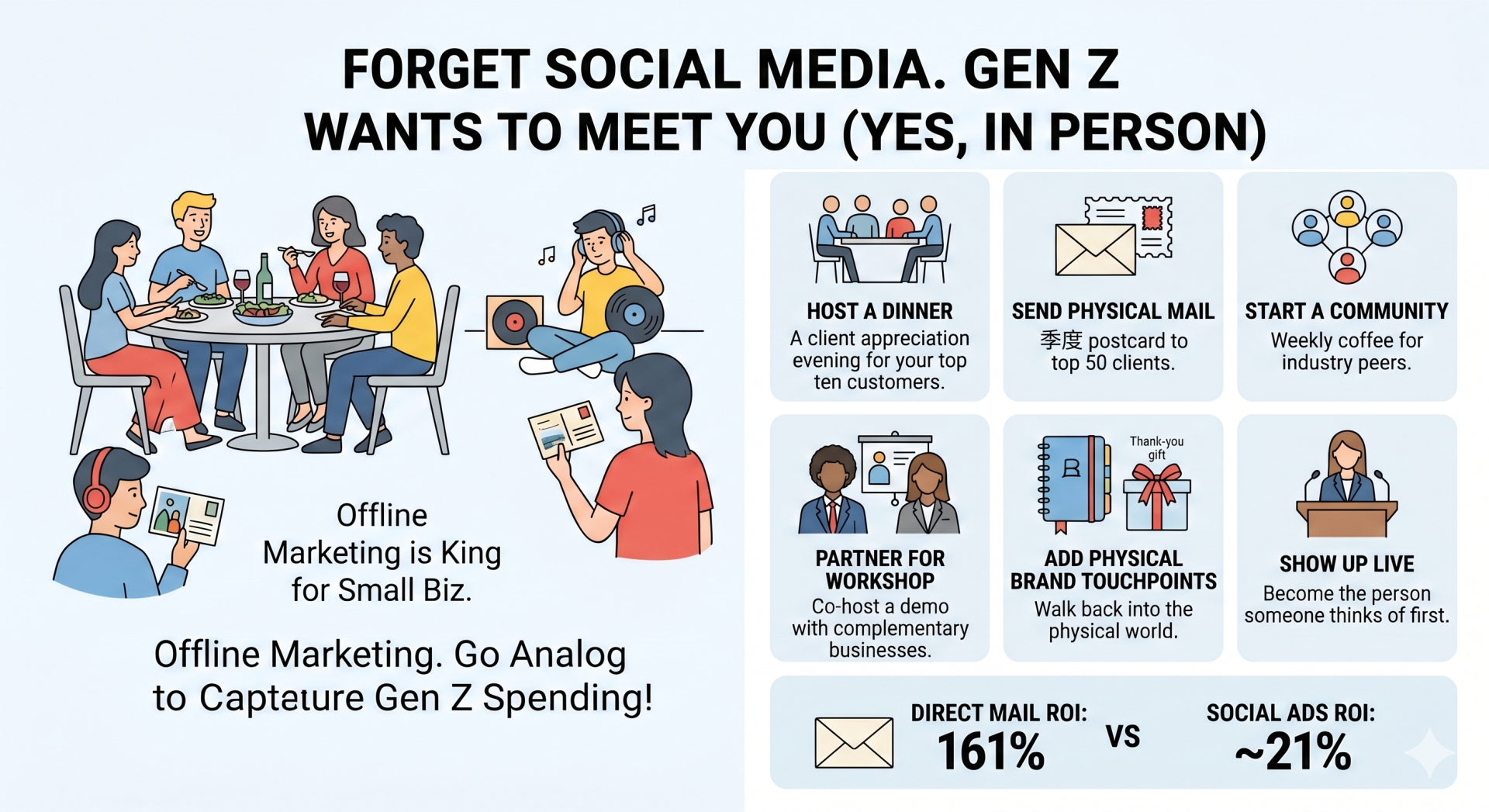
Here is the part that makes me unreasonably excited to write. The offline marketing strategies for small business that are working right now cost almost nothing to run, require zero platform expertise, and get more enjoyable the more you do them. An algorithm decides who sees a paid ad. These tactics reach exactly who you aim them at.
1. Host a small gathering
Pick eight people. Clients, prospects, referral partners, anyone you’d genuinely enjoy sitting across a table from. Find a restaurant with a back room, borrow a conference space, or clear your dining room table. Send handwritten invitations on actual paper. Then show up and have dinner together.
That is the entire strategy. Mike Michalowicz talks about the business hierarchy of needs, and near the top of that hierarchy is belonging. People do business with people they feel connected to. A dinner does in two hours what six months of LinkedIn content cannot do in six months.
Gary Vaynerchuk’s team hosts intimate, no-pitch summits where CMOs from Adobe, Meta, and PepsiCo show up. You don’t need Gary Vee’s contact list to make this work. A mastermind dinner for five of your best referral partners. A client appreciation evening for your top ten customers. A lunch-and-learn for the prospects you’ve been trying to close for months. The cost is a meal. The ROI is trust that compounds for years and relationships that send you business while you sleep.
For a practical playbook on running these events, our guide to client appreciation events for small business covers everything from invitations to follow-up.
2. Send physical mail
Forty-eight percent of B2B emails never arrive. Your direct mail piece gets there 100% of the time. And 70% of consumers say physical mail feels more personal than digital messages, which means it lands differently even when it does arrive.
A quarterly postcard to your top 50 clients costs about $30 in postage. A handwritten thank-you note to the ten customers who spent the most with you this year costs 45 minutes and ten stamps. A one-page physical newsletter mailed to your best prospects costs less than most businesses spend on a single LinkedIn ad that three people read. The ROI math on direct mail is genuinely embarrassing compared to digital alternatives, and the good news is almost nobody in your category is doing it anymore.
The analog marketing advantage here compounds. Every piece of physical mail sits on a desk, gets pinned to a board, or ends up on a refrigerator. Digital ads disappear the moment the impression fires. A postcard sticks around for weeks. Sometimes months.
3. Start a community circle
Pick a recurring format (monthly dinner, quarterly workshop, or weekly coffee) and invite a tight, specific group of people to keep showing up. Keep the membership criterion clear (same industry, same role, same geography, same problem) and the facilitation light. The value is not the agenda. The value is that these people get to know each other, and you become the person who brought them together.
That positioning is worth more than any ad campaign you will ever run.
You can charge for this. A curated peer network for consultants or business owners in your niche can run $500 to $2,000 per year. Or run it free as a referral engine, because the people you bring together will send you business for years. eMarketer’s 2026 analysis found community-driven experiences outperform every digital channel on customer loyalty in an inflationary environment. You can optimize an email subject line. Belonging cannot be optimized.
Referrals flow naturally from these gatherings. For a system to turn those conversations into actual leads, see our guide to how to ask for referrals without feeling awkward.
4. Partner for a pop-up or workshop
Find two or three businesses that serve the same customer you serve but do something you don’t. Think about the natural combinations: a bookstore and a therapist, a gym and a nutritionist, a business attorney and an accountant, a graphic designer and a copywriter. Co-host a demonstration, a workshop, or a casual open house. Split the costs, share the audience, and show up together.
The format does not need to be elaborate. A 90-minute workshop in a borrowed conference room generates more goodwill, more leads, and more memorable impressions than a month of social posts. And the co-promotion means both businesses expand their reach without spending on ads. Hospitality Net’s 2026 events trend report puts it plainly: in an AI-saturated, low-trust digital world, in-person events stand out as one of the most effective ways to build credibility, human connection, and long-term loyalty.
For ideas on showing up in your local community in a way that generates real leads, see our guide to local marketing ideas that turn browsers into buyers.
5. Add physical brand touchpoints
Objects persist in a way that digital impressions simply do not. A branded notebook sits on a desk for 18 months. A hand-stamped envelope gets opened before the electric bill. A physical resource guide gets passed to a colleague. A thank-you gift package gets photographed and shared organically, without an influencer contract or a boosted post.
Gen Z is spending real money on tactile, physical goods specifically because they feel different from everything else in their lives. The bar is low for small businesses here because most of your competitors stopped doing this entirely. Send a small welcome package to every new client. Mail a handwritten birthday card to your top 20 customers. Print a physical version of a resource you would normally send as a PDF. Walk back into the physical world and you will stand out immediately, because the space is almost empty.
6. Show up live and in person
Take a speaking slot at a chamber luncheon. Record a guest spot on a podcast your best customers already listen to. Demo something at a community event. Sit on a panel at a conference where your ideal clients are in the room. A Pegasystems/YouGov study from early 2026 found 66% of consumers actively prefer human-led interaction over AI. A Kinsta survey of 1,011 U.S. consumers found 93.4% prefer interacting with a human when they have a real problem to solve.
Every live appearance is a trust signal that no digital content can replicate. Showing up in a room is still the fastest way to become the person someone thinks of first when a need arises. It has always been this way. The difference today is that almost everyone else stopped showing up, which means the room is yours for the taking.
Knowing how to introduce yourself at these events is the first skill to develop. See our guide to how to introduce yourself at a networking event without sounding like a robot. And when you combine live appearances with a deliberate referral system, the compounding effect is significant. Our guide to how to get referrals for your business covers how to turn every in-person appearance into a referral engine.
Why being small is your structural advantage in the analog economy
Here is the part that does not get said enough. Large companies cannot do analog at scale. A Fortune 500 brand cannot send handwritten notes to 10 clients. It cannot host an intimate dinner where the owner is in the room, present and accountable. It cannot build a local community circle where everyone knows each other’s names. It cannot remember that your top client’s daughter started college this year. It cannot feel like a neighbor.
These companies are locked into multimillion-dollar digital ad commitments, complex MarTech systems, and AI content factories. Pivoting to analog takes years of budget cycles, brand committee approvals, and agency briefings. Meanwhile, you can start on Tuesday.
The things that make you “small”, your proximity to clients, your ability to remember names, your flexibility, your genuine investment in the outcome, are exactly the things that make analog marketing work. Nielsen found that blending analog touchpoints into your marketing mix improves on-target reach by 5x compared to digital-only approaches. And your competitors are not doing this. They are still arguing about their Facebook ad creative and wondering why their open rates keep dropping.
The window when digital marketing was cheap, easy, and trusted has closed. What opened in its place is a world where presence is scarce, human connection is premium, and the cost of entry is showing up. Offline marketing strategies for small business are a direct route into that world, one that requires a decision, not a budget. Showing up, being human, making people feel something: these are tactics that require a decision, not a budget. For a complete picture of how to stack both offline and digital channels together intelligently, see our breakdown of direct marketing vs. digital marketing for small businesses.
The nail salon owner in Phoenix who mailed those $60 worth of postcards understood something the digital marketing industry has been trying to obscure for years: the most effective marketing has always been the most human marketing. The tools change. The algorithm updates. The platform fees climb. What never changes is that people do business with people they trust, and trust is built in rooms, on paper, and over meals. That is where your business belongs right now.
Frequently asked questions about offline marketing strategies for small business
What are offline marketing strategies for small business?
Offline marketing strategies for small business are physical, human, and in-person tactics that operate outside digital platforms, including direct mail, client events, handwritten notes, physical gifts, live speaking, pop-up workshops, and community gatherings. These tactics are experiencing a resurgence because digital trust is collapsing and a growing segment of consumers, particularly Gen Z, are actively choosing physical and human experiences over digital ones. For small businesses, offline marketing carries a structural advantage that larger companies cannot replicate: the ability to show up at a genuinely human scale, where the owner is in the room, knows the customers’ names, and can make people feel something.
Why is Gen Z going analog and what does it mean for small business marketing?
Gen Z is going analog because COVID forced the most defining years of their lives through a screen. Now that they have spending power, they are spending it on what screens cannot replace: touch, presence, shared meals, belonging, and community. Fortune estimates the Gen Z analog economy at over $5 billion and growing. For small businesses, this is a direct spending signal. 48% of U.S. teens now view social media as mostly negative. Vinyl records outsold CDs for the fifth consecutive year. Craft materials reached $23 billion in sales. Every dollar Gen Z spends on physical, human, in-person experiences is a dollar that analog-ready small businesses can capture without running a single ad campaign.
How does direct mail ROI compare to digital channels for small businesses?
Independent research (meaning studies conducted by organizations with no financial stake in email or social media platforms) shows direct mail delivering a 161% ROI compared to social media advertising’s approximately 21%, according to ANA Response Rate Report data and Keen/Nielsen independent analysis. Direct mail also carries an 80-90% engagement rate versus email’s 20-30% open rate. This gap has widened as email deliverability deteriorates. 48% of B2B emails currently never reach the intended inbox. A physical piece of mail has a 100% mailbox delivery rate and no spam filter to fight. For small businesses with an existing customer list, even a modest quarterly postcard campaign typically outperforms the equivalent spend on digital ads.
What analog marketing strategies have the lowest startup cost?
The lowest-cost analog marketing strategies for small businesses are handwritten notes to existing clients, a quarterly postcard mailing to your top 50 customers, and hosting a small gathering of six to ten clients or referral partners. Postage for 50 postcards runs roughly $25 to $30. A client dinner at a modest restaurant for eight people costs $200 to $400 and typically generates more referrals and repeat business than the equivalent spent on digital ads. A local speaking slot at a chamber event or community organization costs nothing. Analog marketing’s biggest advantage beyond ROI is that these tactics compound over time through word-of-mouth and referrals in a way that paid digital advertising never does.
How do I measure whether analog marketing is working for my small business?
Offline marketing strategies for small business are measurable when you build in simple tracking from the start. For direct mail, include a unique offer code, a specific phone number, or a landing page URL that appears only on the physical piece. For events, count bookings, referrals, and new contacts generated within 30 days of the gathering. For handwritten notes, track which clients respond, return, or refer someone within 60 days. Conversion windows for analog are longer than digital, direct mail typically converts over 30 to 60 days rather than 24 to 48 hours, but the relationships created are far more durable. One practical benchmark: if a single client acquired through analog marketing books again or refers one other person, the ROI on almost any analog tactic is positive.