
In This Article

- To make AI copy convert, give it three inputs: real customer questions, examples with measured results, and a test you run on purpose.
- At one large online retailer, AI pre-sale assistance lifted sales 16.3% over an unavailable-service message, while AI-optimized ad titles produced no detectable sales gain.
- You finish with a four-part workflow, a campaign log, and a painting-company example to adapt for your next estimate follow-up.
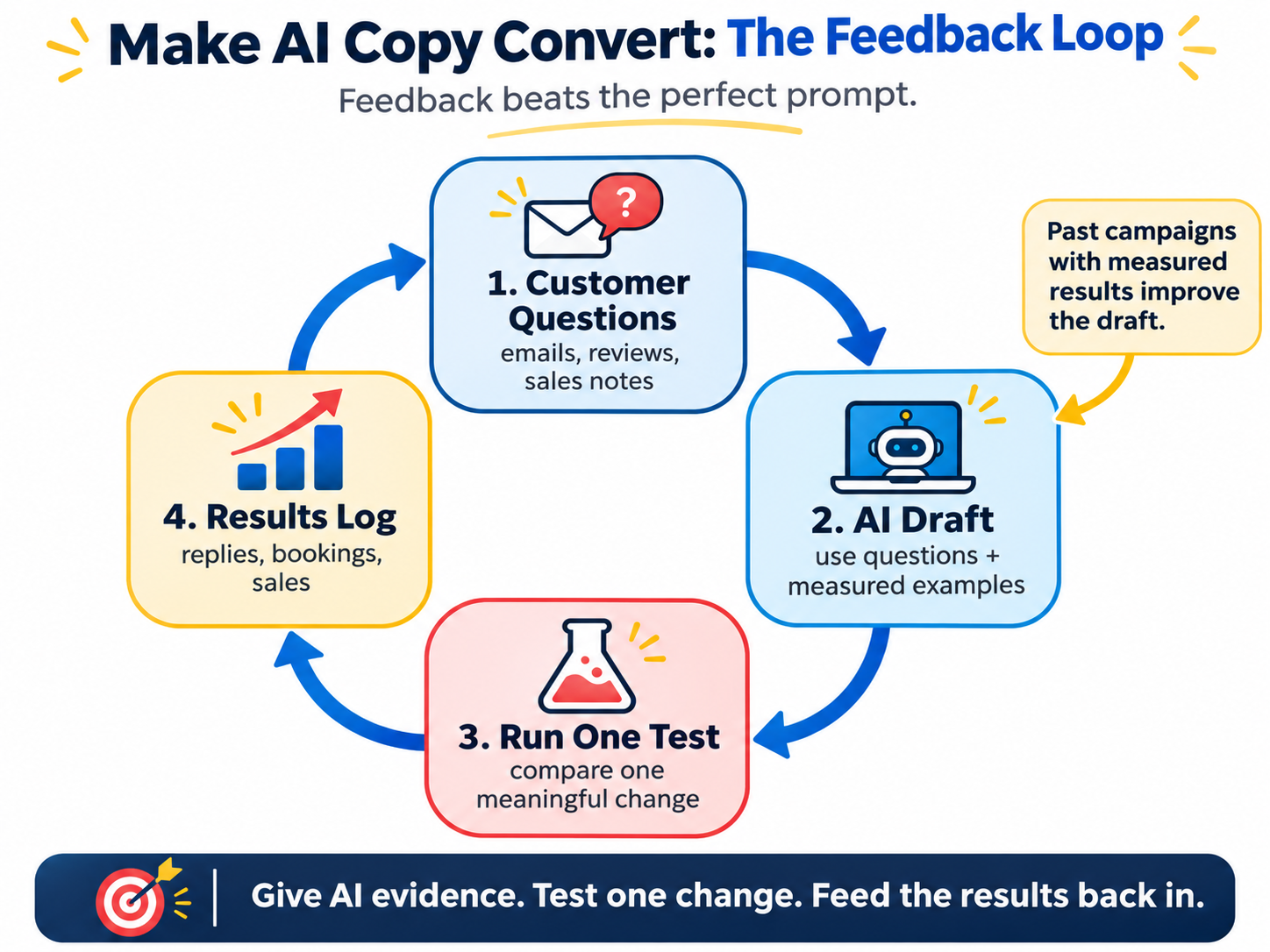
To make AI copy convert, give it three inputs before it writes a word: the questions your customers ask before they buy, past campaigns with measured results, and one test comparing a single change. AI drafts in seconds. Your evidence tells it what to say, and your results show whether the words earned a booking, a reply, or a sale.
Picture a Tuesday afternoon. You ask AI for five follow-up emails, and five tidy drafts appear in under a minute. You schedule them, check the task off, and feel productive. By Friday, nobody has booked, bought, or replied. Finished marketing and effective marketing are two different results, and AI delivers the first one on its own.
If the AI chatter has you overwhelmed, here is the short version. Use the tools you already pay for. Give them better raw material, then check what happened. This article walks through both steps with one running example, a painting company’s estimate follow-up.
Does AI help you get more customers?
Sometimes. The strongest direct evidence comes from randomized field experiments at a large cross-border online retailer. Researchers tested seven AI applications between September 2023 and June 2024, with individual experiments reaching from tens of thousands to millions of users. AI’s effect on sales varied by application, from no detectable improvement to a 16.3% increase. Two results show the range:
- AI-powered pre-sale assistance increased sales by 16.3%. The comparison group saw a message saying customer service was unavailable. Human salespeople were never the benchmark.
- AI-optimized Google advertising titles produced no detectable sales improvement in this experiment.
The post-purchase numbers held up too. The authors report no deterioration in product returns or customer ratings, and the gains came mainly through higher conversion rates.
My reading: the useful question is whether a change helps a customer past something blocking a purchase. A pre-sale chat answers questions at the moment of doubt, while a reworded ad title leaves the buyer’s doubts for later. The researchers did not separate informational effects from persuasive ones, so treat this as a working theory.
What do your customers still need to know before they buy?
Start with evidence, since invented personas give AI nothing true to work from. Gather a small, anonymized collection of real customer material:
- Questions prospects ask before buying.
- Reasons given for declining or delaying.
- Reviews describing why customers chose you.
- Emails showing confusion about scope, price, process, or fit.
- Notes from sales conversations.
Short on material? Write down the five questions prospects ask before saying yes, the Day 1 task in my free ways to get customers plan. Remove names and personal details, then ask AI to sort what you gather into three piles: questions present in the evidence, information missing from your current content, and possible explanations needing investigation.
Compare these customer questions with this service page. Identify questions the page does not answer. Quote the supporting customer evidence for each gap. Label any inferred objection as a hypothesis. Do not invent motivations.
The retailer’s product-description test added richer, multilingual information to listings, many of which had little or no text before. Columbia Business School’s summary lists smarter search, pre-sale chatbots, and richer product descriptions among the tested features.
Which examples should you give AI?
Style imitation says, “write like this marketer.” Performance-informed analysis says, “compare these campaigns, their circumstances, and their measured outcomes.” The second instruction gives AI something to learn from. Build a small example library and record these fields for each campaign:
| Field | What to record |
|---|---|
| Marketing asset | The full email, page, ad, or follow-up |
| Audience | Who saw it and how they arrived |
| Offer | Price, scope, conditions, and the intended action |
| Exposure | Number of recipients or visitors |
| Outcome | Qualified replies, bookings, purchases, or another defined result |
| Context | Timing, discounts, audience warmth, and other relevant differences |
Include losing and inconclusive examples. A library of winners shows AI what success looks like and hides everything about failure. Then ask for a comparison:
Compare these campaigns. Identify observable differences in the buying problem, promise, proof, objection handling, and next step. Separate those observations from speculation about why results differed. Do not assume the copy caused the outcome.
Research on spreading expertise points this way. In a study of 5,179 customer-support agents, AI assistance raised issues resolved per hour by 14% on average and by 34% for novice and lower-skilled agents, with suggestive evidence of AI spreading stronger workers’ practices. This is support productivity, so read it as a reason to investigate how examples transfer expertise. Whether copying winners sells more remains unproven.
How do you make AI copy convert with a real test?
AI generates test candidates in seconds. Your audience stays the same size, and a test needs people to test on. This makes the choice of comparison the valuable part.
Five headlines expressing the same promise make a weak test. A stronger test compares a general benefit with a specific deliverable, because your evidence shows prospects do not understand what they receive. Ask AI to propose several explanations for the problem, then pick one comparison to run. Write the plan before you send anything, with these fields:
- Hypothesis
- Existing version
- Proposed change
- Audience
- Primary conversion outcome
- Downside to monitor
- Assignment method, meaning how each person receives one version
- Sample-size and duration plan
- Conditions for calling the result inconclusive
Microsoft’s experimentation team warns of false winners from checking results repeatedly and comparing many metrics. Their guidance: set a planned duration up front, stay with it unless early evidence clears a stronger threshold, and watch guardrail metrics alongside the one you hope improves. Novelty distorts early numbers too, since a fresh design often draws a burst of attention, which fades.
No universal “run it for seven days” rule exists. Sample size and duration depend on your baseline conversion rate, the effect you hope to detect, and your traffic.
How do you teach AI what worked?
Bring the results back before you ask for the next campaign. Keep a simple log:
| Hypothesis | Change | Exposure | Conversions | Downside observed | Conclusion | Next question |
|---|---|---|---|---|---|---|
Training, in this workflow, means supplying relevant context and updating a reusable evidence file. The chatbot’s underlying model stays the same, and your file grows. Paste the file and the latest results into your next chat with this prompt:
Review the test plan and results. Separate observations from explanations. Identify what remains uncertain. Recommend the next useful test without treating this result as a permanent rule.
Keep “inconclusive” on the menu of conclusions. An honest “we learned little” beats an invented winner. AI without your results recommends from industry averages, which is why my article on AI marketing mistakes tells you to feed it your own data first.
Feedback beats the perfect prompt.
AI makes marketing production easier. Conversion improves when AI receives customer questions, relevant examples with measured outcomes, and a disciplined way to test what works.
How does a painting company make AI copy convert?
Here is one scenario from start to finish. It is illustrative: I invented the business and the customer questions, and no results exist yet. A residential painting company sends estimates, and many go unanswered.
1. The original follow-up
Hi Dana, I wanted to check in and see whether you reviewed the estimate. Let me know if you have any questions.
2. The evidence supplied to AI
The owner pastes six anonymized prospect questions and two notes from lost estimates. Several ask about preparation, cleanup, and disruption: “Do I have to move the furniture?” “How long is the room unusable?” The gap prompt from step 1 shows the estimate and follow-up both skip preparation and cleanup, and AI labels “homeowners fear disruption” a hypothesis.
3. The revised message
Hi Dana, I wanted to follow up on your living room and hallway estimate. Homeowners often ask what they need to do before we arrive. You clear small items and wall hangings. We move and cover furniture, protect floors and fixtures, and clean up at the end of each day. Want a five-minute call to walk through the schedule?
4. The owner’s fact-checks and edits
- Removed an AI line promising a “dust-free” job. The company contains dust and does not promise zero.
- Replaced a vague prep list with the company’s real prep list.
- Deleted a 10% discount AI added unprompted. The owner had not approved it, and margins are thin.
- Confirmed every claim about floor protection and cleanup matches what crews do.
5. The test plan and results log
| Stage | Example |
|---|---|
| Business symptom | Estimates are going unanswered |
| Customer evidence | Some prospects ask about preparation, cleanup, and disruption |
| Current follow-up | A check-in asking whether the homeowner reviewed the estimate |
| Hypothesis | Explaining what the homeowner does, and what the company handles, resolves uncertainty |
| Proposed comparison | Existing follow-up versus one addressing preparation and cleanup |
| Primary outcome | Accepted estimates |
| Diagnostic outcome | Replies |
| Guardrail | Unprofitable commitments or expectations the company is unable to meet |
Send each version to half of the open estimates, alternating down the list. Set the end date before sending, judge by accepted estimates, and use replies as the diagnostic. Record exposure, replies, and acceptances in your log. The example stops here because no real campaign exists. Your numbers go in the next row.
What is your first step?
Choose one email, service page, or follow-up already reaching potential buyers. Gather the questions those buyers ask. Give AI this evidence. Develop one meaningful comparison. Measure the customer action, and let this number outrank how much content you produced.
Pick the asset today, collect the questions this week, and write the test plan before you ask AI for a draft. Give AI evidence it helps you investigate, and let your results decide what comes next. This is how you make AI copy convert.
Want a Second Set of Eyes on Your Follow-Up?
Send me the email, page, or follow-up you picked. In a Fix-It Session, I record a video audit of what is working and what is blocking replies, then send a one-page action plan within 24 hours. $150. No meetings to schedule.
Frequently asked questions
How do I make AI copy convert better?
Give AI evidence before you ask for words. Start with real customer questions from emails, reviews, and sales notes, and ask AI to find the questions your current copy leaves unanswered. Add two or three past campaigns with their audience, offer, exposure, and outcome, including the failed ones. Then pick one meaningful change to test, such as a general benefit against a specific deliverable, and record the result in a simple log. AI speeds up drafting, yet the conversion gain depends on what the draft says to a buyer with a particular doubt. In the retailer experiments, AI pre-sale assistance lifted sales 16.3% over an unavailable-service message, while AI-optimized ad titles showed no detectable sales improvement. Results varied by application, so expect your own numbers to differ and measure them. Fact-check every claim AI adds, especially discounts, guarantees, and timelines you have not approved.
What should I give AI to write better marketing emails?
Give AI four things: the audience and how they arrived, the offer with its price and scope, the customer questions or objections you have heard, and one or two past emails with their results. Anonymize names and personal details before you paste anything. Ask AI to quote the customer evidence behind each suggestion and to label any inferred objection as a hypothesis. Specific inputs produce specific drafts. A real question, such as what prep a homeowner owes before painters arrive, gives AI something concrete to answer, while a request for a persuasive email leaves it guessing at your buyer. Keep the next step in the email singular, whether a reply, a booking, or a purchase, so you measure one customer action. Then edit the draft in your own voice before it goes out to your list.
How do I test AI-written copy with low traffic?
Run small pilots and customer conversations, and report them as exploratory learning. A low-traffic site takes months to produce reliable A/B results, so avoid declaring a winner from a handful of visits. Send the new version to a defined group of qualified prospects, record replies, bookings, and purchases, and ask responders what made them act. Use those conversations to write a sharper hypothesis for the next round. Microsoft’s experimentation guidance explains why repeated peeking at early numbers and comparing many metrics produce false winners, so decide your end date and your main outcome before you send. Pick one bold comparison, since small wording tweaks need large samples to show a difference. Write down what result would count as inconclusive before the test starts, so a weak result stays weak and nobody rewrites the story afterward.
Does AI marketing increase sales?
Sometimes, depending on the task and the starting conditions. The most direct evidence is a set of randomized field experiments at one large online retailer, where individual AI applications ranged from no detectable sales improvement to a 16.3% relative increase. The largest gain came from AI pre-sale assistance compared with a message saying customer service was unavailable, which says nothing about AI outperforming human salespeople. The retailer’s post-purchase measures showed no deterioration in returns or ratings. Separate research on customer-support agents found AI raised productivity, measured as issues resolved per hour, which says nothing about sales. Keep productivity, clicks, leads, purchases, revenue, and profit separate in your own tracking, and treat published numbers as one retailer’s results. Your business has its own audience, offer, and buying process, so a small test with your own customers settles the question for you.
Should I ask AI to score its own marketing copy?
Use AI as an editor and leave the scoring to your customers. When AI grades its own draft, you receive a model’s opinion of its own writing, which is a guess about conversion. Customer behavior shows whether copy converts: replies, bookings, purchases, and accepted estimates. AI does help with review tasks. Ask it to flag claims you have not verified, find questions the copy leaves unanswered, or compare two drafts against your customer evidence. Treat every answer as a hypothesis to test. Avoid describing AI-generated customer reactions as customer research as well, since real emails, reviews, and call notes carry actual customer language. When a draft goes live, log the exposure and outcome, and let those numbers decide which version stays. A score from AI belongs in the notes column, and conversions belong in the results column.