
In This Article

A recession-proof small business isn’t a specific industry or a lucky niche — it’s a business built so a bad quarter doesn’t become a catastrophe. Two things have to work at the same time: your costs need to be flexible enough to shrink when revenue drops, and you need a way to keep getting customers that doesn’t depend on a big ad budget or perfect economic conditions. Companies that did both came out of the 2008 recession with sales averaging 17% higher than those who cut everything, according to a Harvard Business School study tracking 4,700 companies across multiple downturns.
In March 2026, the NFIB Small Business Optimism Index fell to 95.8 — three points below the 50-year average, with profit trends dropping 11 points in a single month. I’ve spent the last several years watching business owners respond to economic turbulence, and the pattern is consistent: the ones who survive aren’t in the “right” industries. They built the right structure before they needed it.
Why Most Recession-Proof Advice Misses the Point for Service Businesses

The standard recession-proof business list runs through the same industries every time: healthcare, auto repair, accounting, groceries. The argument is that people need these things regardless of economic conditions, so businesses in these sectors stay safe.
That’s irrelevant if you run a consulting practice, a coaching business, a freelance agency, or any service-based operation where your revenue lives inside client relationships. Your industry doesn’t protect you. Your business model either does or it doesn’t.
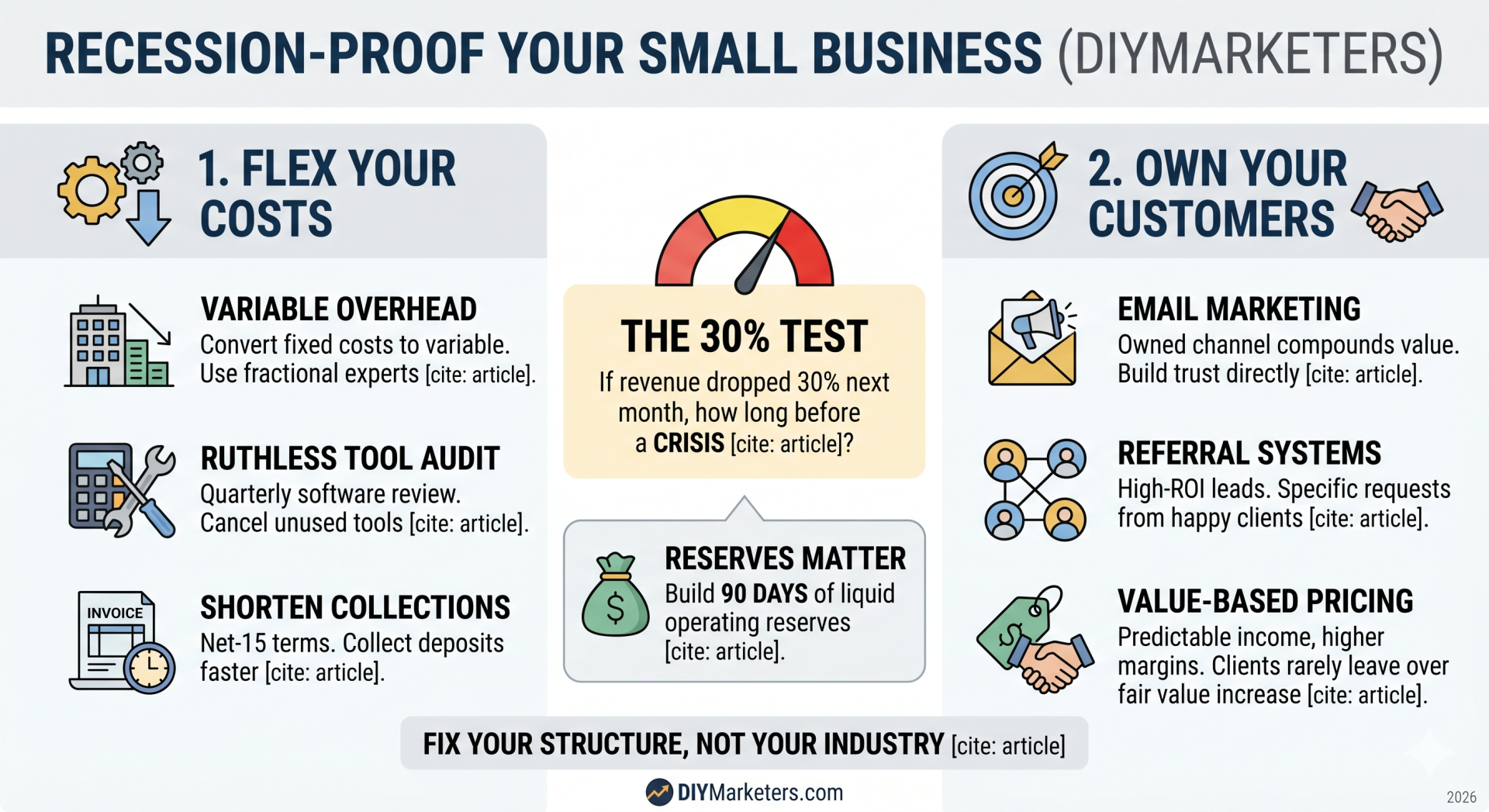
The real question isn’t “Am I in a recession-resistant industry?” The real question is: “If my revenue dropped 30% tomorrow, how many months before I’m choosing between paying myself and keeping the lights on?” If that number is less than three months, you don’t have a recession problem. You have a structure problem — and structure problems have structure solutions.
A recession-proof small business isn’t built by crossing your fingers and hoping you’re in the right niche. It’s built around two deliberate choices: keeping your costs flexible and keeping your customers close.
The Two Things You Need Sorted Before the Economy Gets Ugly
Here’s the simplest way to think about this. Your business has two sides: the side that determines how much it costs to keep you operational, and the side that determines how you get and keep customers. Most business owners focus all their stress on one or the other — cutting costs in a panic or scrambling for new clients — and ignore the connection between them.
The businesses that come through economic rough patches have both sides working together. They’ve structured their costs so that a slow month is uncomfortable, not fatal. And they’ve built customer relationships and marketing habits that don’t evaporate the moment they stop running ads.
The mistake most service businesses make when things get tight is they cut the customer side first (stop marketing, stop communicating, go quiet) while ignoring the cost side (still paying for the same tools, same overhead, same fixed expenses). That’s exactly backwards. Cut the right costs. Keep showing up for customers. That’s the whole game.
How to Set Up Your Business So a Bad Month Doesn’t Break You
The 1970s stagflation playbook reads like it was written for 2026. The entrepreneurs who survived that era — when inflation hit 14% and interest rates topped 20% — did it through one overriding discipline: they converted fixed costs into variable costs wherever possible.
They converted employees to contractors to eliminate payroll overhead. They negotiated 60 to 180-day payment terms from vendors who needed the business. They stayed liquid instead of leveraged. When competitors failed, they bought liquidated assets at fire-sale prices. Walmart and McDonald’s both grew stronger during the 1970s because they ran lean operations and offered reliable value when consumers needed to stretch every dollar.
The 2026 version of this playbook looks slightly different, but the underlying logic is identical.
Convert fixed costs to variable costs. Every full-time hire is a fixed cost obligation. Every retainer you pay for tools you don’t measure is a fixed cost leak. Every long-term lease or subscription you haven’t evaluated recently is fixed overhead you’re carrying into uncertainty. Go through your cost base with a fresh eye: what changes with revenue, and what stays the same regardless? The goal is a back office that automatically shrinks when revenue drops and expands when it grows.
Use contractors and fractional resources. This is the 1970s contractor model applied to modern professional services. When you need specialized work — design, bookkeeping, copywriting, tech support — a contractor gives you the output without the overhead. For your own clients, this is also a pitch worth making: a fractional expert with a proven track record costs less than a full-time hire and carries zero employment overhead. That’s a value proposition that resonates in any economic climate.
Audit your tools ruthlessly. The SBA notes that AI tools are commoditizing fast — what costs $200/month today will likely cost $20/month within 24 months. Review your software stack quarterly. If you’re paying for features you don’t use or for tools that have free alternatives, that’s margin you’re voluntarily giving away.
The Cash Flow Problem Most Service Businesses Don’t See Until It’s Too Late
For the first time in a major small business survey, cash flow has overtaken inflation as the number one concern among small business owners — 31% citing cash flow stress versus 29% citing inflation, according to OnDeck and Ocrolus Q1 2026 data. That shift matters, and it tells you something important.
When business owners say “cash flow,” they usually mean one of two problems: either revenue has dropped (demand problem) or the timing between when money goes out and when it comes in is broken (systems problem). The first problem requires a marketing solution. The second problem requires a structural fix — and it’s often the faster one to address.
Shorten your collection cycle. The standard net-30 invoice is an artifact from a more forgiving era. In a tight economy, net-30 means you’re essentially lending your clients money for a month, interest-free, while you carry your own costs. Move to net-15, require deposits on new projects, or offer a 2% discount for payment within 5 days. Each of these moves money toward you faster without requiring a single new client.
Lengthen your payment cycle. On the vendor and supplier side, the 1970s playbook applies directly: negotiate longer payment terms wherever possible. Ask for net-45 or net-60. Many vendors will agree, especially if you’re a reliable client. The gap between when you collect and when you pay is your operating cushion. Widen it deliberately.
Build a three-month reserve, not a three-week one. The Bank of America Institute’s 2026 small business data consistently shows that businesses with 90+ days of operating reserves navigate economic volatility without forced decision-making. Six weeks of runway means every slow month is a crisis. Three months of runway means a slow month is annoying but manageable. The target is three months of operating expenses in liquid form — not invested, not tied up in equipment, liquid.
Price for the value you deliver, not the hours you work. Hourly billing is the enemy of cash flow predictability. When you bill by the hour, your revenue fluctuates with your time availability. Value-based pricing, retainers, and project fees give you predictable income and protect your margins when input costs rise. If this is an area you haven’t addressed yet, the DIYMarketers price increase strategy guide walks through the mechanics of restructuring your pricing without losing clients. McKinsey’s research on pricing in inflationary environments confirms what most service providers learn too late: clients rarely leave over a 10-15% price increase when the value is clear. They leave when they no longer see the value.
Why Cutting Your Marketing Budget Is the Most Expensive Mistake You Can Make Right Now
Here’s where most recession-proofing advice completely falls apart. It tells you to cut your marketing budget, focus on “essential” spending, and wait for conditions to improve. The data says the opposite works.
The Harvard Business Review’s recession research is unambiguous: companies that maintained marketing investment during economic downturns saw sales growth averaging 17% higher than those who cut it. That’s not a marginal difference. That’s the difference between rebuilding from scratch when conditions improve and being positioned to grow when competitors are recovering.
The reason is mechanical: when competitors cut marketing, ad inventory gets cheaper, organic search gets less competitive, and your visibility increases relative to the market without you spending a dollar more. You get more reach for the same investment. The businesses that understand this don’t view marketing as a discretionary expense. They view it as the cheapest competitive advantage available in a downturn.
The key is where you put that investment. Rented channels (paid ads, social media platforms, third-party marketplaces) work well in good times and turn volatile in bad ones — ad costs spike during uncertainty, algorithms change, and platforms limit your reach overnight. Owned channels compound in value regardless of what the economy does.
Email Marketing Is the recession-proof Channel Your Business Needs
In 2024, 23% of small businesses called email their most effective marketing channel. By 2025, that number jumped to 44%, according to Constant Contact’s State of Small Business Marketing report. That’s not a small shift — it nearly doubled in 12 months.
The reason is structural. Email is an owned channel: you own the list, you control the delivery, and the relationship you build there doesn’t evaporate if an algorithm changes or a platform decides to throttle your reach. Every subscriber you earn compounds in value over time. Every email you send builds familiarity and trust in a way that a paid ad doesn’t replicate.
For a recession-proof small business, email solves three problems at once. It keeps existing clients warm and loyal, reducing churn during periods when clients are re-evaluating every vendor relationship. It gives prospects a low-friction way to stay connected with you before they’re ready to buy. And it creates a direct line to an audience you’ve built — an audience that ad platforms have no ability to take from you.
If email marketing feels overwhelming or you’re not sure where to start, the fundamentals are simpler than the tools make them seem. A consistent weekly or bi-weekly email that delivers genuine value — insights, frameworks, practical tips — compounds in trust faster than any other channel available to a small business on a limited budget.
Your Best Customers Are Already Sitting on Your Best Leads
The second channel most service businesses already have — and systematically ignore — is referrals from happy clients.
Customer retention is the highest-ROI activity available to a service business in any economic climate. Keeping an existing client costs a fraction of acquiring a new one. During economic uncertainty, clients who already trust you are far more likely to expand their work with you than to take a chance on someone new — if you stay visible and continue demonstrating value.
The referral channel works the same way. A satisfied client who you’ve asked for referrals — with a clear, specific request, not a vague “let me know if you know anyone” — is your most efficient lead generation system. Referred clients close faster, pay more reliably, and stay longer than cold-acquired clients. During a downturn, when ad costs are up and buyer skepticism is high, the referral channel becomes even more valuable relative to everything else.
If your referral flow has slowed or become unpredictable, that’s worth diagnosing. There are a few common structural reasons this happens, and they’re covered in the DIYMarketers analysis of why referral marketing stops working. The fix is usually simpler than it looks — it’s often a systems gap, not a relationship problem.
Customer loyalty programs and regular touchpoints matter more during economic volatility than at any other time. When clients are evaluating every line item, the service providers who communicate value consistently and proactively are the ones who keep the contract.
Content Marketing as a Long-Term recession-proofing Asset
Content — blog posts, articles, guides, videos — is the slowest-building but most durable part of how you get customers. A piece of content you publish today generates organic search traffic and inbound interest for years. That’s a compounding return on a one-time investment.
During a recession, content marketing has a specific strategic advantage: it keeps working when you’re not. While your team is delivering client work and your competitors have paused their content, your published library continues to attract, educate, and pre-qualify prospects around the clock.
The content that works best for a recession-proof small business isn’t trend-chasing or commentary on the news cycle. The highest-value content answers the specific questions your ideal client is typing into Google or asking an AI right now. If you’re a consultant or fractional executive, those questions look like: “How do I get more consulting clients?” “What should I charge for consulting?” “How do I build a referral network in a new market?” Build a content library that answers these, and you have a lead generation asset that costs nothing to run once it’s published.
If your content has been inconsistent or you’re not sure why your marketing keeps failing to generate leads, the issue is often structural — the wrong topics, the wrong search intent, or no clear path from a piece of content to a conversion. That’s a diagnosable problem.
A Quick Check to See Where Your Business Actually Stands Right Now
A recession-proof small business is a known state — you either have the structure or you don’t, and you can find out in an afternoon.
Here are the questions that tell you where the gaps are:
On the cost side of your business:
- What percentage of your monthly expenses are fixed, regardless of revenue?
- How many months of operating reserves do you have in liquid accounts?
- What is your current average collection time (days to payment after invoicing)?
- What recurring expenses haven’t you reviewed in the last 6 months?
- If your largest client paused tomorrow, when would you feel it financially?
On the customer side of your business:
- What percentage of your leads come from owned channels (email, referrals, organic search)?
- What is your client retention rate over the last 12 months?
- When did you last ask a satisfied client for a specific referral?
- Do you have a consistent email communication cadence with your list?
- How many pieces of content are actively generating inbound leads right now?
If the cost-side answers make you uncomfortable, the priority is cash flow and reducing fixed expenses. If the customer-side answers reveal over-dependence on paid channels or cold outreach, the priority is building email, referrals, and content before you need them.
Most businesses have gaps in both places. The order of operations matters: fix the cost side first so you have the breathing room to invest in getting customers. Then build the marketing side before you need it — not during a crisis when it’s too late to let it take hold.
If you want a direct audit of where your specific business stands — with a clear action list, not a generic checklist — that’s exactly what a Fix-It Session delivers. More on that below.
| If You See This… | It Means… | Your Next Move |
|---|---|---|
| Fixed costs above 70% of monthly expenses | Revenue drop of 30% hits you almost immediately | Audit recurring costs, convert to variable where possible |
| Less than 60 days of operating reserves | Every slow month is a crisis, not an inconvenience | Prioritize reserve-building over new investments |
| Over 50% of leads from paid channels | Your pipeline evaporates the moment you cut ad spend | Build email list and referral system in parallel |
| Client retention rate below 70% | You’re replacing more than a third of your revenue every year | Identify churn triggers, build a retention touchpoint system |
| Marketing is paused or inconsistent | Competitors are capturing your audience’s attention by default | Restart with email — it’s the lowest-cost, highest-return move |
Frequently Asked Questions About Building a recession-proof Small Business
What does it mean to have a recession-proof small business?
A recession-proof small business is one built to absorb revenue volatility without forcing crisis-mode decisions. It doesn’t mean immune to economic shifts — it means structured to survive a significant revenue drop (typically 25-40%) without the owner having to choose between paying themselves, paying staff, and keeping the business operational. That structure has two sides: what it costs to run your business (variable expenses, cash reserves, fast collection cycles, no unnecessary fixed overhead) and how you get customers (email, referrals, and content that keep working even when you stop paying for ads). When both sides are working, a slow quarter becomes a minor inconvenience. Without that structure, a slow quarter becomes an existential threat. Build it before you need it — building it during a crisis costs significantly more and hurts far more than you expect.
How much cash reserve does a service business need to be recession-proof?
The practical benchmark for a service-based small business is 90 days of operating expenses in liquid form — meaning actual cash in a business savings account, not equity in equipment or a line of credit you haven’t drawn. Three months of runway changes your decision-making completely: let a slow stretch run its course, invest in marketing without panic, and negotiate from a position of patience rather than desperation. The Bank of America Institute’s 2026 small business data consistently shows that businesses with 90+ days of reserves navigate economic volatility without forced decisions, while those with less than 45 days tend to make reactive cuts that compound the problem. Building to 90 days takes time — most service businesses should target 30 days first, then 60, then 90, treating each milestone as a structural upgrade worth protecting.
Should I cut marketing to survive an economic downturn?
The research says no — and it says it clearly. The Harvard/Bain study tracking 4,700 companies across multiple recessions found that businesses maintaining marketing investment during downturns emerged with sales averaging 17% higher than those that cut it. The economic logic is simple: when competitors cut marketing, ad inventory gets cheaper, organic competition drops, and your visibility increases relative to the market at no additional cost. You get more reach for the same investment. The businesses that thrive during downturns don’t cut marketing indiscriminately — they cut rented channels (paid ads) and increase owned channels (email, referrals, content). This strategy costs less and delivers compounding returns. If your marketing isn’t working right now, the problem is almost never budget — it’s direction. Understanding where your marketing is failing is the first step, and that’s a diagnosable problem with a specific fix.
What marketing channels are the most recession-proof?
Owned channels outperform rented channels in any economic environment, and the gap widens during downturns. Email is the most powerful owned channel available to a small service business: you own the list, control the delivery, and the relationship you build compounds in trust over time. In 2025, 44% of small businesses named email their most effective marketing channel, up from 23% in 2024, according to Constant Contact research. Referral marketing is the second most recession-proof channel — referred clients close faster, cost nothing to acquire, and stay longer. Organic search through consistent content creation is the third, because a well-ranked article generates inbound leads for years on a one-time investment. Together, these three channels form a self-reinforcing marketing system that doesn’t require ongoing ad spend and grows stronger over time regardless of economic conditions.
How do I know if my current business model is recession-proof or not?
The fastest diagnostic is the DIYMarketers 30% Test: if your revenue dropped 30% starting next month, how long before you face a genuine crisis? If the answer is less than 90 days, your business carries significant vulnerability. From there, the audit splits in two directions. On the cost side, look at what percentage of your monthly expenses are fixed regardless of revenue, how many days it takes to collect after invoicing, and how much liquid cash you’re holding. On the customer side, look at what percentage of your leads come from channels you own versus channels you pay for, your 12-month client retention rate, and how consistently you’re communicating with your email list and referral network. Most service businesses find gaps in both places — fixed costs are higher than the owner realizes, and too much lead generation depends on paid or unpredictable sources.