
In This Article
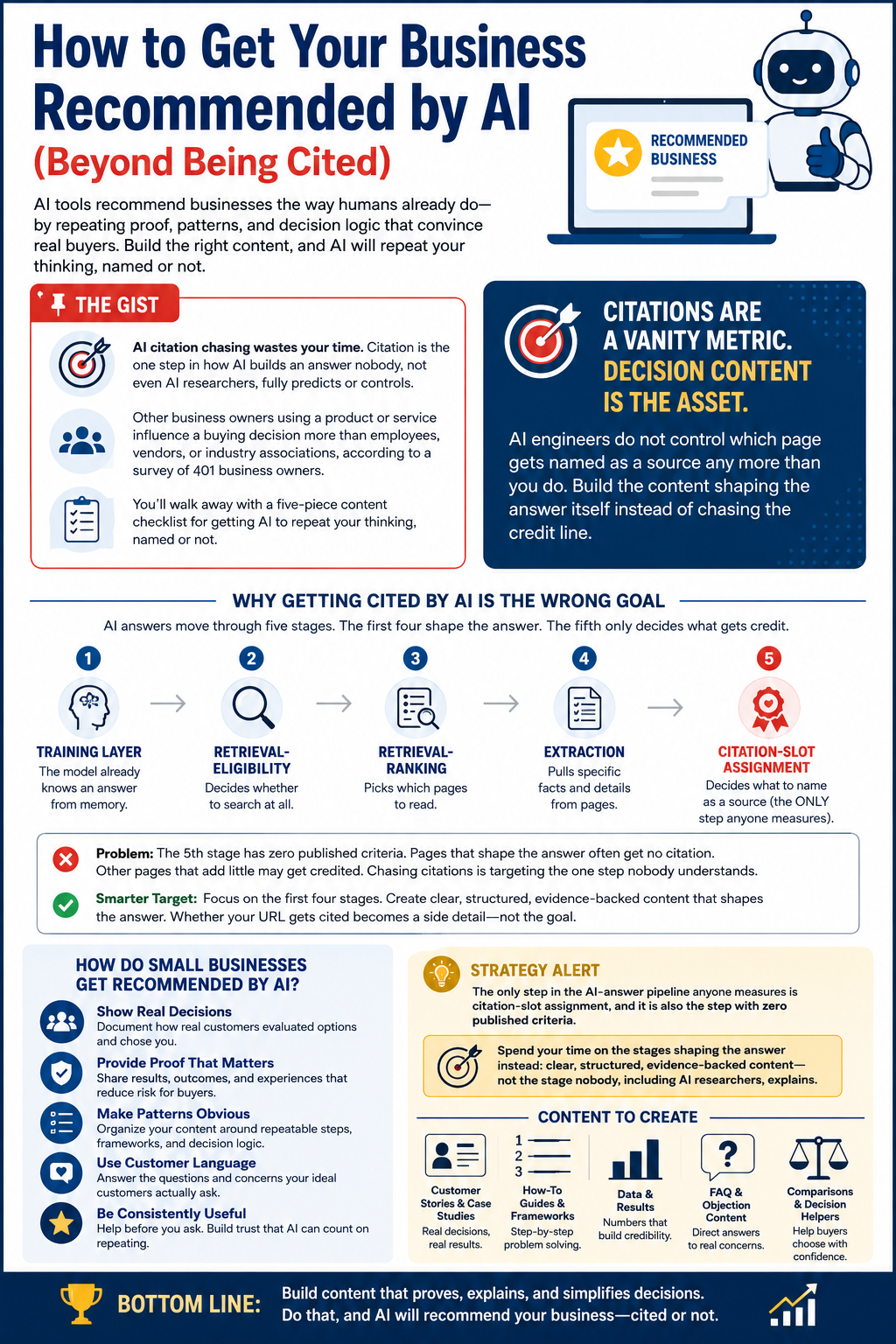
- AI citation chasing wastes your time. Citation is the one step in how AI builds an answer nobody, not even AI researchers, fully predict or control.
- Other business owners using a product or service influence a buying decision more than employees, vendors, or industry associations, according to a survey of 401 business owners.
- You’ll walk away with a five-piece content checklist for getting AI to repeat your thinking, named or not.
Getting your business recommended by AI has nothing to do with chasing mentions in ChatGPT or Google’s AI Overviews. AI tools recommend businesses the way humans already do, by repeating proof, patterns, and decision logic already proven to convince real buyers. Build content capturing how actual customers decided, and AI repeats your thinking, named or not.
I spent three months tracking AI Overview citations for DIYMarketers articles. The mentions climbed every week. Bookings from those articles stayed flat. This gap exposed a thinking error in my own GEO strategy. And I bet that you’re doing the same thing.
Why Getting Cited By AI Is The Wrong Goal
There is SO MUCH advice out there on how to create content that’s getting cited by AI. That’s important, but I think it misses the mark and I think it’s the wrong question.
AI search consultant Ann Smarty mapped out how AI tools build an answer, and the map explains why citation chasing leads nowhere useful. An AI answer moves through five stages: a training layer where the model already knows an answer from memory, a retrieval-eligibility stage where it decides whether to search at all, a retrieval-ranking stage where it picks which pages to read, an extraction stage where it pulls specific facts, and a citation-slot assignment stage where it decides what to name as a source.
Here is the problem. The first four stages shape the answer itself. The fifth stage, citation-slot assignment, only decides what gets credit. A page gets read, mined for facts, and woven into an answer, then never receives a citation. Another page contributing nothing might get name-checked anyway. Smarty puts it plainly: nobody has clarity on what determines the fifth step, even though it is the only part marketers measure.
Citation chasing targets the one stage in the pipeline nobody, including the engineers building these models, fully understands. The smarter target sits earlier in the pipeline: become the content shaping stages one through four, the ones determining what the AI ends up saying. Whether your URL gets named turns into a side detail instead of the goal.
Most small business owners pursuing AI visibility strategies stack schema markup and keyword variations aimed at a coin flip. The owners who show up inside AI-assisted decisions do something different. They build the kind of proof making an AI’s underlying logic agree with them, the same proof already moving real customers. If your current AI strategy looks like a longer list of AI marketing mistakes small business owners keep making, the fix starts with redirecting effort toward the stages shaping the answer.
How Do Small Business Owners Decide What To Buy?
The best way to get cited uses an SEO strategy and philosophy that has NEVER changed; write for your customer and provide information they are looking for so that they can make a decision.
The Alternative Board surveyed 401 business owners about purchasing decisions, and the results explain a lot about why AI citations carry less weight than marketers assume. Other business owners using a product or service influence a buying decision more than any other single source, ahead of employees, vendors, and industry associations. Younger business owners lean on this signal even harder than older ones.
Confidence works the same way. Personal trial and error convinced 64% of respondents, customer testimonials convinced 53%, and customer case studies convinced 47%. Vendor websites and sales reps ranked far behind. Business owners trust people who already bought the thing, tried the thing, and lived with the outcome.
HubSpot’s State of Entrepreneurship research backs this up at scale: 61% of entrepreneurs find new customers through word of mouth, more than any paid channel. Word of mouth and AI-assisted search run on the same fuel. A small business owner who gets recommended at a Tuesday coffee meeting and a small business owner who shapes an AI’s answer about their category both win the recommendation the same way, by being the proof someone else points to.
This pattern shows up across small business marketing trends heading into 2026, and it explains why a brand mention buried inside an AI answer means far less than a customer willing to vouch for you by name. The fundamentals did not change when AI search arrived. Recommendation still beats reach. AI reads the same signals humans already trust.
What Does AI Need From Your Content To Recommend You?
Caltech researchers studying trustworthy AI point to three things determining whether a model’s output holds up: clear data, transparency about how a conclusion got reached, and robustness, meaning small noise in the input does not flip the answer. Put plainly for content strategy: AI repeats sources stating a clear situation, naming the evidence, and skipping vague hand waving.
Deloitte’s 2026 Global Human Capital Trends research found 60% of executives now use AI regularly to support decisions, and the organizations getting real value treat decision-making as a discipline with explicit frameworks instead of a vague brainstorm. The same discipline applies at the scale of a single small business owner choosing a CRM or a marketing freelancer.
A blog post saying “this tool is great for small businesses” gives AI nothing to extract. A piece saying “a 12-person landscaping company with a $40,000 annual marketing budget switched from spreadsheets to this CRM after missing three follow-ups in one month, and closed 9 additional jobs in 90 days” gives AI, and a human reader, a complete decision unit: situation, trigger, constraint, action, outcome.
Most small business content reads like the first example. Decision content reads like the second. AI systems built to support real choices reach for the second kind every time, regardless of how to use AI in your small business or how often the word “AI” shows up on the page.

How To Get Your Business Recommended By AI
How to get your business recommended by AI starts with building five kinds of content most small business websites skip entirely.
Micro case studies. Write 150 to 300 word snapshots covering a real customer’s business context, the problem pushing them to act, their constraints (budget, time, skill level), what they did, and one to three concrete outcomes with numbers. BlueWhale Research found small companies under 50 employees lean heavily on this exact challenge-solution format, with 44 to 53% naming it the single most useful element of a case study. Five tight micro case studies beat one polished hero story every time.
Peer-voiced decision stories. Reframe testimonials as before-and-after decisions instead of generic praise. “Great service, five stars” tells nobody anything. “I almost canceled my email list because open rates sat under 8%, then one conversation with a subscriber changed three subject lines and open rates jumped to 22%” gives AI a reusable script for the exact situation a future customer faces.
Comparison and option-framing pieces. Lay out two or three real options for a specific situation, including the DIY option or doing nothing at all, organized around constraints and tradeoffs instead of feature lists. This format mirrors how an AI tool gets asked to compare choices for a person.
Simple ROI mini-briefs. Skip the spreadsheet. State cost, time to impact, the biggest risk, and the likely outcome for a defined scenario in four sentences.
Structure matters more than volume when you build social proof in this format. Five detailed micro case studies built around real customer situations carry more weight, with AI and with a human reader, than fifty generic testimonials saying a business “exceeded expectations.”
Why Knowing Your Customer Still Beats Any AI Trick
None of the five formats above work without one input: knowing your customer’s exact words, constraints, and decision triggers better than any AI tool, any competitor, and possibly better than the customer puts into words alone.
A landscaping company owner assuming customers care most about price might build comparison content around pricing tiers. The customer who canceled three quotes because nobody answered the phone within an hour cares about something else entirely. A wrong guess here breaks every piece of decision content built on top of it.
Five real conversations with current or lost customers surface this information faster than any survey tool or AI prompt. A clear picture of who buys, why they hesitate, and what finally moves them forward turns guesswork into raw material for every micro case study, decision story, and comparison piece described above.
This is the part AI cannot do for a small business owner. A model formats proof beautifully. It cannot generate proof not yet sitting inside a real customer relationship. The fundamentals stayed exactly where they always sat: know your customer better than anyone else, then let the content formats above carry the knowledge to wherever buyers, human or AI-assisted, are deciding.
What Should You Build This Week?
Pick one buying decision a future customer faces this quarter, choosing between hiring a part-time assistant or buying software, or deciding whether your service fits a tight six-week timeline. Build one micro case study, one decision story, or one comparison piece around this decision, structured with the labels above: situation, constraint, action, outcome.
The table below shows the difference between content built for citations and content built for decisions.
| If Your Content Looks Like This… | It Means… | Your Next Move |
|---|---|---|
| Your blog post lists generic benefits with no numbers | AI has nothing concrete to extract or reuse | Add one real customer scenario with a number attached |
| Your testimonials say “great service, highly recommend” | Humans and AI both skip it as unverifiable praise | Rewrite it as a before-and-after decision story |
| Your case study features a 500-employee client | Small business readers and AI both flag it as irrelevant | Add a micro case study sized to your actual audience |
A citation from AI was never the real goal. Recommendation, from a person comparing options over coffee or from an AI tool helping someone decide, comes down to the same work it always did: know your customer better than anyone, then build the proof this knowledge deserves.
Frequently Asked Question About How to Get Your Business Recommended by AI
Does it matter if AI tools never mention my business by name?
Not as much as marketers assume. The fifth stage of how AI builds an answer, citation-slot assignment, decides what gets named as a source, and nobody outside a model’s own training has clear visibility into how the decision gets made. A page gets read, mined for facts, and woven into an AI’s answer while never receiving credit. Meanwhile a page contributing nothing gets cited anyway. A name-check in the fifth stage means optimizing for the one part of the process you cannot reliably influence. The stages worth more attention sit earlier: whether your content gets found, gets read, and gets pulled into the underlying logic of an answer. A prospect reading an unnamed answer built from your facts often finds you anyway, through a follow-up search for the specific numbers or scenario your content described. Build content shaping the underlying logic and the credit line becomes a bonus, not the goal.
How is a micro case study different from a regular case study?
Most published case studies run 800 to 1,500 words, profile a flagship client, and read like a press release. A micro case study runs 150 to 300 words and covers five things in order: the customer’s business context, the problem pushing them to act, their real constraints, what they did, and one to three outcomes with numbers attached. Small companies under 50 employees prioritize this exact challenge-solution format over benchmarks or long-form outcome stories, according to BlueWhale Research. A consultant with three client relationships writes five of these in an afternoon, while one polished hero case study often takes a month of scheduling, approvals, and rewrites. Five micro case studies sized to your real customer base give both AI tools and human readers more usable decision material than one polished hero story sized for a client you do not have. Shorter, plainer, and built around a real constraint beats longer and more polished almost every time.
Do I need a content team to build decision content like this?
No. The format matters more than the production budget. A single small business owner with five real customer conversations writes a usable micro case study in under an hour once the five required pieces (context, problem, constraints, action, outcome) sit in front of them. The barrier is not staffing. It is collecting the raw material, which means having direct conversations with current and past customers instead of guessing at their reasons. A simple five-question interview script, covering context, problem, constraints, action, and outcome, turns any customer call into raw material a solo owner writes up the same day. Block thirty minutes this week for one customer conversation focused entirely on the decision leading them to hire you or buy from you. This single conversation becomes the spine of your first piece of decision content.
What if I only have a handful of customers to draw from?
A handful works fine, and arguably works better than a long list. Five detailed micro case studies, each pulled from a real conversation, give AI and human readers more specific, citable patterns than fifty generic five-star reviews. Depth beats volume in every survey on what convinces a buyer, including the 401-owner Alternative Board study showing personal trial and error and detailed testimonials outperform broad social proof. A consultant with three solid client relationships has more usable proof than a SaaS tool with three hundred anonymous five-star ratings and no story behind any of them. Start with your three best customer relationships, the ones where you know the full story: what almost stopped them from buying, what changed their mind, and what happened after. Three strong pieces of decision content beat thirty thin ones.
How long before this approach changes anything?
Expect weeks before AI-assisted search shows any movement, and months before it shows up clearly in referral conversations or new leads. Decision content works on two timelines at once. Humans reading a sharp comparison piece or a specific micro case study act on it the same day. AI tools retrain, re-crawl, and re-rank on their own schedule, usually slower than a human reader and impossible to predict precisely. Build for the human reader first. A prospect reading a micro case study matching their exact situation converts whether or not an AI tool ever surfaces the page. Track referral conversations and sales call mentions alongside search rankings, since decision content often shows up there first, well before any AI tool starts citing the page directly. AI visibility tends to follow once the content does its job for humans first.
Additional Reading:
- This Buyer Persona Generator Will Get You Inside Your Customer’s Head
- Why Customers Leave Big Companies for Small Business
- How to Think Like a Marketer
Sources cited:
- Ann Smarty, “How Are AI Answers Generated”
- The Alternative Board, “How Business Owners Make Buying Decisions”
- HubSpot, “The State of Entrepreneurship Report”
- BlueWhale Research, “Are Your Case Studies Effective?”
- Caltech Science Exchange, “Can We Trust Artificial Intelligence?”
- Deloitte Insights, “AI and the Future of Human Decision-Making”