
In This Article

- A guarantee works when it removes one named fear, and do-the-work offers need two promises: one rewards the person doing the work, one protects the person paying.
- In eight studies with 5,025 people, participants stuck with a program longer when they had to finish a small block of work before any reward kicked in.
- You walk away with a five-part guarantee checklist, the Two-Promise Guarantee template, and wording a business owner will sign for employee training.
If you want to know how to create a guarantee, start with your buyer’s biggest fear, then write five parts: the promise, the conditions, the remedy, the time window, and the claim process. When the result depends on your customer doing the work, split the guarantee into two promises: one rewards the participant for a few verified actions, and one protects the buyer if those actions fail to produce progress.
These days, we’re in an economy where every single buyer wants to avoid risk. They want to make sure that the money they are spending with a business will deliver on the promise. And the best way to do that is with a guarantee. When we think of a guarantee, we think of “100% satisfaction or your money back.” But that isn’t always the best type of guarantee to offer. In today’s article, I want to dig deeper into how to create a guarantee that reduces or eliminates risk for the buyer.
But first, a little history.
In January 2009, car buyers were terrified of layoffs. So Hyundai skipped the usual pitch about engines and warranties. The company promised buyers the right to return a financed or leased car if they lost their income within a year, with no damage to their credit.
Hyundai rode the program to become one of three brands to post a U.S. sales gain in 2009, and the partner managing it paid off more than $8 million in consumer debt. Hyundai won by naming the exact fear sitting in the showroom.
Your customers carry a fear too. For coaching, fitness, courses, and employee training, the fear has two layers: “Will I waste the money?” and “Will I, or my team, even do the work?” A single money-back promise answers the first question and ignores the second.
A business guarantee is a written promise stating what you will do if the purchase fails to deliver what the buyer paid for. It works as a sales tool when it removes the specific risk stopping someone from buying.
Why are small purchases getting the big-decision treatment?
Shoppers now bring car-buying caution to a $49 purchase. Salsify’s 2026 consumer research found 39% of shoppers compare prices more carefully before they buy, and 38% have cut back in certain categories.
Shoppers also want proof before they want a deal. A Syndigo study of more than 8,700 consumers found ratings and reviews (53%) and detailed product descriptions (52%) now outrank a discount (49%) as the factors people weigh most. BCG’s 2026 research adds nearly 70% of consumers won’t buy something within their budget if it lacks perceived value.
My read: the no-brainer purchase is gone. Buyers want evidence, and when your evidence runs thin, they want protection. Your guarantee sits right beside your social proof and your perceived value as the third leg of the buying decision. It also makes how to create a guarantee one of the most practical sales questions you will answer this year.
What fear should your guarantee remove?
The first step in how to create a guarantee is naming one specific fear about the transaction and removing it. The guarantees with the best track records all do this. Look at what each of these companies promised:
| Business | The buyer’s fear | What the guarantee covers |
|---|---|---|
| Hyundai | Getting stuck with car payments after a layoff | Return the car if you lose your income in year one |
| CarMax | Regretting a big purchase after living with it | A return window after you take the car home |
| FedEx | Paying full price when the package arrives late | A refund or credit on eligible services when FedEx misses its delivery commitment |
| BloomTech | Finishing the program and still not getting hired | Tuition back plus 10% for graduates who meet job-search requirements and get no qualifying offer |
BloomTech deserves a second look. The school ties its promise to behavior the student controls (the job search) and an outcome the school influences (a job offer). This structure is the backbone of every guarantee in this article.
Refunds carry a limit too. Hampton Hotels ran an unconditional money-back guarantee for 25 years, and when the brand studied its own data, it found refunding a stay did not automatically lead guests to plan a return visit. A refund calms the moment. Progress keeps the customer.
What should a guarantee include?
Once you know the fear, the rest of how to create a guarantee comes down to five parts. Write each one in a sentence or two:
- The fear: the one thing your buyer worries about, such as wasting money, getting stuck, or doing the work and seeing no progress.
- The promise: what you cover, stated in measurable terms and tied to something you control or influence.
- The conditions: zero if you control the outcome, three to five if the customer does the work, each with a number, a deadline, and a proof requirement.
- The remedy: a redo, extra support, a service credit, a partial refund, or a full refund, matched to the fear.
- The window and claim process: how long the guarantee lasts, how to claim it, and how fast you respond.
Use this list as your checklist for what to include in a guarantee, whether you sell a $49 template or a $5,000 program. Different combinations of the five parts produce the four common guarantee types: unconditional satisfaction guarantees (Hampton), return windows (CarMax), service-level promises (FedEx), and conditional results guarantees (BloomTech).
Keep exclusions to events which prevent you from delivering, such as a client canceling the project. Broad exclusions like “at our discretion” tell careful buyers the promise exists to avoid paying.
For ready-to-use wording on simple services, grab one of my guarantee examples for small business. Coaching, fitness, and employee training hand the outcome to your customer, and those offers need the extra structure below.
The Two-Promise Guarantee is a DIYMarketers framework for offers where the customer does the work. One promise rewards the participant for verified actions, and a second promise gives the buyer a defined remedy if those actions fail to produce the agreed progress.
How to create a guarantee when your customer has to do the work
The method for how to create a guarantee on a do-the-work offer has two moves: reward a few verified actions, and tie your remedy to progress you influence. A coaching guarantee, a fitness guarantee, and an employee training guarantee all need this structure.
Weight loss coaches, personal trainers, course creators, and corporate trainers share one headache. The result depends on effort you don’t control. A client skips workouts, an employee ignores the training, and your guarantee turns into a refund for someone who never tried.
The usual fix is a conditional money back guarantee buried under a wall of conditions: attend every session, complete every worksheet, follow all advice. Buyers read the fine print and conclude you wrote the guarantee so you would never have to pay it.
The fix: pick three to five actions with a clear link to the result, skip the rest of the curriculum, and sort everything into three layers:
- Behavior (the participant controls it): 20 logged calls to qualified prospects per week, four completed workouts, five recorded practice sessions.
- Leading result (your program influences it): appointments requested, a measurable strength or fitness benchmark, a skill demonstrated on a recorded call.
- Lagging outcome (too many outside forces): revenue, final goal weight, a promotion.
Tie your remedy to the leading result. Lagging outcomes depend on pricing, markets, metabolism, and managers you will never meet, and a promise you control is a promise you keep.
What should the person doing the work earn?
The person doing the work should earn a reward in stages, starting after a small first block of work. Rewards form the first half of how to create a guarantee for a do-the-work offer, and the research gets specific about timing.
In the Journal of Consumer Research, eight studies with 5,025 participants found people persisted longer when they had to complete a set number of actions before rewards began. The effect weakened when the first stretch of work ran too long.
Put this into practice with a work-first milestone. The participant completes the first 20% to 30% of required actions, which opens the reward pool, then earns smaller portions at each milestone after.
Streaks add fuel. Across six preregistered studies with 4,493 participants, escalating rewards for consecutive completions produced more work than larger flat payments. Build in one declared recovery day so a single sick day doesn’t wipe out a month of effort.
Watch quality. A 2025 study found an all-or-nothing completion reward produced more full completions and lower-quality work. So “20 dials” loses to “20 dials to qualified prospects, logged in the CRM with a next step.”
For employee programs, let the participant pick the reward before the program starts. A capped menu keeps the boss’s cost fixed while the employee chooses what feels valuable:
- $500 cash or a general-purpose gift card
- $250 cash plus a $250 professional development credit
- One paid day off plus a $250 gift card
- $500 toward a conference or association membership
Should you make customers put money on the line?
Keep deposits optional. The research favors rewards over penalties for most customers.
Deposit contracts look like a shortcut when you work out how to create a guarantee, since customers with money on the line seem likelier to show up. The data disagrees. In a controlled physical activity study, 62% of people signed up for the deposit version and 100% signed up for the reward version, with no statistically significant difference in effectiveness.
Loss framing carries its own cost. Research published by the American Economic Association points to negative consequences from loss-framed performance incentives, the “keep the bonus unless you fail” model.
What does a guarantee look like when the boss pays and the employee does the work?
When the boss pays and the employee does the work, the guarantee protects the boss and the reward drives the employee. Employee training puts the hardest test on how to create a guarantee. The owner pays. The employee does the work. The owner’s fear sits two steps away from the employee’s motivation.
Take a sales trainer I advised who sells a prospecting program to real estate brokerages. Her first draft offered each associate a $500 reward for completing the work. The reward motivated the associate. It did nothing for the broker who signed the check.
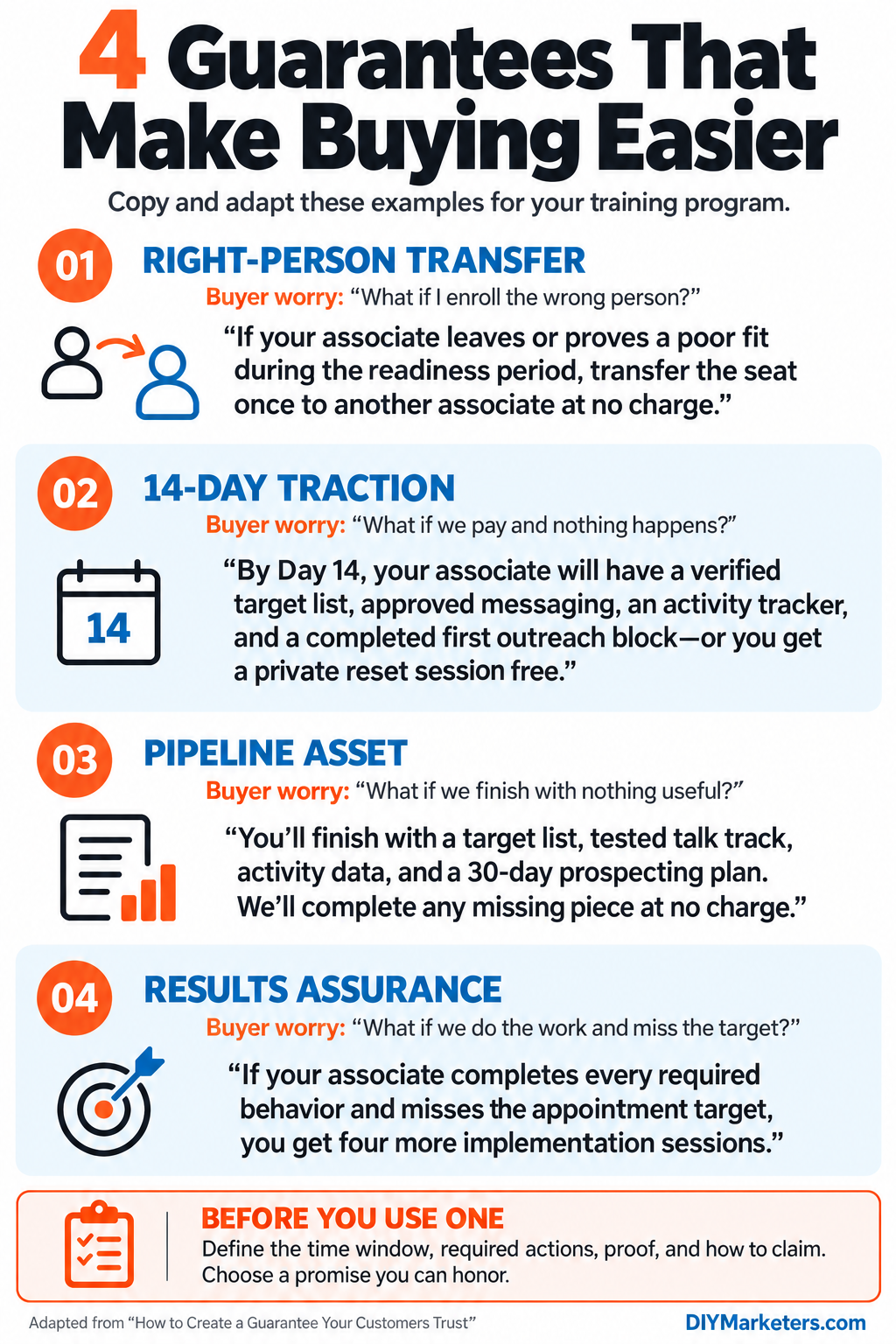
So we listed what would make the broker regret the purchase. Four fears came up: picking the wrong person, weeks passing with no activity, another management project, and finishing with nothing to show. The guarantee we drafted covers each one:
- Right-person transfer: if the associate leaves or proves a poor fit during the readiness period, the seat transfers once to another associate at no charge.
- 14-day traction: by Day 14, the associate has a verified target list, approved messaging, an activity tracker, and a completed first outreach block, or the broker gets a private reset session free.
- Pipeline asset: the brokerage finishes with a target list, tested talk track, activity data, and a 30-day prospecting plan, and she completes any missing piece at no charge.
- Results assurance: if the associate completes every required behavior and misses the appointment target, the brokerage gets four more implementation sessions.
The associate still earns the $500, paid in five $100 milestones. The reward drives the work. The guarantee protects the broker’s decision.
Complete the four Success Behavior milestones on your scorecard and earn one-fourth of your reward at each one. If you complete all four to standard and do not reach [leading result] by [date], we provide [30 days of added coaching / a service credit / a defined partial refund]. Miss a milestone, and you keep what you earned and get one recovery window.
Two-Promise Guarantee template, DIYMarketers
How to create a guarantee customers believe
The rule for how to write a guarantee people trust: short, specific, and easy to claim. Specific beats generous when you decide how to create a guarantee. Conversion Rate Experts reported a computer repair company, Geeks2U, saw 11% and 21% sales lifts in A/B tests after it made a specific guarantee prominent on its page.
A clear guarantee also shortens the sale. It answers the unspoken worry behind “let me think about it,” which I cover in my guide to speeding up the sale, and it carries extra weight when you sell high ticket offers. Hold yourself to deadlines too: publish your feedback turnaround so the accountability runs both ways.
Run your current guarantee through this table:
| If your guarantee says this… | It means… | Your next move |
|---|---|---|
| “Complete all modules” | A subjective hurdle buyers read as rigged | Name three to five leading actions with proof requirements |
| “Results guaranteed” | You promised a lagging outcome outside your control | Guarantee a leading result you influence |
| “We’ll work with you until you succeed” | Open-ended liability, which buyers find hard to believe | Set a firm endpoint, such as 30 days or four sessions |
| “Full refund, no questions” | Protection with no path to progress | Offer continued support or a credit, with a refund as the backstop |
| “Deposit required” | Fewer people sign up | Make the deposit an opt-in |
The whole method for how to create a guarantee fits in one sentence: name the fear, reward the actions, and protect the progress.

Frequently asked questions about guarantees
What should be included in a business guarantee?
A business guarantee should include five parts: the fear it removes, the promise, the conditions, the remedy, and the claim process with a time window. Start by naming the one fear your buyer brings to the purchase, such as wasting money, getting stuck, or doing the work and seeing no progress. Write the promise in measurable terms, tied to something you control or influence. List conditions only when the result depends on the customer, and cap them at three to five, each with a number, a deadline, and a proof requirement. Choose a remedy which matches the fear: a redo, extra support, a credit, a partial refund, or a full refund. Close with how long the guarantee lasts and exactly how to claim it, ideally through one short form. Keep exclusions to events which prevent delivery, because broad discretionary exclusions make careful buyers assume the promise exists to avoid paying.
How do you create a guarantee for coaching when clients have to do the work?
You create a guarantee for coaching by tying your promise to a short list of verified actions and a leading result you influence. Choose three to five behaviors with a direct link to progress, such as completed workouts, logged sales calls, or recorded practice sessions. Define the proof you accept for each one, the deadline, and what happens after a miss. Then promise a remedy only when the client completes those behaviors and the agreed progress still fails to show up. The remedy works best as additional sessions or a service credit, with a partial refund as the backstop. Clients who skip the work never trigger the remedy, and clients who do the work get real protection. Add a reward for hitting milestones, paid in stages, so clients have a reason to keep going during the hardest weeks, and give each client one recovery window for a missed milestone.
What is a conditional money back guarantee?
A conditional money back guarantee refunds the customer only after specific conditions are met, such as completing required actions or submitting proof within a set window. Service guarantee research suggests conditional guarantees reduce perceived risk and unconditional versions do not always reduce it further, provided the conditions stay relevant and easy to invoke. The danger lies in stacking conditions. When buyers see “attend everything, finish every worksheet, follow all advice,” they assume the business wrote the guarantee to avoid paying. Keep conditions to a handful of actions with a clear connection to the result, state each one with a number, a date, and a proof requirement, and make the claim process simple. A short submission form beats a negotiation. The fewer and clearer the conditions, the more credible the promise looks on your sales page, and the easier it becomes for your team to honor claims consistently.
Should a guarantee include a full refund?
A guarantee should include a full refund when you control the outcome and a bad experience cannot be fixed, such as a hotel stay or a missed delivery. For programs where the customer does the work, a full refund often works against you, because it pays people to leave before your program has a chance to work. Offer continued support first: extra coaching sessions, an implementation reset, or a service credit with a firm endpoint. Keep a partial or full refund as the final backstop for customers who completed every required action and still saw no progress. Hampton Hotels found refunding a stay did not automatically lead guests to plan a return visit, which shows a refund calms the moment without building loyalty. Progress keeps customers, so structure your remedy around getting them to the result, and spell out the exact support package so buyers know what they receive.
What rewards motivate employees to finish training?
Rewards motivate employees to finish training when they arrive in stages, start after an early milestone, and let the employee choose the form. Research on work-first rewards found people persist longer when they complete a set block of actions before rewards begin. Escalating rewards for consecutive weeks of the target behavior also produced more effort than larger flat payments in preregistered studies. A practical setup gives each employee a capped reward, such as $500, split into five $100 milestones tied to verified actions. Let the employee pick from a short menu before the program starts: cash, a gift card, a paid day off, or a professional development credit. Choice raises the perceived value without raising the cost to the business. Avoid rewarding attendance alone, because the business gains little from a seat in a room, and avoid all-or-nothing prizes, which push people to rush through low-quality work.