
In This Article

- Trust never disappears when a big brand breaks it. It moves. The Trust Transfer Playbook positions your small business to catch it.
- Buyers now waste $252 a year on subscriptions they never use, and a net 38% of small businesses raised prices in June, the highest reading in three years. Buyers have money and zero patience.
- You will leave with seven moves big brands are structurally unable to copy, plus the numbers to watch so you know the strategy is working.
How to compete with big companies comes down to one asset in 2026: trust. Buyers are spending more and trusting less. Big brands keep shedding customer trust through unexplained price hikes, chatbots, and shrinking value. Small businesses win by catching the trust in motion, making their honesty visible, and proving value every single month. The seven moves below show you exactly where to start.
Three numbers crossed my desk this week. The average American now spends $111 a month on subscriptions and wastes $252 a year on ones they never open, according to CNET’s 2026 subscription study. Consumer sentiment hit a five-month high in July, driven almost entirely by cheaper gas. And a net 38% of small business owners raised prices in June, the highest reading since January 2023, per NFIB’s Small Business Economic Trends survey.
Put those together and a picture forms. Buyers have money. What they lost is patience. They are paying more, getting less, and running a quiet audit on every dollar leaving their accounts.
Big brands built this moment. They swapped service teams for chatbots and called it innovation. They shrank the product, kept the price, and said nothing. Each move pushed a little more trust out the door.
Here is the part nobody else is telling you. Trust like this never disappears. It moves. Right now it is circling your market, looking for somewhere to land.
Why buyers are pulling back from big brands right now
The University of Michigan’s July 2026 numbers tell a specific story. Sentiment rose 10% to 54.4, its best reading since February. Even so, buyers sit 12% gloomier than a year ago, still hunting deals and trading down. The lift came from gas prices and relief at the pump. None of it came from renewed faith in the companies selling to them.
Translate Hsu’s caution into buyer behavior and you get a customer in audit mode. They review every recurring charge. They question every renewal. They pull back from anything unable to prove its place in the budget.
The subscription data makes the pattern measurable. Subscription spending rose 23% in a year while the waste pile grew right alongside it. Buyers keep paying for things they stopped seeing value in, and they resent it more every month.
This is where the opportunity sits for you. Buyers are hunting for honest, legible businesses rather than cheap ones. They want to know what they are getting, what it costs, and what happens when something goes wrong. Big brands spent a decade engineering those answers out of the customer experience.
What is the Trust Transfer Playbook
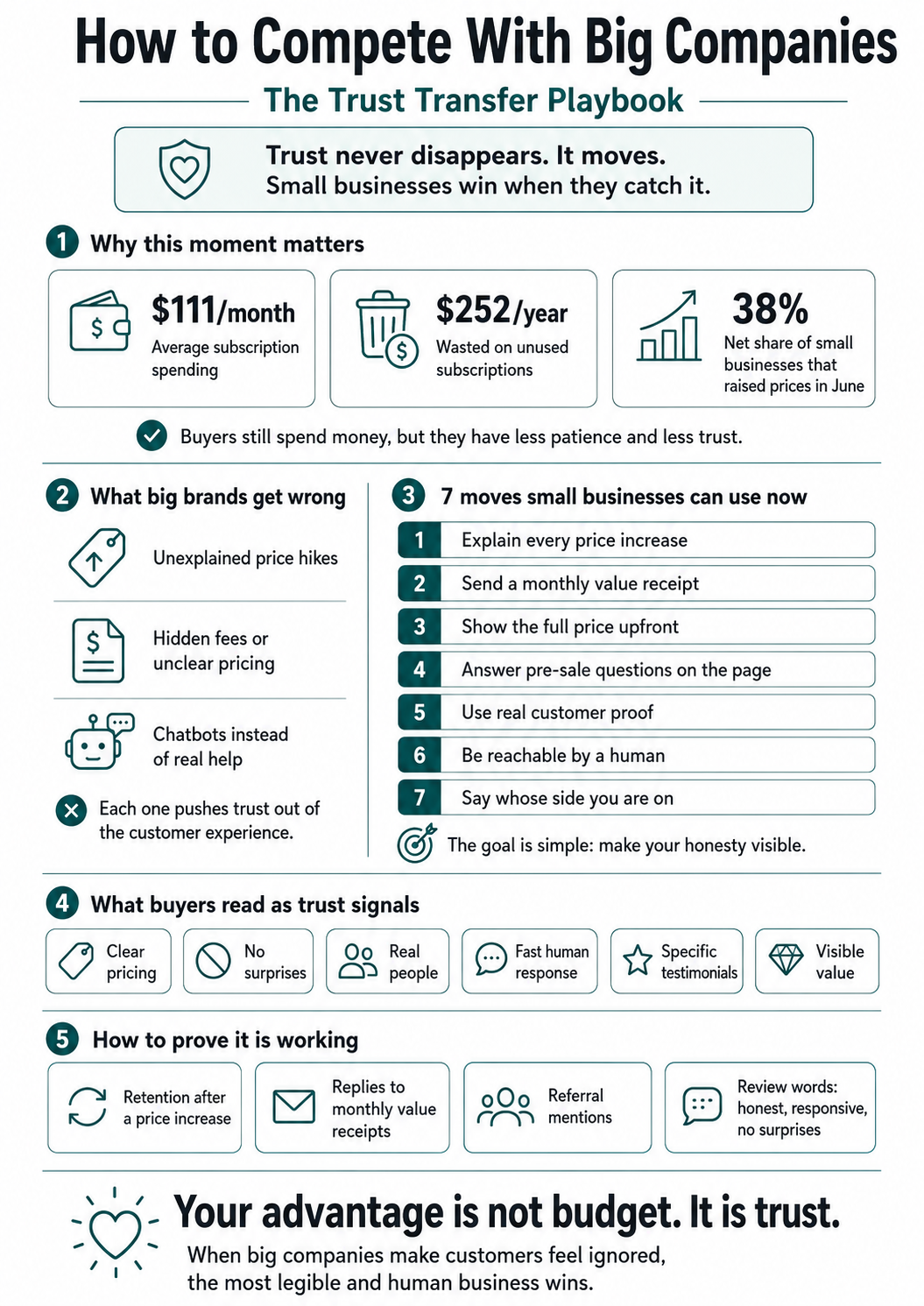
The Trust Transfer Playbook is my framework for capturing the customer trust big brands release every time they raise a price without explanation, bury a fee, or replace a human with a script. It rests on one principle: trust moves. When a big brand breaks it, buyers carry it to the next business willing to prove they deserve it.
Most advice on how to compete with big companies tells small business owners to niche down, out-service the giants, or find cheaper channels. All fine. All incomplete. The missing piece is timing. Trust becomes available in waves, and the wave breaking right now, measured in sentiment surveys and subscription churn, is one of the largest I have seen in twenty years of working with small businesses.
The playbook has seven moves. Each one converts something you already do into something buyers see. Visibility is the whole game here, because invisible honesty earns you nothing.
How to compete with big companies when you have no ad budget
This is how to compete with big companies. You make yourself the most legible option in the market while the giants keep hiding behind fine print. Work through these seven moves in order, one per week if you need to pace it.
1. Explain every price increase in one honest sentence
NFIB’s June data shows small business pricing power at a three-year high, and a net 32% of owners plan more increases in the next three months. Most of those increases will go out with no explanation attached. Silence is the big-brand play, and it burns trust on contact.
When you raise a price, say why. One sentence, specific and true. “We added a second round of revisions to every project” lands differently than “due to rising costs.” The first sounds like a person who respects you. The second sounds like an airline. I walk through the exact sequence, value first, number second, options third, in my guide on how to communicate a price increase to customers.
2. Send a monthly value receipt
The $252 in wasted subscriptions points at something most owners miss. Customers rarely cancel because the value stopped. They cancel because they stopped seeing it. Different problem, different fix.
Every buyer with a recurring charge is one bank-statement review away from asking whether you earn your line item. Beat them to the question. Send every client or member a short recap each month. Skip the newsletter format. Make it a receipt: hours saved, problems solved, deliverables shipped. Three lines with real numbers.
Big subscription businesses bank on inertia. They hope you forget you are paying. You win by doing the reverse: making sure your customer always knows their money worked.
3. Show the full price before the buyer asks
Capital One Shopping’s pricing psychology research found reference points raise perceived value by 32%. A 2025 review of pricing studies adds two more numbers: all-inclusive bundles lift perceived value 20% and satisfaction 15% among first-time buyers versus a menu of add-ons.
Both findings work for the same reason. They remove uncertainty. A buyer forced to do math, or to guess what is included, sits one unanswered question away from closing the tab.
Open your main offer page today. Does it show a buyer what they get, line by line, before it shows the price? If it doesn’t, fix it this week. List the à la carte total. List what is included. Show the final number. You are showing everything, and in this market showing everything reads as a competitive weapon.
4. Answer the pre-sale questions on the page
Friction kills more sales than price does. A buyer hits a question your website ignores, decides contacting you costs too much effort, and leaves. Big brands staff entire optimization teams against this problem and still fumble it, because the process sits three departments away from anyone who talks to customers.
You talk to customers. You already know what they ask before they buy. Write the real questions down and answer them on your sales page. “What happens if I’m not happy?” “Do I need a contract?” “How fast will I see results?” Answer those in plain language and watch your conversion rate respond.
5. Put real customers on the page
Big brands spend millions on campaigns built around vague emotional promises. You hold something they will never manufacture: real people with real results who will say so on the record.
A specific testimonial outworks a polished ad every time in a skeptical market. “Ivana helped me figure out why my emails weren’t converting and fix it in two weeks” does more than any headline you write about yourself. Ask three current clients for one sentence about what changed since they hired you. Include what they were struggling with before. Put it where new buyers see it.
6. Be reachable by a human who fixes things
Customer service is where big companies made their loudest, most visible mistakes. Hold times, scripted chat, offshore support with no authority to solve anything. Buyers know the experience by heart and they hate it.
A real person who knows the account, responds within a day, and holds the authority to fix a problem is a genuine differentiator in 2026. It sounds obvious because it is. A Fortune 500 company is structurally unable to offer it at scale, and the ones who tried cutting their way to profit learned why cutting customer service costs doesn’t improve profit. Make your accessibility visible. Publish a real response time on your contact page. Show your face. Those are trust signals, and buyers price them in.
7. Say out loud whose side you are on
The deepest driver of big-brand fatigue goes past price and service. Buyers sense large companies optimize for shareholders first and customers somewhere further down the list. They are right, and they know they are right.
Your business gets to run the other direction: solve the customer’s problem, price it at real value, deliver it through a person who shows up. State it plainly in your marketing as a description of how you operate rather than an attack on anyone else. Buyers who find a business they trust spend more, refer more, and stay longer. The economics of trust compound in a way no ad budget replicates.
What buyers read as trust signals
| If a Buyer Sees This… | It Signals… | Trust Moves… |
|---|---|---|
| A price increase with a one-sentence reason | This business respects me enough to explain | Toward you |
| A monthly receipt of value delivered | My money is visibly working | Toward you |
| Full pricing with everything included, listed up front | Nothing is hidden here | Toward you |
| “Due to rising costs” with no specifics | I am being managed | Away from whoever sent it |
| A chatbot guarding the contact page | Nobody here wants to talk to me | Away from whoever built it |
How to compete with big companies and prove it is working
The second half of how to compete with big companies is proof. My whole philosophy at DIYMarketers is marketing risk reduction. Every dollar a small business wastes on marketing is a survival threat, so no strategy earns a permanent spot in your week without proof. The Trust Transfer Playbook is measurable, and you should measure it.
Watch four numbers. First, retention through your next price increase: what share of customers stayed? Second, reply rate on your monthly value receipts, because replies mean people read them. Third, referral mentions, as in new customers who name an existing customer when asked how they found you. Fourth, the language inside your reviews. When words like “honest,” “responsive,” and “no surprises” start appearing, the transfer is underway.
Set a baseline for each number this week, then check monthly. If you want a structured way to do it, my guide on how to benchmark your small business shows you how to build customer-expectation benchmarks without buying data you don’t need.
The trust is moving whether you catch it or not
Buyers are in audit mode. They review what they spend, question what they get, and drop whatever fails to earn its place. The businesses surviving the audit are the legible ones, where a buyer sees in seconds what they get, why it costs what it does, and who answers when something breaks.
Master how to compete with big companies in this market and you inherit a strange gift. Your biggest competitors are running a multi-year campaign to convince their customers to leave. Your job is to be standing in plain sight, receipts out, human available, when those customers start looking. Most small business owners already operate honestly. The ones who win will be the ones who make it visible.
Frequently asked questions
How does a small business compete with big companies?
A small business competes with big companies by winning on trust rather than budget. Big brands hold the advantage in reach, pricing leverage, and ad spend, yet they keep losing the one thing buyers want most in 2026: a clear, honest exchange with a business who answers. Start with legibility. Show buyers exactly what they get, what it costs, and what happens when something goes wrong. Explain every price change in plain language. Send current customers a monthly recap of the value they received. Keep a real person one message away from every account. None of these moves requires an ad budget, and none of them scales inside a Fortune 500 org chart, which is exactly why they work. The businesses winning customers away from big brands right now are the ones making their honesty visible on the page instead of assuming buyers will sense it on their own.
Why are customers leaving big brands for small businesses?
Customers are leaving big brands because the value exchange stopped feeling fair. Years of shrinkflation, unexplained price increases, chatbot-only service, and auto-renewal traps created a measurable erosion in buyer trust. CNET’s 2026 subscription study found the average adult now spends $111 a month on subscriptions while wasting $252 a year on ones they never use, a clear sign people feel they pay more than they receive. University of Michigan data from July 2026 shows sentiment still sits 12% below year-ago levels even as it improves, which reflects persistent buyer defensiveness. When a buyer in this mood meets a small business with transparent pricing, a reachable owner, and visible proof of results, the contrast does the selling. The move away from big brands is less about ideology and more about buyers protecting themselves from companies who treated their patience as an infinite resource.
What advantages do small businesses have over big companies?
Small businesses hold four structural advantages no enterprise replicates at scale. First, direct access: a buyer reaches a decision-maker in one step, while big brands route them through tiers of scripted support. Second, honest pricing: you explain a price change in one sentence, while a public company answers to a revenue model built on complexity and quiet increases. Third, visible proof: your testimonials come from real, named customers a prospect might even know, which outperforms brand advertising in a skeptical market. Fourth, speed: you fix a problem the day it appears, with no ticket queue in between. Each advantage matters more in 2026 than it did five years ago because buyers are actively auditing their spending and rewarding businesses they understand. The catch is visibility. These advantages only convert when your marketing shows them, which is the entire purpose of the Trust Transfer Playbook.
Should small businesses raise prices right now?
The data says the window is open and narrowing. NFIB’s June 2026 survey shows a net 38% of small business owners raised prices, the highest share since January 2023, while the share planning future increases slipped two points, an early sign the pricing cycle is cooling. If a raise is overdue, move this quarter, and pair the new number with a one-sentence explanation of what changed or what is now included. Buyers accept increases from businesses they trust and understand. They reject increases that arrive silently, because silence is the big-brand pattern they are already fleeing. Announce the change in advance, lead with the value, and offer at least one option, such as locking the current rate through the next renewal. Handled this way, a price increase becomes a trust deposit rather than a churn event.
What is the Trust Transfer Playbook?
The Trust Transfer Playbook is a DIYMarketers framework for capturing the customer trust big brands release every time they raise prices without explanation, hide fees, or replace humans with scripts. It rests on the principle of trust in motion: broken trust never evaporates, it travels to the next business willing to prove it deserves it. The playbook contains seven moves: explain every price increase in one honest sentence, send a monthly value receipt, show full pricing up front, answer pre-sale questions on the page, display specific customer testimonials, stay reachable through a real human, and state your operating principle out loud. Each move converts honesty you already practice into honesty a buyer sees before purchasing. Progress is tracked through four numbers: retention through a price increase, value-receipt reply rates, referral mentions, and the language appearing in reviews.
Additional reading
- Why Customers Leave Big Companies for Small Business. The 4-metric audit revealing whether you are positioned to catch them.
- Keep Customers When Raising Prices. The value method for making an increase stick without churn.
- New Survey Reveals Consumer Preferences for Small Business. Why buyers root for you before you say a word.