
In This Article

- Free marketing without a process is expensive busywork, you spend zero dollars and burn the one resource you can’t replace: time.
- 42% of small business owners have less than one hour per day for marketing, yet most “free marketing” advice hands them a list of 25 tactics and says “get started.”
- A five-step marketing process tells you exactly where to point your limited time before you post a single thing, and it’s the reason two business owners doing the same “free” tactics get completely different results.
You want to know how to market your business for free without wasting time on random tactics that go nowhere. Start here: research the problem your customers want solved, define the specific customer you can help, create an offer they understand and want, choose one marketing strategy that fits where they look for solutions, and measure the result. The process comes first, etime, because without it, free marketing becomes an expensive hobby you pay for in hours.
I’ve been doing this for over 35 years, and I still see the same mistake in nearly esolopreneur conversation I have. They show up with a list of free marketing ideas, post on social, claim Google Business, start a newsletter, join Facebook groups, make short videos, and they do all of them at once, halfheartedly, for three weeks. Then they conclude “marketing doesn’t work for my business.” That’s not a marketing problem. That’s a process problem. There’s a difference, and it’s worth getting angry about.
Should I spend my time or my money on marketing when I have little of both
There is never enough time or money for marketing, especially when you have little of both, But do nothing, get nothing.
But here’s where I will give you some insider advice — don’t spend time and money on marketing “ideas”. Marketing ideas are those silver bullet tactics you hear on some video or instagram post or article or in a room. That is NOT where your time and money should go.
Instead, focus your efforts on the marketing process. And if you’re going to focus on the marketing process, focus on research; getting a deep understanding of your market, and your ideal customer to the point where you understand how they breathe. This one step of the process will help you focus and put your time and money toward just those activities that will generate new ideal clients.
Why most advice on how to market your business for free is quietly lying to you
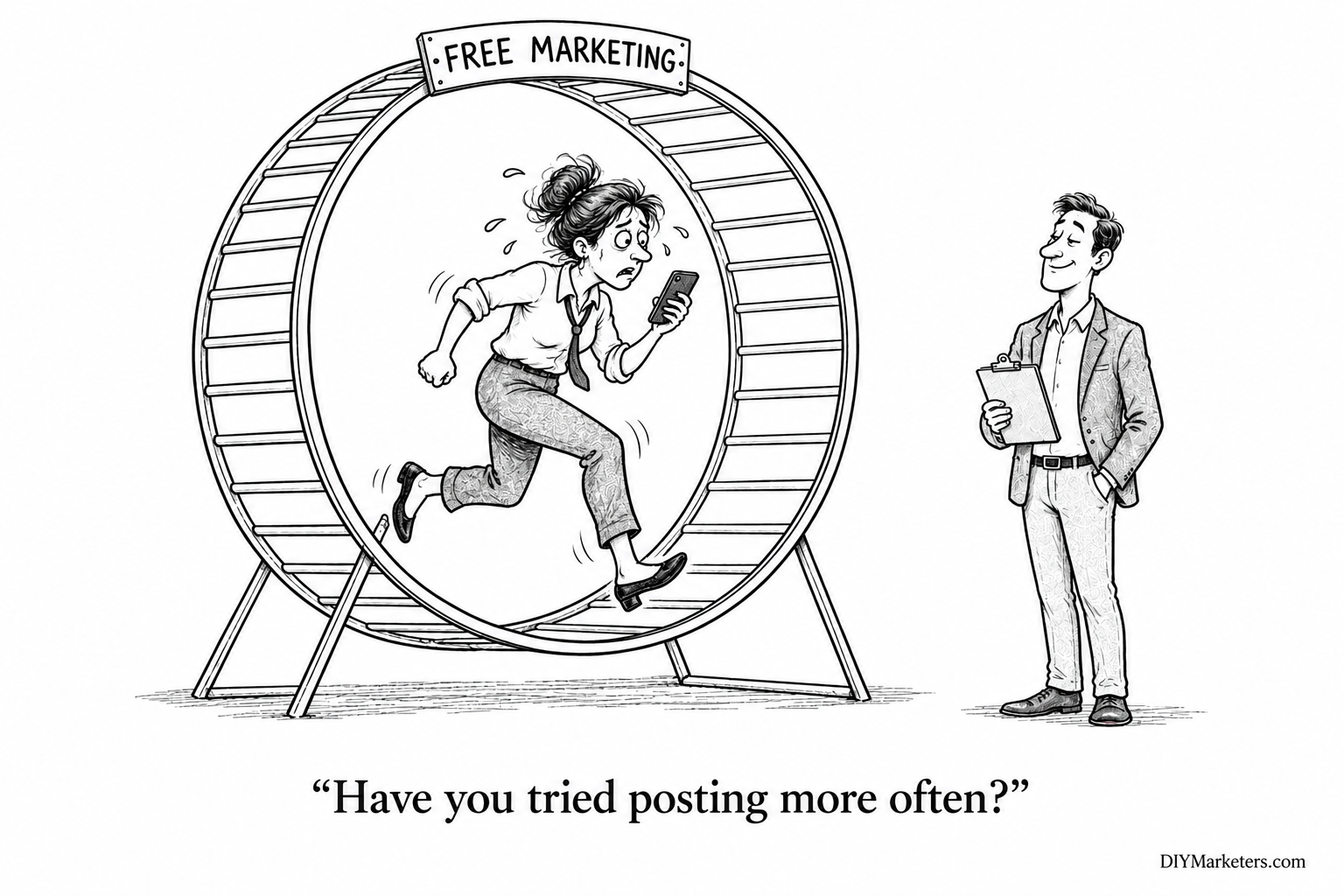
This is such a peeve of mine because it’s literally stealing your marketing budget. Experts and software companies KNOW that you don’t know how marketing works. And the easiest thing to do is to lean in your natural tendencies to DO SOMETHING.
Here’s what the internet says when you search for how to market your business for free:
- Start posting on social media
- Claim your Google Business Profile
- Start a newsletter
- Ask for referrals
- Join Facebook groups
- Make short-form videos
- Write blog posts
- Network at events
- Use AI to create content faster
Every single one of those things is free. And every single one of them is also a trap if and when you do them before you know who you’re trying to reach, what you’re offering, and why anyone should care.
Just because a tool or tactic is free doesn’t mean anything if you don’t know where and how to use it. A paint roller is free to borrow. It still makes a mess on walls you weren’t supposed to paint.
The real reason marketing strategies fail for small businesses isn’t budget. It’s sequence. Owners implement before they plan, post before they research, and measure clicks before they measure customers. The five-step process I’m walking you through fixes the sequence, and it costs nothing to follow.
What is the five-step free marketing process?
The simple marketing process for small business has two sides: a planning side and a doing side. The planning side covers research, ideal customer, and offer. The doing side covers strategy and measurement. Most solopreneurs skip straight to the doing side, and that’s where the waste happens.
Here’s the process, mapped to the decisions it forces you to make:
| Step | The Question It Answers | What Skipping It Costs You |
|---|---|---|
| 1. Market Research | What problem is underserved or frustrating enough to solve? | Content and offers built on assumptions nobody pays for |
| 2. Ideal Customer | Exactly who has that problem, wants it solved, and can act on it? | Marketing to “everyone”, which is the same as marketing to no one |
| 3. Irresistible Offer | What specific result can I package so a buyer sees the value? | Posting about credentials and services that don’t connect to outcomes |
| 4. One Strategy | Where and how will I reach this specific customer? | Running efree channel at once, none of them well |
| 5. Measurement | What result proves this is working, or tells me to stop? | Being busy without learning, improving, or converting |
The cheapest marketing isn’t the tactic with the lowest price tag. It’s the tactic you chose after doing enough thinking to know why it should work. Let’s go step by step.
Step 1: Research before you promote anything
Start here, not with posting. The most common reason free marketing produces nothing is that the business owner skips market research entirely and goes straight to content creation. Content without research is noise with a logo on it.
Market research at zero budget means talking to customers, reading competitor reviews, and listening in the spaces where your buyers already complain out loud. Read 20 to 30 competitor reviews on Google, Yelp, or G2. Look for repeated complaints in one- and two-star reviews. Ask five past customers what almost stopped them from buying. Go to Reddit, niche forums, or LinkedIn comments and document the exact words people use to describe their problem.
Research is not a delay in marketing. It’s how you avoid paying for the wrong marketing with your time. One day of reading reviews and talking to two customers changes everything you were about to post, pitch, or produce.
Step 2: Define one customer you will find
Free marketing becomes expensive when you try to reach everyone. Specificity is what makes cheap channels effective. Instead of “I help small businesses with marketing,” try “I help independent service businesses turn inconsistent referrals into a simple, repeatable customer-acquisition process.” One of those sentences has a target. The other one doesn’t.
The key to low-cost marketing for small businessis reducing the search area for your first customer. A narrow customer definition isn’t a smaller opportunity, it’s a smaller search area. You spend less time deciding what to say because you know exactly who you’re talking to.
Ask yourself these questions before writing a single post or sending a single email:
- Who has this problem often enough to act on it?
- Who is easiest to reach without paying for it?
- What do they call the problem in their own words?
- What outcome would make the purchase feel worth it?
- Where do they go when they’re looking for a solution?
That last question is the one that selects your channel. You don’t pick LinkedIn or Google or email because someone told you to. You pick the place your specific customer already goes to solve this specific problem.
Step 3: Build an offer before you build content
An offer is not your service description. An offer is a specific result, packaged so clearly that the right customer can immediately picture themselves in it. Without an offer, efree tactic creates more work, epost, email, and conversation has to reinvent what you do from scratch.
The strongest free marketing messages come from a clear offer. A clear offer tells you what to say, who to say it to, and where to say it. Offers are also testable at zero cost, say it to five people in conversation before you build a landing page, run an email, or post anything. Their reaction tells you everything.
When you think like a marketer, you build the offer first and the content second, always. Content without a clear offer is a hobby. Content with a clear offer is marketing.
Step 4: Choose one free marketing strategy, not efree tactic
This is where the rant is officially justified, because this is the step that everyone skips. A strategy is the broad route you choose to reach and convert your ideal customer. A tactic is the specific action you take within that route. Running all five strategies at once isn’t productivity, it’s a panic attack with a content calendar.
Here are the five no-budget strategy routes, and the honest truth about when each one works:
| Strategy Route | What It Means | Best Free Tactics | Time to First Signal |
|---|---|---|---|
| Content / Inbound | Create useful content buyers find when they search | Search-focused articles, FAQs, local pages, email | Weeks to months |
| Direct / Outbound | Start a relevant conversation with people who likely have the problem | Personal reconnection, LinkedIn outreach, targeted email | Days to weeks |
| Relationship / Retention | Generate more value from people who already know you | Follow-up, referrals, reactivation, reviews | Often days |
| Local / Intent Capture | Be easy to find when a nearby buyer is actively searching | Google Business Profile, reviews, local service pages | Weeks to months |
| Borrowed Distribution | Earn access to a trusted audience someone else already built | Guest teaching, partnerships, expert Q&As, community contributions | Days to weeks once placed |
Pick the route that matches where your ideal customer already goes to look for help. If buyers search for the problem on Google, start with content or local. If you can name 20 people who likely have the problem right now, start with direct. If you have past customers or warm leads, start with relationship and retention, because that’s word-of-mouth marketing for small businessdone correctly, and it’s the fastest path to a sale with zero spend.
Referrals deserve a special mention here. They get their own category in most marketing guides, but referrals are a relationship-retention tactic, not a strategy unto themselves. Referral marketing stops workingwhen it’s treated as passive and magical instead of active and systematic. Work the relationship strategy, and referrals follow.
Step 5: Measure what free marketing is costing and producing
Here’s the uncomfortable truth: “free” marketing has a price. You pay in time, mental energy, switching costs, and opportunity cost, the work you gave up to do the marketing instead. According to the Federal Reserve Bank of St. Louis’s definition of opportunity cost, ehour spent posting on Instagram is an hour not spent on a discocall, client delivery, or a direct email to a warm lead. That calculation matters.
Track this weekly, not monthly:
| What to Track | Why It Matters |
|---|---|
| Hours spent | Reveals the real cost of “free”, so you stop confusing activity with investment |
| People reached who fit your ideal customer | Separates plausible buyers from vanity metrics |
| Conversations or replies | Measures whether the message is creating interest, the earliest buying signal |
| Qualified leads or bookings | Measures buying intent, the number you’re in business for |
| Proof collected | Reviews, outcome stories, and customer language, these compound over time |
| What you learned | Repeated objections, customer language, and pricing signals are worth more than a week of posts |
At the end of the week, ask three questions: Keep? Change? Stop? If a tactic produced a customer, a credible lead, useful proof, or a reusable asset, keep it. If it produced none of those things, go back to the process. Did you misread the customer? Is the offer unclear? Is the channel wrong? The answer is almost never “work harder.”
The hidden price of free marketing nobody talks about
The dangerous thing about no-budget marketing is that it hides its price. A free tool feels cheap. A free social media account feels like a gift. But when it asks you to make 40 tiny creative decisions, toggle between three platforms all afternoon, and wonder whether anyone noticed, it’s more expensive than a modest ad campaign you haven’t earned the right to run yet.
Attention residue research by Sophie Leroyshows that even after switching to a new task, part of your attention stays stuck on the previous one. That’s the real tax on “free” marketing when you’re running five channels at once with no process telling you what to prioritize. You’re not busy. You’re cognitively depleted, and depleted owners make worse marketing decisions, not better ones.
The solution isn’t to spend more money. It’s to protect your attention the same way a good budget protects your cash. Before committing to any free tactic, ask:
- How long until this creates a useful business signal?
- How many extra decisions, platforms, or follow-ups does it require?
- What more valuable work am I giving up to do this?
- What will this leave behind, a conversation, a sale, proof, a page, a relationship?
A free tactic that leaves nothing behind is pure effort. The process turns effort into output. That distinction is what marketing strategies for small businessrarely teach, and why solopreneurs who follow the process consistently outperform those who chase tactics.
Your seven-day free marketing process sprint
If you want to stop reading and start doing, this is your first week. One action per day. Under 90 minutes. Zero dollars.
| Day | Process Step | Action | Output |
|---|---|---|---|
| Day 1 | Market Research | Read 20 competitor reviews and list repeated complaints, frustrations, and desires | A one-page problem pattern list in your own words |
| Day 2 | Ideal Customer | Choose one type of customer who has the problem and is reachable without paid ads | A one-paragraph ideal customer profile |
| Day 3 | Offer | Write this sentence: “I help [customer] get [outcome] without [common frustration]” | A clear offer statement you can say out loud and test today |
| Day 4 | Strategy | Choose one route: content, direct, retention, local, or borrowed distribution | One strategy decision, written down and committed to for 30 days |
| Day 5 | Tactic | Choose one action within that strategy and schedule it on your calendar | A single task with a time block, not a list, one thing |
| Day 6 | Execution | Complete the one action in a focused 60–90-minute session with zero interruptions | One completed, real marketing activity |
| Day 7 | Measurement | Record hours invested, responses, leads, proof collected, assets created, and lessons | A keep/change/stop decision before starting Week 2 |
Here’s what that looks like in practice. A local bookkeeper notices competitor reviews repeatedly mention slow response times and confusing pricing. She spends Day 1 documenting that pattern. Day 2, she defines her ideal customer as independent contractors behind on bookkeeping before tax season. Day 3, her offer becomes: “Get your books caught up and know what you owe before tax season, without waiting a week for a reply.” Day 4, she chooses local intent capture as her strategy. Day 5, her one tactic is updating her Google Business Profile with a fast-response promise and a simple pricing guide. Day 7, she checks how many calls and quote requests came in. That is a radically better use of “free marketing” than posting generic bookkeeping tips into an empty social feed. It also requires no advertising budget, and the option to advertise a small businessgets much cheaper once you know what’s working organically.
Stop collecting free tactics. Start learning faster.
No marketing budget doesn’t mean no marketing resources. You have time, customer knowledge, experience, relationships, a point of view, a website, a message, and the ability to learn from the market before you spend more money or attention on marketing that isn’t working yet.
Those resources are finite. That’s precisely why free marketing can’t begin with a list of platforms and tactics. It has to begin with a process: find the problem, define the customer, shape the offer, select one strategy, and measure what happens. Then, and only then, choose the free tactic that fits the strategy. Not the tactic that happens to be loudest, newest, or easiest to start.
The goal isn’t to do more marketing for free. The goal is to make ehour of marketing teach you something useful, create something reusable, or move the right customer closer to saying yes. Want to see where your marketing is leaking right now? Start by auditing where your marketing money and time is going, you might be surprised how little of it is pointed at the process that produces customers.
Frequently asked questions about how to market your business for free
What is the most effective free marketing strategy for a small business?
The most effective free marketing strategy for a small business depends on where your ideal customer already looks for help, but for most service businesses, the relationship and retention route produces the fastest results at zero cost. That means following up with past customers, reactivating warm leads, and asking for referrals in a structured, non-awkward way. According to word-of-mouth marketing research, the people most likely to buy from you again are the ones who already have. A structured reactivation email to five past customers, a genuine check-in to three warm leads, and a referral ask timed to a recent success can produce more leads in a week than three months of posting on social media. The tactic is free. The process that makes it work is what most owners skip.
How do I market my business for free when I have less than one hour per day?
When you have under one hour per day for marketing, the process becomes your biggest asset, because it eliminates the time wasted deciding what to do next. Start with one week of five-minute daily tracking: write down emarketing action you took, how long it took, and what it produced. Most owners find they’re spending 80% of their marketing time on activities that have produced zero customers. With that data, cut everything that isn’t producing conversations and customers. Replace it with one direct, specific action per day aimed at one specific person who fits your ideal customer profile. A personal email to a former client. A follow-up to a proposal that went quiet. A direct message to a connection who asked about your services six months ago. Under an hour. Targeted. Measurable the same day.
Is social media free marketing if it takes hours eweek?
Social media is technically free, but the time investment is not, and for most small business owners, the return doesn’t justify the cost. Research on attention residue shows that switching between content creation, platform management, and regular business tasks carries a measurable cognitive tax that slows down everything else you’re doing. Social media works as a free marketing channel when it’s content-strategy-driven (you have a clear offer and ideal customer and you know exactly who you’re talking to), when you’re consistent for long enough to build search association (typically three to six months minimum), and when you have a clear call to action that drives people somewhere they will buy. Without those three conditions, social posting is a visibility hobby, not a marketing strategy. That distinction matters when your time is your only real marketing budget.
How long does free marketing take to produce results?
Free marketing produces results on completely different timelines depending on the strategy you choose. Direct and relationship strategies, reaching out to warm connections, following up with past leads, and reactivating past customers, can produce conversations within days and customers within a week. Content and local strategies, building search-visible articles, optimizing your Google Business Profile, and earning reviews, typically take three to six months to produce consistent inbound traffic. The mistake most small business owners make is starting with a slow-burn strategy (content, social) when they need fast revenue, then abandoning it before it pays off. The process helps you match the right strategy to your current timeline. If you need customers this month, start with direct. If you’re building for the next quarter, start content. Do both eventually, but start with the one that matches what you need right now.
What’s the difference between a free marketing tactic and a free marketing strategy?
A strategy is the broad route you choose to reach and convert your ideal customer. A tactic is the specific action you take within that route. For example, “content marketing” is a strategy. “Writing a search-optimized article targeting the question my ideal customer types into Google” is a tactic within that strategy. “Relationship marketing” is a strategy. “Sending a personal follow-up email to three former clients this Tuesday” is a tactic. The confusion between the two is what leads most small business owners to try efree tactic at once, they’re treating tactics like strategies, running all of them simultaneously, and burning out without ever building momentum in any single direction. One strategy, executed through consistent tactics, produces compounding results. Five strategies executed through scattered tactics produce exhaustion.
Additional reading
- The Simple Marketing Process for Small Business, the five-step framework this article is built on, with worksheets
- Why Marketing Strategies Fail for Small Businesses, even when you follow the advice exactly
- What Email Marketing ROI Looks Like for Small Business, the one free channel that compounds