
In This Article

Updated: April 2026
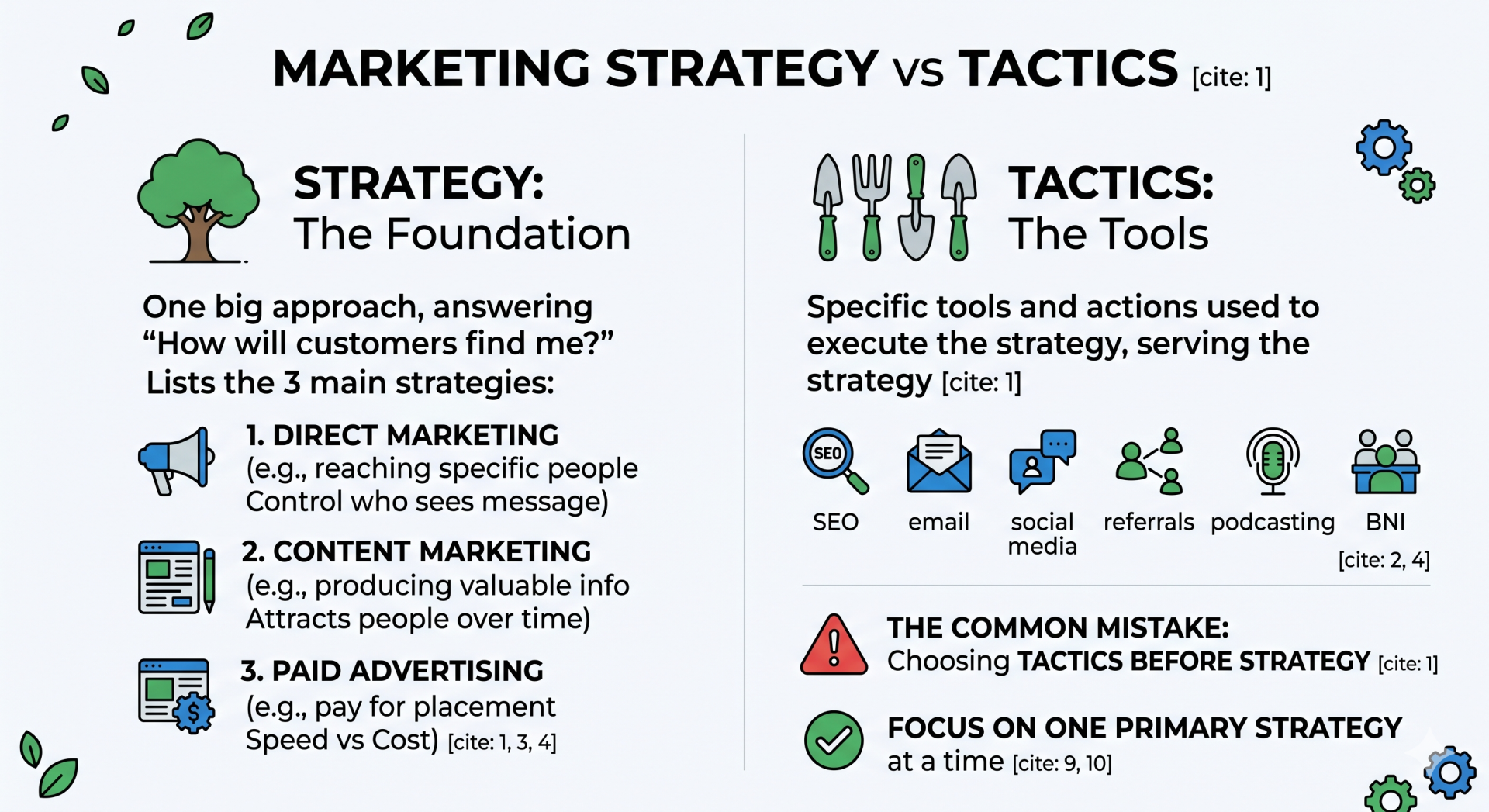
The difference between a marketing strategy and a marketing tactic is this: your strategy is the decision about how you will attract customers — the one big approach your entire marketing effort is built around. Tactics are the specific tools and channels you use to execute that strategy. Strategy comes first. Tactics serve it. When you flip that order — when you pick tactics before you have a strategy — you end up doing a lot of marketing work that produces very little revenue.
I’ve watched this play out the same way for 30 years. A business owner spends a Saturday going down a YouTube rabbit hole about Instagram Reels. By Monday they’re posting daily. Six weeks later they’ve abandoned it for podcasting, convinced that’s the answer. The tools changed. The confusion didn’t. The problem was never Instagram or podcasting. The problem was picking tactics before having any strategy to attach them to.
Why Your Marketing Keeps Failing When You Keep Trying Different Tactics!– IMAGE PLACEHOLDER: alt=”marketing strategy vs tactics diagram showing strategy as foundation and tactics as tools” –>
What Is a Marketing Strategy for a Small Business?
A marketing strategy is the single overarching decision that answers one question: how will customers find out I exist?
It’s not a list of things you’ll do. It’s not a calendar. It’s a fundamental choice about the mechanism through which your business attracts new customers. And for small business owners, that choice comes down to three options — and only three.
Direct Marketing means you reach out to specific people, one at a time or in targeted groups, with a direct offer or message. Think referrals, networking, cold outreach, direct mail, and personalized email. You control who sees your message and when.
Content Marketing means you produce valuable information — articles, videos, podcasts, social posts — that attracts people to you over time. They find your content, develop trust, and eventually buy. It’s slow to build and fast to compound.
Paid Advertising means you pay to put your message in front of people. Google ads, Facebook ads, sponsored posts, display advertising. Speed is the advantage. Ongoing cost is the constraint.
That’s it. Three strategies. Every tactic you’ve ever heard of — Instagram, SEO, email newsletters, referral programs, BNI, YouTube — fits inside one of those three buckets. Learn how to pick the right one for your business here.
What Is a Marketing Tactic?
A marketing tactic is any specific action, tool, or channel you use to carry out your strategy.
Tactics without a strategy are just busy work. They feel productive because you’re doing something. But doing the wrong things efficiently is still inefficient.
Here’s a table that shows exactly how strategies and tactics relate:
| Marketing Strategy | What It Means | Tactics That Serve It |
|---|---|---|
| Direct Marketing | You reach specific people with a direct message or offer | Referral programs, networking, cold email, direct mail, BNI, LinkedIn outreach |
| Content Marketing | You produce content that attracts people to you over time | Blog posts, SEO, podcasts, YouTube, email newsletters, social media posts |
| Paid Advertising | You pay to put your message in front of targeted people | Google Ads, Facebook Ads, Instagram Ads, sponsored content, display ads |
Notice that email appears under both Direct Marketing and Content Marketing. That’s the point. The tactic isn’t the strategy — the same tool serves different strategies depending on how you use it. An email to your segmented referral list is Direct Marketing. A weekly newsletter you write to build trust with cold subscribers is Content Marketing.
Why Confusing Marketing Strategy vs Tactics Keeps Small Businesses Stuck
Walk into any small business networking event and ask owners what their marketing strategy is. Most will describe a list of tactics: “I’m on Instagram, I do some Google ads, I’m thinking about starting a podcast, and I just joined BNI.”
That’s not a strategy. That’s a symptoms list.
When you operate from a list of tactics instead of a clear strategy, three things happen. You split your attention across too many channels. You never give any one approach enough time to build momentum. And when results are slow — which they always are at first — you blame the tactic and switch to a new one, resetting the clock on whatever was just starting to work.
The fix isn’t discipline or a better content calendar. The fix is having a strategy so clear that every tactic decision becomes obvious. When you know your strategy is Content Marketing, you stop wondering whether you should try paid ads this month. When your strategy is Direct Marketing through referrals, you stop feeling guilty about not posting on Instagram every day.
Strategy gives you permission to say no. That’s its most underrated function. If you’ve been feeling frustrated with marketing, this is almost always why.
How to Choose the Right Marketing Strategy for Your Business
The right strategy isn’t the one that sounds most exciting. It’s the one that matches your business model, your budget, and your current stage of growth.
Here’s a simple diagnostic:
Choose Direct Marketing if: You sell a service, you’re relationship-driven, you have a clear target customer you can name and reach, or you’re early-stage with no audience and no ad budget. Referral marketing is the highest-ROI starting point for most service businesses. It costs almost nothing, compounds through trust, and works in almost every service category. Here’s a guide on building a referral system that actually works.
Choose Content Marketing if: You want to build long-term authority, you have patience for compound growth (6–18 months before significant results), and you can consistently produce valuable content. This strategy rewards consistency above everything else. If you’ll stop when it gets boring, this isn’t your strategy.
Choose Paid Advertising if: You have a proven offer, a clear customer, and money to invest. Paid advertising is the fastest path to leads — and the fastest path to a depleted bank account if you don’t have the first two. Don’t run ads to test whether your offer works. Fix the offer first.
What Good Tactics Look Like Under Each Strategy
Once your strategy is clear, picking tactics gets easy. You stop asking “should I try TikTok?” and start asking “does TikTok help me execute my strategy?” The answer is either yes, no, or not yet.
Here’s what strong tactic selection looks like in practice:
Direct Marketing — tactics that work: Referral programs with a clear ask and follow-up system. Networking groups like BNI where you build trust through repeated exposure. (See whether BNI is worth it for your business.) LinkedIn outreach to a specific list of target customers. Direct mail to a defined geographic or demographic segment. The common thread: you’re talking to specific people, not broadcasting to everyone.
Content Marketing — tactics that work: SEO-optimized blog posts that answer the questions your customers are searching. A podcast that demonstrates your expertise in a format your audience already consumes. An email newsletter that turns browsers into buyers through consistent value. A YouTube channel. The common thread: you’re creating assets that attract people to you over time.
Paid Advertising — tactics that work: Google Search ads targeting high-intent keywords. Retargeting ads to people who’ve already visited your site. Facebook and Instagram ads with tight audience targeting and a tested offer. The common thread: you’re paying for speed and precision, and you need an offer and landing page that already converts.
The tactics that don’t work are the ones chosen out of context — picked because someone in a Facebook group said they were working, or because a competitor seems to be doing them, or because a new platform launched and the fear of missing out kicked in.
How to Tell If Your Marketing Is Strategy-Led or Tactic-Led
Here’s a fast self-assessment. Answer these three questions:
1. Can you name your primary marketing strategy in one sentence? Not a list of things you do — one sentence describing the mechanism through which new customers find you. If you can’t answer this in under 10 seconds, you don’t have a strategy.
2. Does every marketing activity you do this week connect to that strategy? If you can’t draw a direct line from the tactic to the strategy, it’s either optional or it needs to stop.
3. Have you been running your primary strategy consistently for at least 90 days? Most strategies need 90 days before they show real data. If you’ve switched approaches in the last 90 days, you abandoned a strategy before you had evidence it wasn’t working.
The Most Common Marketing Strategy vs Tactics Mistakes Small Business Owners Make
After 30 years of working with solopreneurs and small business owners, these are the patterns I see constantly:
Mistake 1: Treating the platform as the strategy. “My marketing strategy is social media” is not a strategy. Social media is a tactic. It serves Content Marketing or Paid Advertising. Naming the platform doesn’t answer the question of how you get customers.
Mistake 2: Running all three strategies at once. I’ve seen business owners running a referral program, writing weekly blog posts, and running Facebook ads simultaneously — and wondering why nothing is working. Splitting energy across three strategies means none of them get enough attention to produce results. Pick one primary. Commit.
Mistake 3: Switching strategies before the data is in. Content Marketing takes 6–18 months to show meaningful organic traffic. Direct Marketing through referrals takes 90 days of consistent asking before you see a steady flow. Paid Advertising needs at least $1,000–$2,000 in test spend before you have reliable data. If you quit before those benchmarks, you quit before the evidence. What to do when your referral marketing stops producing results.
Mistake 4: Optimizing tactics before the strategy is working. You don’t need a better Instagram caption. You need a clear strategy that tells you whether Instagram belongs in your plan at all. Tactic optimization is a second-order problem. Get the strategy right first.
Mistake 5: Confusing activity with momentum. Posting every day feels like marketing. Attending every networking event feels like sales. But activity without a strategic frame doesn’t compound — it just accumulates. Momentum requires direction. That direction is your strategy.
Marketing Strategy vs Tactics — A Practical Example
Here’s how this works in the real world. Take a bookkeeper who serves small business owners. Her primary strategy is Direct Marketing. Her target customer is a service business owner in her region with $500K–$2M in revenue.
Her tactics: She attends one BNI chapter weekly. (See alternatives to BNI if you want to evaluate your options.) She sends a personal check-in email to her 50 best referral sources every quarter. She asks every satisfied client for one introduction — not a general referral, a specific name and warm introduction.
She doesn’t do Instagram. She doesn’t have a podcast. She writes a short email newsletter, but it serves her Direct Marketing strategy — it keeps her name in front of the people who refer to her, not cold strangers.
Her Content Marketing tactic — the newsletter — is secondary and feeds her primary Direct Marketing strategy. That’s the right relationship. Tactic serves strategy. Strategy doesn’t chase tactic.
This bookkeeper gets 80% of her new clients through referrals and has for eight years. She’s never once wondered whether she should try TikTok, because her strategy already answers that question. TikTok doesn’t serve Direct Marketing to a hyper-specific regional customer. So the answer is no, without a second thought.
That’s what a clear strategy buys you: the ability to say no fast, and yes with confidence.
Frequently Asked Questions: Marketing Strategy vs Tactics
What is the difference between a marketing strategy and a marketing tactic?
A marketing strategy is the overarching approach your business uses to attract customers — the big-picture decision about the mechanism of customer acquisition. A marketing tactic is a specific tool, channel, or action used to execute that strategy. Strategy answers the question “how will we get customers?” Tactics answer “what will we do this week to move that forward?” You choose one primary strategy, then select tactics that serve it. Tactics chosen before a strategy is set tend to produce scattered results and wasted budget.
How many marketing strategies should a small business use?
One primary strategy, supported by tactics from other approaches. There are only three core marketing strategies available to small businesses: Direct Marketing, Content Marketing, and Paid Advertising. Most small business owners try to run all three at once, which fragments their attention and prevents any single approach from building real momentum. The most effective businesses commit to one primary strategy, run it consistently for at least 90 days, measure the results, and then layer in supporting elements once the primary is producing.
Is social media a marketing strategy or a tactic?
Social media is a tactic, not a strategy. It can serve Content Marketing (when you use it to distribute value-driven content to build an audience), Direct Marketing (when you use it for targeted outreach to specific prospects), or Paid Advertising (when you run paid social campaigns). Calling social media your “marketing strategy” is one of the most common mistakes small business owners make — it describes the channel, not the mechanism through which you acquire customers.
What marketing strategy works best for solopreneurs?
For most solopreneurs and service-based small businesses, Direct Marketing through referrals is the highest-ROI starting point. It requires no ad budget, leverages existing relationships, and compounds through trust over time. Over 50% of small businesses already get their best customers through word-of-mouth — but most don’t systematize it. Building a repeatable referral system with a clear ask, consistent follow-up, and a way to make it easy for people to refer you is the single highest-return marketing investment most solopreneurs can make.
How do I know if my marketing strategy is working?
A marketing strategy is working when it produces a predictable, repeatable flow of qualified leads. The benchmarks differ by strategy: Direct Marketing through referrals typically shows consistent results after 90 days of systematic outreach. Content Marketing shows meaningful organic traffic growth after 6–12 months of consistent publishing. Paid Advertising should show cost-per-lead data within the first $1,000–$2,000 in spend. If you’re not measuring leads — not impressions, not followers, not likes — you don’t yet have the data to evaluate whether your strategy is working.