
In This Article

- Your customers hesitate over uncertainty as much as price. You earn their confidence when you redesign who carries the risk, when they pay, and what happens when something goes wrong.
- Only 63% of U.S. adults would cover a $400 emergency expense with cash, and 78% of drivers say they do not always trust their mechanic.
- You will know which customer fear to investigate first, which two or three models to weigh, and how to test one with 5 to 10 customers before you commit.
To change your business model and put customers at the center, start with the fear holding them back from buying. Then redesign how you charge, deliver, and guarantee your work around it. Customers weigh uncertainty, timing, risk, and convenience alongside price, and a redesigned model speaks to all four. Small businesses make this move faster than large competitors.
A warning light comes on. You know the car needs a mechanic, and you start doing mental math before you pick up the phone.
How much will this cost? Will they find repairs I do not need? Who do I call to double-check the answer?
ConsumerAffairs surveyed 1,000 U.S. drivers in August 2023 and found 78% do not always trust their mechanic. Only 17% believe they are always charged fairly. A shop in Columbus, Ohio read numbers like those and changed how it earns money.
What did Penelope’s Garage change about how customers pay?
Penelope’s Garage sells monthly memberships for car care. Basic costs $50 a month plus tax. Premium costs $100 a month plus tax. Both carry a three-month minimum.
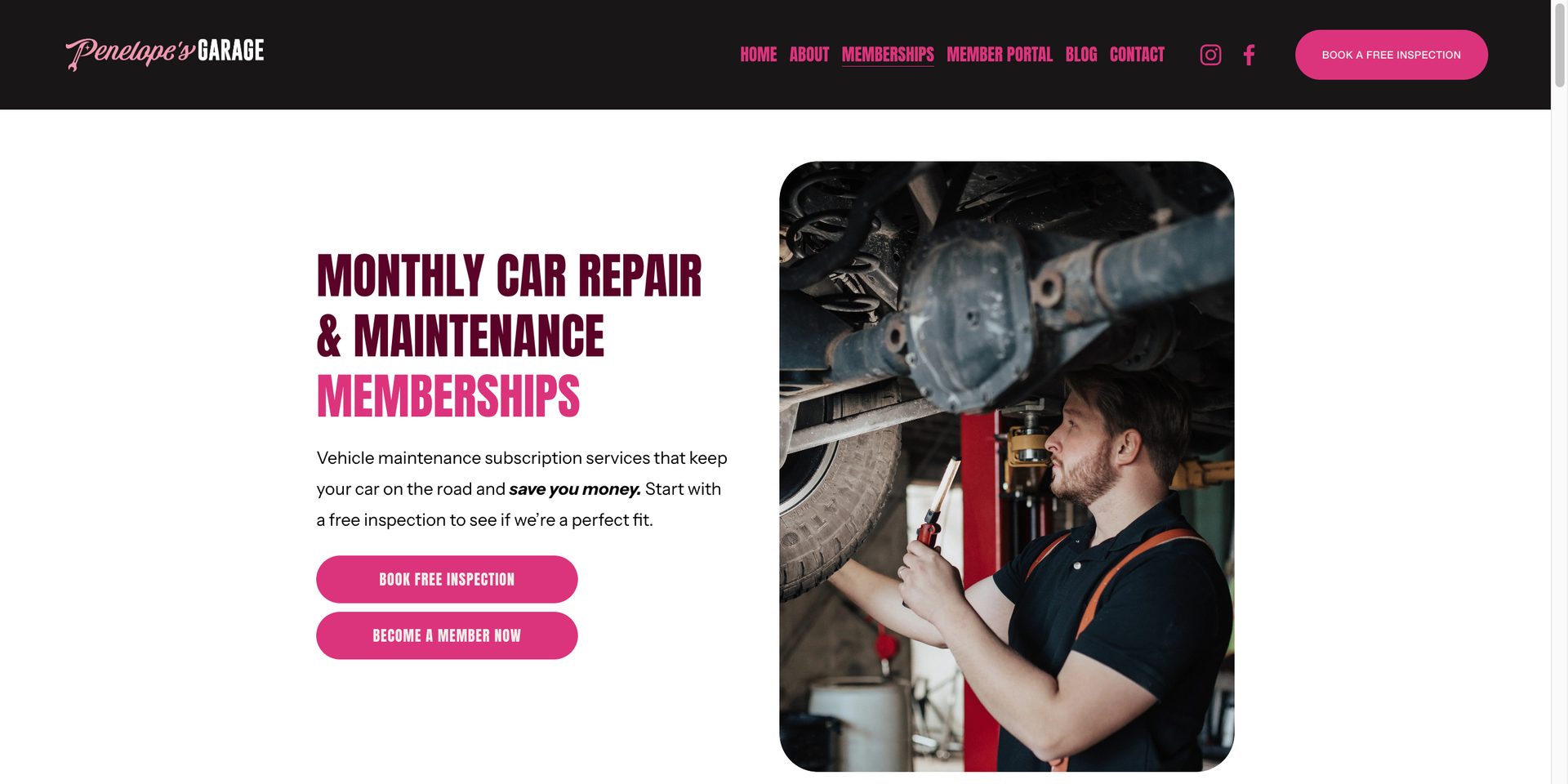
Members get preventive maintenance, inspections, a loaner car, and pickup and drop-off within 10 miles. Basic members pay $80 an hour for labor on outside work, Premium members pay $70, and parts carry a 10% markup.
Look at what moves. The customer pays a known amount for routine care. The garage earns recurring revenue and a standing relationship. Both sides gain a reason to catch small problems early.
The homepage also addresses the upselling worry, promising memberships give the shop no reason to sell you repairs you do not need. My piece on a membership campaign built to get you paid twice covers the sales side of this model.
Why does affordability depend on more than price?
Price takes the blame when customers hesitate, so we discount, add financing, or build a cheaper package. Sometimes price is the problem. Often the problem is uncertainty about the final bill, the results, and what happens when something goes wrong.
The Federal Reserve’s Economic Well-Being of U.S. Households in 2025 report found 91% of adults call price increases a major or minor financial concern. Only 63% would cover an unexpected $400 expense with cash or its equivalent.
A person on a tight budget weighs four things: how much they pay, when they pay, how predictable the bill is, and how much risk lands on them. A lower monthly payment still raises the total cost when exclusions and surprise fees pile up. I cover the sales side in how to sell when customers struggle to pay.
Trust sits in the same equation. Edelman’s 2025 brand trust research surveyed 15,000 people across 15 countries and ranked trust alongside quality and value as a purchase consideration. PwC’s 2025 Customer Experience Survey reports 52% of consumers stopped buying from a brand after a bad product or service experience. Those figures describe why customers leave, and your own test shows whether a new model keeps them. For the buying side, read why customers stop buying even when the economy looks fine.
Why is it easier for you to change your business model than for a big company?
A national chain needs committee approvals, software changes, and legal review before it alters how it charges. You need a conversation and a spreadsheet. You know your customers by name, hear complaints firsthand, and offer a new plan to ten people on Monday and adjust it by Friday.
I wrote about how to compete with big companies when customers stop trusting them, and the pattern holds here: speed and accountability are your edge. Johnson, Christensen, and Kagermann describe in Harvard Business Review a business model as a customer value proposition, a profit formula, key resources, and key processes. You control all four pieces, which makes it realistic to change your business model this quarter.
Your size is your advantage
Big companies need months to approve a new way of charging. You redesign an offer this week, test it with a handful of customers, and keep what works.
Which business model matches your customers’ biggest fear?
Most small businesses charge by the hour, by the product, or by the project, and those models work. Match the model to the worry holding your customer back and trust follows.
| Customer fear | Model to consider | What the customer gains | How you earn |
|---|---|---|---|
| Unexpected expenses | Membership or preventive-care plan | Predictable routine costs | Recurring fees plus services outside the plan |
| Unclear final price | Fixed-price package | Known price and deliverables | Flat fee for a defined scope |
| Paying before seeing results | Milestone payments | Limited upfront exposure | Payments as agreed stages finish |
| Doubt about your quality | Paid diagnostic or starter project | A test before a big commitment | Entry fee, then optional larger work |
| Confusing extras | Productized service | Clear scope, timing, and price | Repeatable service at a set margin |
| No remedy if something goes wrong | Guarantee-backed offer | A defined remedy | Normal revenue plus a funded guarantee |
Penelope’s sits in the first row. A web designer whose clients fear a $5,000 project ballooning to $8,000 reaches for a fixed-price package. A consultant whose clients fear paying for advice with no sales attached reaches for a paid diagnostic or milestone payments.
The number comes next, and my guide to value-based pricing for services shows how to set it. Treat this table as my decision framework, because research has not ranked these models.
What five questions reveal your customers’ biggest fear?
I call this process the Fear-to-Model Match: ask five questions, match the loudest fear to a model in the table, then score the match for fit. The questions come first, and Harvard Business Review’s jobs to be done idea explains why: ask what progress your customer wants to make and what stands in the way.
Ask these five questions to five to ten customers, and include one person who said no.
- What worries you most about buying a service like mine?
- What unpleasant surprises have you experienced with companies in this industry?
- What feels unfair about how companies in this industry charge?
- What would make you comfortable buying sooner?
- How would you prefer to pay, and why?
Write down the exact words. Customers hand you your next offer when they describe the surprise they dreaded. My roundup of customer loyalty statistics shows price is rarely the only reason customers stay, so listen for service worries alongside cost worries.
How do you change your business model without risking the business?
To change your business model without betting the company, score the match first. Rate your chosen model from 1 to 5 on three factors, and weight each one:
- Reduces customer fear (40%). Will customers feel less uncertainty, risk, or inconvenience?
- Profitable for you (35%). Do you earn a sustainable contribution margin?
- Practical to deliver (25%). Do your team, tools, and capacity support it?
Multiply each rating by its weight, divide by five, and add the results. A 4, a 3, and a 4 give you 0.40 × 4/5 + 0.35 × 3/5 + 0.25 × 4/5 = 0.73, a score of 73. I chose these weights to put the customer first while respecting your margin, so adjust them to fit your business. My rule of thumb: 80 or higher, test now. 60 to 79, refine first. Below 60, pick another model.
Then test small. Offer the new model to five to ten customers, or to one service line. A home maintenance company might offer 20 homeowners a monthly preventive plan, and a marketing consultant might offer a three-month project with payments tied to deliverables. Track three numbers: how many customers say yes, how much more confident they feel, and what margin the offer earns after delivery costs.
Run the math before you launch. A membership needs the typical customer’s usage and your cost to serve it, and a fixed-price package needs a written scope and a price for extras. Vague exclusions, an impossible guarantee, or constant change orders cost you trust.
What would your customers change about how they buy from you?
Ask three customers this week. Listen for the moment they hesitate, then choose one change to test.
Penelope’s Garage looked at a trust problem and redesigned how it earns money. Its results still need proof, and the owner’s numbers will tell the story. [Insert quote from Ivana Taylor about why small business owners hold this flexibility advantage.]
Your customers carry their own worries into every purchase, and you hold the flexibility to answer them. Change your business model one customer fear at a time. If your marketing reads well and customers still hesitate, look at the model.
What do small business owners ask before they change a business model?
What is a customer-centered business model?
A customer-centered business model is a way of earning money built around the customer’s biggest worries, with those worries driving your pricing, delivery, and guarantees. It answers four questions: which problem the customer needs solved, how you deliver the solution, how you get paid, and who carries the risk when something goes wrong. Penelope’s Garage shows one version. The shop charges a monthly membership for routine maintenance, publishes its labor rates, and offers a loaner car, so the customer knows the cost of routine care in advance. A web designer shows another version with a fixed-price package and a written scope. Both examples change the structure of the offer itself. You still need profit, so every customer-centered design needs a margin check. Start by listing your customers’ top three worries, then ask which part of your pricing or delivery creates each one.
How do I know if a membership fits my service business?
A membership fits when your customers need your service repeatedly and you deliver fresh value at the same rhythm as billing. Check three things. First, confirm the need recurs: oil changes, bookkeeping, lawn care, and monthly coaching all repeat, while a one-time kitchen remodel does not. Second, calculate the typical customer’s usage and your cost to serve it, then price the plan above this cost with a healthy margin. Third, test willingness to commit by offering the plan to five to ten existing customers. Track how many say yes and how many stay past the first three months. Penelope’s Garage requires a three-month minimum, which gives both sides time to see the value. If your customers use your service once a year, a prepaid bundle or a fixed-price package will fit better than a monthly fee.
Does a lower monthly price make a business more affordable?
A lower monthly price helps only when the total cost and the predictability improve too. Affordability has four parts: the amount customers pay, when they pay, how predictable the bill is, and how much risk they carry. A $50 plan with exclusions and surprise fees feels cheaper on day one and costs more by year end. The Federal Reserve’s 2025 household survey found only 63% of adults would cover a $400 emergency expense with cash or its equivalent, so predictable payments carry real weight for most households. Payments spread across months, prices published before work begins, and clear exclusions all raise confidence. Run the full-year math for your typical customer under your old model and your new one, then show this comparison on your sales page so the customer sees the difference in plain numbers.
How many customers should I test a new business model with?
Start with five to ten customers, or one service line, before you rebuild anything else. A small group gives you honest reactions without putting your whole revenue base at risk. Pick customers who match your best-fit buyer, and include at least one person who hesitated before buying in the past. Track three numbers: how many say yes, how much more confident they feel, and what contribution margin the offer earns after delivery costs. Run the test for one full billing cycle at minimum, and for three months when you sell a membership. A home maintenance company might offer 20 homeowners a monthly preventive plan. A consultant might offer a fixed-price diagnostic to clients wary of a large engagement. Decide in advance which result tells you to expand, adjust, or stop, so enthusiasm does not make the call for you.
What are the risks of switching to a subscription or membership model?
The biggest risks are churn, unprofitable usage, and customer fatigue. Repeat billing without repeat value leads to cancellations, and research on subscription growth shows churn strongly shapes how many users and how much revenue a business keeps over time. Heavy users of an unlimited plan cost more to serve than they pay, so cap usage or price by tier. Customers also tire of charges for services they barely use, and a 2024 Journal of Business Research study found consumers in two experiments preferred a single flat-rate plan over an upfront fee plus recurring charges. Reduce these risks with a clear list of inclusions, a short minimum commitment, easy cancellation, and a monthly reminder of the value delivered. Penelope’s Garage still earns revenue from repairs outside the plan, which shows a membership does not need to cover everything.
Additional reading
- Guarantee examples for small business, with five templates
- How to make more money with fewer customers
- Payment plans for small business and how to offer them
Stop Spinning. Start Building.
Booked & Billing is your complete system for client acquisition. From your first lead magnet to closing retainers, you get the blueprint, the templates, and the strategy. Three tiers match your stage: READY ($997) → BOOKED ($2,500) → LAUNCHED ($3,997).