
In This Article

Updated: April 2026
Referrals vs References comes down to this: a referral is a warm introduction — someone who knows your work actively sends a prospect to you. A reference is a past client who confirms your credibility when a prospect asks. Both build trust. They work at different stages of your sales process, and mixing them up costs you deals.
92% of consumers trust referrals from people they know more than any other form of advertising.
I spent years treating these as the same thing — and it showed. Prospects would ask me for references, I’d hand over a list, and then nothing would happen. The problem wasn’t the reference. It was that I had no referral system running alongside it. Once I separated the two and built a deliberate process for each, my pipeline looked completely different.
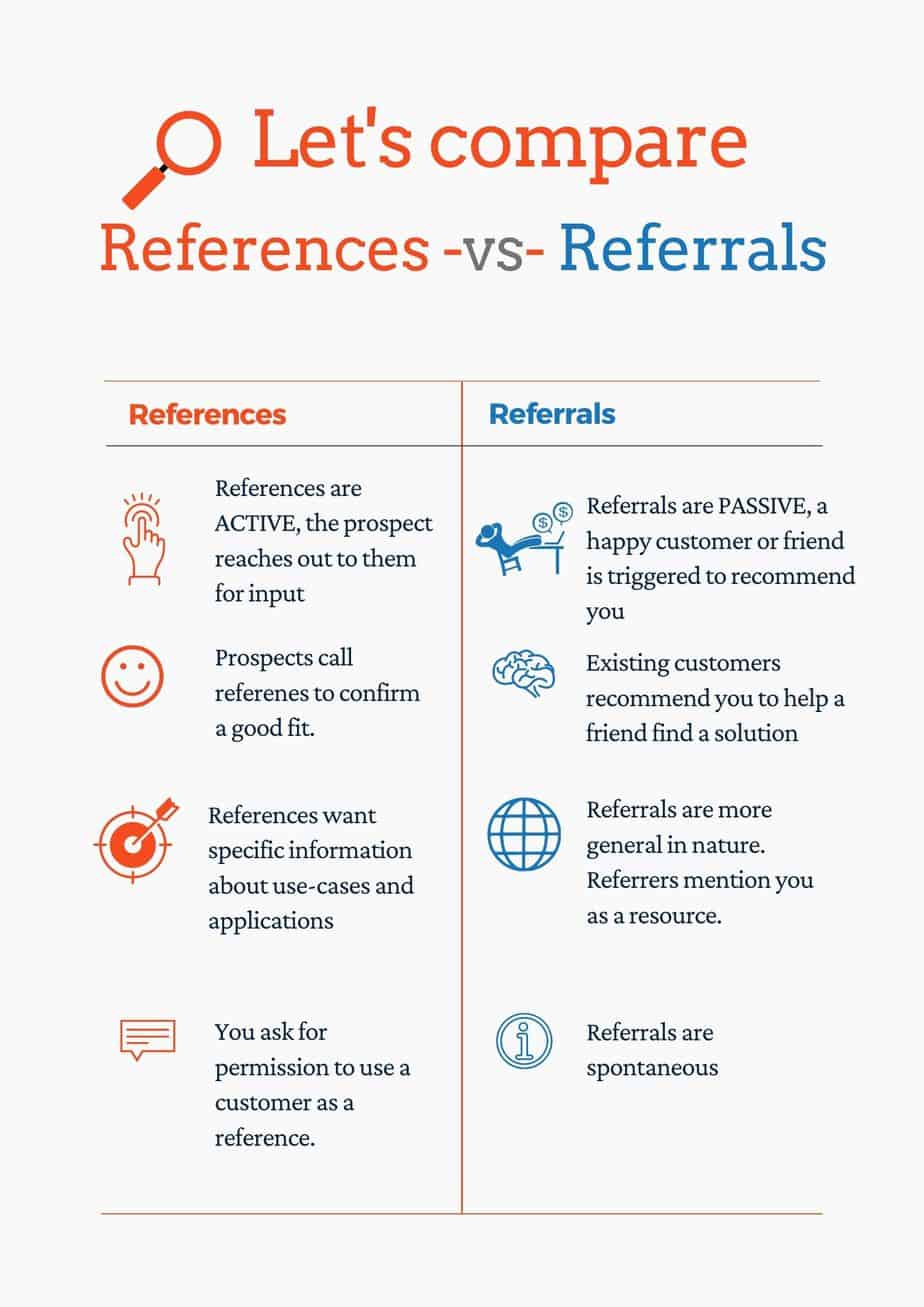
Referral vs Reference: A Side-by-Side Comparison
Here’s the clearest way to see how these two tools differ — and when each one matters most in your sales process.
| Factor | Referral | Reference |
|---|---|---|
| Who initiates it | Your happy client — unprompted or via a referral program | Your prospect — they ask you for a list |
| Stage in the sales process | Top of funnel — creates awareness and interest | Bottom of funnel — confirms a nearly-made decision |
| What it communicates | “You should talk to this person about your problem.” | “Yes, they did what they said they would do.” |
| Requires a system | Yes — referrals rarely happen without asking | Yes — you need a prepared list ready to send |
| Best marketing analogy | Word-of-mouth advertising | Social proof and credibility verification |
Think of Your Customers as Hiring Managers
This reframe changed how I approach business development entirely. When you’re a solopreneur or consultant, every potential client is making a hiring decision. They have a problem — a job that needs doing — and they’re evaluating you and your competitors the same way an HR department evaluates candidates.
Referred customers have a 16% higher lifetime value than non-referred customers
That means they want references the way an employer wants references: to verify your track record, check your reliability, and hear from someone who’s actually worked with you. They want referrals the way a hiring manager trusts a colleague’s recommendation over a cold application.
Once you see your sales process through this lens, the whole system clicks into place.
What Is a Reference?
A reference is an active request by a potential customer for information about your business. Your prospect asks, you provide a list of past clients, and those clients confirm your credibility when contacted.
References answer one question: “Can this person deliver?” They’re not there to sell your services. They’re there to remove doubt. Think of them as character witnesses at the end of a decision that’s mostly already been made.
Most business owners think of references as a hiring formality. For solopreneurs, they’re a sales tool — and an underused one. A well-prepared reference can accelerate the close on a deal that might otherwise stall for weeks.
How to Build a Reference List That Actually Closes Deals

Your references should be the clients who know you best and can speak to the specific outcomes you delivered. Not just “great to work with” — but “here’s the problem I had and here’s exactly what changed.”
Don’t hand over a list and hope for the best. Prepare your references. Give them a short brief: who this prospect is, what their concerns are, and what aspects of your work are most relevant to that conversation.
Here’s the process I use:
- Email past clients directly and ask if they’re willing to serve as a reference for a specific type of prospect
- Send them a list of questions the prospect is likely to ask
- Create a landing page or one-pager specifically for references, so prospects have a curated view of your work
- Ask strong clients to leave a review on Google, Facebook, or Yelp — those reviews serve as always-on references
- Record short video testimonials for the clients who can’t always take a call
- Thank every reference publicly and privately — this relationship is worth protecting
References are living assets. The more you invest in maintaining those relationships, the stronger your close rate gets.
What Is a Referral?
A referral is a proactive recommendation. Someone in your network hears a prospect mention a problem, thinks of you, and makes an introduction — without being asked by the prospect. That’s the key distinction. The referral happens before the prospect knows they need you.
Referrals carry a trust transfer that no amount of marketing can replicate. When someone you respect says “you should talk to Ivana,” you take that call. You go in already warm. The sale doesn’t have to start from zero.
This is why building a referral system is one of the highest-ROI investments a small business owner can make. It’s also why you can’t leave it to chance.
How to Build a Referral System That Works Without Feeling Pushy
The biggest mistake solopreneurs make with referrals is waiting for them. Referrals don’t happen automatically — even from your happiest clients. Life is busy. Your client isn’t sitting there thinking about how to grow your business. You have to make it easy and give them a reason to think of you.
The second biggest mistake is asking the wrong way. “Do you know anyone who might need my services?” is too vague. Teach your referral sources exactly who to look for and what to say. Give them a one-liner: “She helps small business owners who are spending money on marketing but can’t tell if it’s working.”
Here’s how to build the system:
- Ask directly — but with specificity. Tell them who your ideal client is. Make the ask frictionless. Learn how to ask for referrals without making it awkward.
- Create a referral email sequence. Set up an automated sequence that goes out 30, 60, and 90 days after a project ends. Include case studies, a reminder of who you help, and a simple ask.
- Give them shareable content. Make it easy for referrers to forward a relevant article or send a link that explains what you do. The easier you make it, the more often it happens.
- Join structured referral networks. Groups like BNI are built around a formal referral-passing process. If you’re a service-based business, these networks can be a consistent source of warm leads.
- Reward your referrers — appropriately. Not everyone can accept gifts, especially in professional or regulated industries. Free services, gift certificates, a donation to their favorite charity, or simply a handwritten note all work depending on the relationship.
Referrals vs References: How They Work Together in Your Sales Funnel
Here’s where most small business owners get tripped up: they treat referrals and references as two separate, unrelated things. They’re not. They’re two stages of the same trust-building process.
A referral opens the door. A reference closes it.
Your referral gets you the initial conversation. Your reference confirms you deserve the business. The prospect who came to you via referral is still doing due diligence — they’re just doing it from a warmer starting position. Give them strong references and you accelerate from “interested” to “signed” without the typical back-and-forth.
The clients who refer you most often are also your best references. Identify those people. Cultivate those relationships deliberately. They’re the core of your word-of-mouth marketing engine.
If you want to see how this fits into a broader networking strategy, check out the alternatives to structured referral networks that work for different business types.
Why Referral Marketing Is the Fastest Path to New Customers for Solopreneurs
Paid advertising requires budget and testing time. Content marketing requires months to build traction. Referral marketing works on day one — because it operates on borrowed trust.
A prospect who finds you via Google has zero relationship with you. A prospect who finds you through a trusted contact arrives already believing you’re credible. The sales cycle is shorter. The close rate is higher. The client quality is better, because your best clients tend to refer people like themselves.
For solopreneurs working on tight budgets, referral and reference marketing is one of the three core strategies worth investing in. It’s not glamorous. There’s no dashboard to obsess over. But it compounds over time in a way that paid channels don’t.
The question isn’t whether to use referrals and references. The question is whether you have a system for both — or whether you’re leaving it to chance.
Frequently Asked Questions About Referrals vs References
What is the difference between a referral and a reference?
A referral is a proactive recommendation — someone in your network introduces a prospect to you before the prospect has started looking. A reference is a past client who confirms your credibility after a prospect has already found you and is in evaluation mode. Referrals generate new opportunities. References close the ones already in your pipeline.
Which is more valuable for growing a small business — referrals or references?
Referrals win for growth. A referral carries built-in trust because someone who knows you is vouching for you to someone who trusts them. References are essential for closing deals, but they don’t generate new leads on their own. If you have to prioritize, build your referral system first and your reference list second.
How do you ask a client to be a reference vs a referral source?
For a reference, ask directly: “Would you be willing to take a call from a potential client who wants to hear about your experience working with me?” For referrals, frame it differently: “If you hear someone mention they’re struggling with [the problem you solve], would you feel comfortable mentioning my name?” Both are simple asks — they just require different framing and different follow-up. Get the exact scripts in this guide on how to ask for referrals.
Can the same person be both a referral source and a reference?
Your best clients usually are both. A happy client who actively sends you referrals is also your most credible reference. Make it easy for them to do both: give them a clear way to introduce you to others and prepare them with talking points so when a prospect calls, they know exactly what to say and which results to highlight.
What should a referral program for a small business include?
A solid referral program includes a clear ask (when and how you request referrals), a reward or recognition system, a follow-up sequence to keep you top of mind with past clients, and shareable content that makes it easy for referrers to explain what you do. See the full breakdown in how to get referrals for your business.