
In This Article

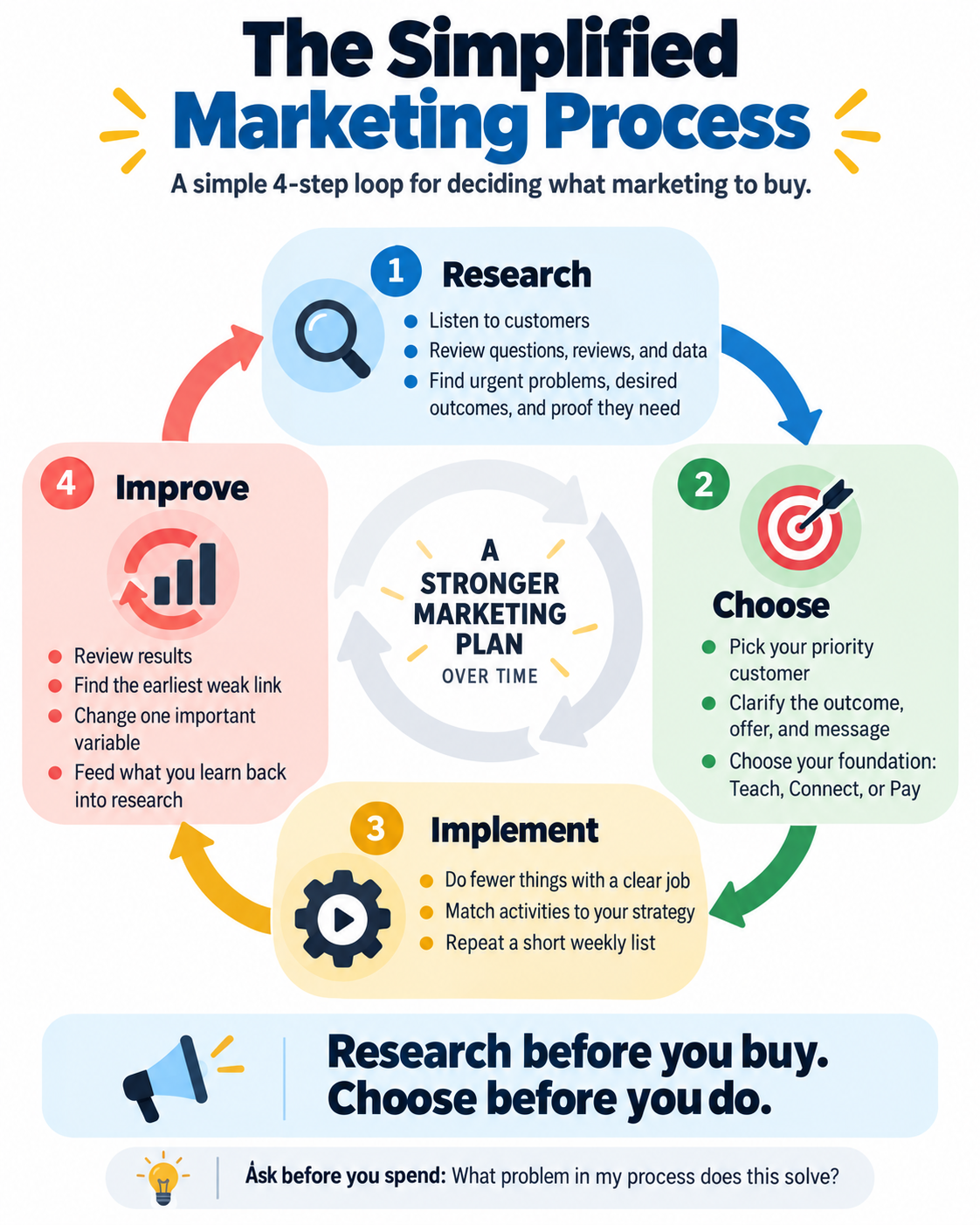
- The only marketing thing a small business has to manage is the marketing process: Research, Choose, Implement, Improve. Every channel, tool, and vendor you will ever consider fits inside it.
- 73% of small business owners are not fully confident their marketing strategy works, and 56% spend an hour or less per day on it.
- You will know which problem a marketing purchase solves, what must be true for it to work, and what to ask before you spend a dollar.
To decide what marketing to buy, run every offer through one four-step process: Research, Choose, Implement, Improve. Research shows what customers need, Choose turns it into a customer, an offer, and a primary strategy, Implement gives each purchase a job, and Improve turns the results into new research. A service fits when it solves a problem you found in the process.
Marketing advice starts in the middle. Post more, run ads, fix your SEO, start a podcast, automate your email. Every recommendation begins with the doing, and none of them ask whether you chose the right customer or built an offer worth buying.
After 35 years in marketing, I see the same pattern over and over. The advice arrives before the diagnosis. You get a prescription, and nobody ran the exam.
Why do small business owners struggle to decide what marketing to buy?
Small business owners are under-taught and over-sold. You know your trade, your product, or your profession. Nobody taught you how to compare channels, judge a provider, read a result, or work out why a campaign failed.
The numbers match the feeling. In a 2024 study of more than 1,300 small business owners and operators in four countries, 73% were not confident their current marketing strategy was contributing to their goals. The same research found 56% spend an hour or less per day on marketing.
In plain English, most of those owners are thinking some version of this: I do not know whether I am doing the right things, and I do not know whether any of it works.
Fear follows the uncertainty. In UPrinting’s 2026 Pollfish survey of 1,000 U.S. small business professionals, 37.6% named wasting money with no return as their biggest marketing fear. Among Baby Boomers, the figure reached 56.4%.
Most providers act in good faith, and each one is a specialist. A specialist sees your problem through the solution they sell. The SEO provider sees a search problem. The ad agency sees a distribution problem, and the social media manager sees a content problem.
Without a process of your own, you have no independent way to check the diagnosis. The gap is where money disappears.
The Only Marketing Thing You Manage
Research, Choose, Implement, Improve. Every audience, offer, message, channel, tool, and vendor you consider is a choice or an activity inside this process.
What is the one marketing process every small business owner needs to manage?
It is a four-part loop: Research, Choose, Implement, Improve. I built it as an owner-friendly adaptation of the customer-value marketing process taught by Philip Kotler and Gary Armstrong in Principles of Marketing. Their framework moves from understanding the marketplace and customer needs, through customer-driven strategy and an integrated marketing program, to relationships and value.
Kotler’s full body of work goes much deeper. Marketing Management covers segmentation, positioning, pricing, channels, communications, loyalty, and growth. My four words do not replace any of it.
Think of the four words as a dashboard. The machinery underneath stays complicated, and you do not have to operate every part of it. You have to know which of the four jobs you are doing today.
Marketing becomes manageable when every activity has a place in a repeatable process. A process gives you sequence, and sequence tells you what to do first.
My simple marketing process for small business guide shows the daily routine. This article shows how the same process protects you at the buying table.
What does marketing research look like for a business with no budget?
Research is the first marketing job, and it never ends. Research reduces guessing, and it gives you a basis for reading results later. It does not guarantee a winning offer.
You already own most of the sources:
- Conversations with customers and prospects
- Questions and objections from sales calls
- Interviews with people who did not buy
- Support requests and repeat problems
- Reviews of your business, your competitors, and your alternatives
- Search queries, forum threads, Reddit, and social comments
- Competitor offers, pricing, and proof
- Your own email, website, and sales data
Use those sources to answer eight questions:
- Which customers feel the problem most urgently?
- What outcome are they trying to reach?
- What have they already tried?
- What is missing from the alternatives?
- What words do they use?
- What makes them act?
- What makes them hesitate?
- What proof would make the choice feel safe?
My market research process walkthrough covers the mechanics. Research before you buy keeps you from paying someone to answer a question you never asked.
How do you decide what marketing to buy?
Choose before you do. This step turns what you learned into six decisions: your priority customer, the outcome they want, your offer, your value proposition, your message, and your foundational strategy.
Kotler and Armstrong call the first part segmentation, targeting, differentiation, and positioning. I translate it into four owner questions. Who is this for, what do they want, why this offer, and why this business?
The foundational decision comes next. Will your business primarily Teach, Connect, or Pay to create customers?
- Teach earns attention and trust by explaining, demonstrating, answering, and publishing.
- Connect creates customers through conversations, referrals, introductions, partnerships, events, and personal follow-up.
- Pay purchases targeted distribution, then converts the attention with a clear offer, a conversion path, and measurement.
Every business uses some of all three, and a Teach business buys an ad now and then. A Connect business publishes proof, and a Pay business still needs useful content and human follow-up. One of the three provides the foundation, and it organizes your time, budget, skills, tasks, and measurements.
Foundational means primary, and it leaves room for the other two. My guide to choosing your marketing strategy shows how to pick yours, and the difference between marketing strategy and tactics explains why the pick comes before the purchase.
How many marketing activities should you implement at once?
Implement fewer things. This is where most online advice begins, and it belongs third. Once you choose a customer, an offer, and a foundation, your task list shrinks, because you assign every activity a job and decline any activity without one.
The foundation you chose gives your week its flavor:
| Foundation | Weekly activities emphasize | Primary question |
|---|---|---|
| Teach | Explaining, demonstrating, publishing, repurposing, distributing | Are people finding and trusting my expertise? |
| Connect | Conversations, introductions, outreach, follow-up, partnerships | Are relationships producing qualified opportunities? |
| Pay | Targeting, creative, offers, landing pages, tracking, optimization | Is qualified demand profitable to acquire? |
Consistency matters here. Repetition becomes valuable when you also measure and learn, so set a small number of activities you will repeat every week.
How do you improve your marketing results without starting over?
Improve what you already have. Every result is new research. Repeat the process, and change the tactic only when the results tell you to.
A weak result leaves several suspects. Check them from the earliest link forward:
- The wrong priority customer
- A problem customers do not rank as urgent
- An offer with weak perceived value
- A message customers do not understand
- Missing proof
- Poor targeting or weak creative
- A landing page problem
- Slow follow-up
- Too little budget or too little time to test
- Faulty measurement
Define the result you expect before you start. Track two or three indicators. Compare the behavior you see with the assumption you made, name the earliest weak link, and change one important variable where possible.
Then record what happened and feed it into your next round of research and choices. Without the loop, every disappointing result sends you shopping for another agency, platform, redesign, or course.
What should you ask before you buy any marketing service?
Run the offer through the process. A legitimate service still fits some businesses and misses others. Use these nine questions before you sign:
- What specific problem in my marketing process does this solve?
- What evidence shows this is my current problem?
- What must already be true for this to work?
- Does it support my foundation: Teach, Connect, or Pay?
- What work, access, content, data, or follow-up will I still provide?
- What does success look like?
- Which leading measures and outcome measures will you report?
- How long does a fair test take?
- What will I learn if the result disappoints?
A strong provider answers these in plain language. My guide to getting trustworthy marketing help adds a screening checklist, and my breakdown of how to stop wasting money on marketing shows where the leaks hide.
Marketing dependency starts here. Every disappointing result sends you searching for another expert, tool, or tactic, and you never learn whether the last one failed or solved the wrong problem.
The fix starts with delegating execution whenever a specialist does the work better. Keep enough process knowledge to commission, evaluate, and manage the work, because you cannot safely outsource all of your marketing judgment.
What does a marketing process audit look like?
Run this audit once a month. It takes about fifteen minutes, and it tells you which of the four jobs needs your attention next:
- What do I know? Research
- What have I chosen? Customer, offer, message, foundation
- What am I implementing every week? The short list of repeatable activities
- What are the results teaching me? Improve
Research before you buy, and choose before you do. Implement fewer things, and improve what you already have.
If your marketing stalls, start with the earliest answer you cannot give. My marketing audit for small business guide goes deeper on each stage.
Replace random acts of marketing with a process. Let every action teach you what to do next.
Frequently asked questions about deciding what marketing to buy
How do I decide what marketing to buy for my small business?
Run every marketing offer through four steps: Research, Choose, Implement, Improve. Start with research. Talk to recent customers, review the questions prospects ask before they buy, and read what people say about you and your competitors. Then choose a priority customer, an outcome, an offer, a message, and one primary strategy: Teach, Connect, or Pay.
Next, ask which problem in the process the purchase solves. An advertising campaign solves a distribution problem. A new website solves a conversion problem. Neither repairs an offer customers do not value, so fix an earlier problem first when the evidence points there.
Finally, decide how you will measure success and how long a fair test takes. Write down what you expect before you spend a dollar. You learn something from the result whether it succeeds or disappoints. Then run the process again with what you learned.
What is the difference between Teach, Connect, and Pay in marketing?
Teach, Connect, and Pay are the three foundational ways a business creates customers. Teach earns attention and trust by explaining, demonstrating, and answering questions through articles, videos, newsletters, and talks. Connect creates customers through conversations, referrals, introductions, partnerships, events, and personal follow-up. Pay purchases targeted distribution through advertising, then converts the attention with a clear offer, a conversion path, and measurement.
Every business uses some of all three. A Teach business buys an ad now and then. A Connect business publishes proof of its work, and a Pay business still needs useful content and human follow-up. One of the three provides the foundation, and it organizes your time, budget, skills, tasks, and measurements. Choose the foundation first, and every activity on your calendar has a reason to be there. My guide to choosing your marketing strategy walks through the decision.
How do I know if a marketing agency is the right fit?
A marketing agency fits when it solves a specific problem you found in your marketing process and the conditions for success already exist. Ask what problem the service solves, what evidence shows this problem is your current one, and what must already be true for it to work. Ask what work, access, content, and follow-up you still provide.
Then ask which measures the agency reports. Request leading indicators, such as qualified conversations, and outcome measures, such as booked customers. Agree on how long a fair test runs and what you learn if the result disappoints.
A provider who answers these questions in plain language earns a trial. A provider who skips them leaves you guessing about the cause of any failure. Specialists see problems through the solution they sell, and your process gives you an independent way to check their diagnosis.
How much time should a small business owner spend on marketing each day?
Plan around an hour or less, because most owners have no more. In the 2024 Constant Contact and Ascend2 research, 56% of small business owners reported spending an hour or less per day on marketing. Content creation, strategy planning, working out what succeeded, and managing platforms ranked among their most time-consuming tasks.
Give the hour a structure. Spend most days on implementation, the repeatable activities your foundation calls for. Reserve a short block each week for reviewing results, and a longer block each month for research and for revisiting your choices.
If you only have thirty minutes, protect the review. Ten minutes of looking at what happened keeps the other twenty pointed in the right direction. Time spent on activities without a job in your process is the first thing to cut. Adjust the split as your results come in.
How do I test marketing when I do not have enough traffic for an A/B test?
Use methods built for small numbers. Customer interviews, patterns in sales calls, message tests run one after another, small paid pilots, and before-and-after comparisons all work with limited traffic. Define the result you expect before you start, track two or three indicators, and change one important variable where possible. Record what happened and when.
These methods produce weaker evidence than a controlled A/B test on a high-traffic site. Treat every conclusion as provisional, and look for the same pattern showing up more than once before you act on it.
Feed each result back into your research. A failed message test tells you something about your customer, your offer, or your timing. The lesson shapes the next choice, which is how a small business improves without starting over. Small tests also cost less, which protects your budget while you learn.
Additional reading
- Why your marketing is not working and how to fix it
- Why your marketing keeps failing when you keep trying different tactics
Not Sure Which Marketing Fits Your Business?
Get a Fix-It Session for $150. I review your marketing, find the earliest weak link in your process, and send you a video walkthrough and a one-page action plan within 24 hours. No meetings to schedule.