
In This Article

Marketing in a recession is not about spending less or discounting more. Your customers haven’t stopped wanting what you sell. They’ve stopped feeling safe saying yes to how you’re selling it. That’s a packaging problem, not a demand problem — and it’s fixable without discounting, pivoting, or starting over.
A client called me last month convinced her business was failing. Sales had stalled. Inquiries were coming in, but people weren’t closing. Her first instinct? Drop her prices. My first instinct? Look at how she was presenting her offer before we touched a single number.
The fix took 20 minutes. We didn’t change the price. We changed the mental math.
Marketing in a Recession Means Reading the Data, Not Ignoring It
The University of Michigan Consumer Sentiment Index hit 53.3 in March 2026 — near record lows. Year-ahead inflation expectations jumped to 3.8%, the largest single-month spike since April 2025. At the same time, the Conference Board’s current conditions index sits at 123.3.
That split tells you everything. People feel okay about right now. They’re terrified about six months from now. They’re spending — but they’re calculating every purchase differently than they were 12 months ago.
The Conference Board named this behavior pattern specifically: spending has shifted to “cheap thrills and necessary services, and away from expensive and highly discretionary activities.”
This isn’t customers being cheap. This is customers being rational under real pressure.
- Gas averaged $4.89/gallon nationally as of March 2026
- Food costs are still elevated
- Housing remains out of reach for millions
When people feel squeezed from three directions, they stop making big commitments and start making small, controllable purchases that feel like wins. That’s the market you’re doing marketing in right now — and the sooner you accept it, the faster you can adjust.
What “Treatonomics” Means for Your Sales Conversion Rate
Consumer researchers at Kantar call it treatonomics — and it’s not a blip. It’s a documented behavioral shift.
36% of consumers say they’ll go into short-term debt to spend on things that bring them joy. Not big-ticket items — small, controllable ones.
Big milestones feel out of reach: home ownership, financial stability, career certainty. So people are creating their own micro-celebrations. Kantar calls them “inchstones” — small personal wins worth marking and spending on.
What does that mean for marketing in a recession? It means the customers who used to say yes quickly to your six-month engagement are the same customers now hesitating at long commitments. The ones who used to decide fast are now asking more questions, taking longer, and sometimes walking away from things they genuinely want.
This is NOT a sales problem. It’s a packaging problem.
The offer hasn’t changed. The economic context around the offer has changed completely.
How to Repackage Your Offer So Customers Say Yes
Most advice about marketing in a recession tells you to cut prices or run promotions. Both are the wrong move. Here’s the practical move instead: look at your highest-converting offer and ask one question.
Can someone say yes to a smaller version of this?
Not a discount. A different entry point. (If customers are already asking for discounts, this breakdown on how to handle discount requests will save you a lot of margin.)
- A session instead of a package
- A monthly option instead of annual
- A quick-win service instead of the full engagement
- A done-in-a-day option instead of a 90-day program
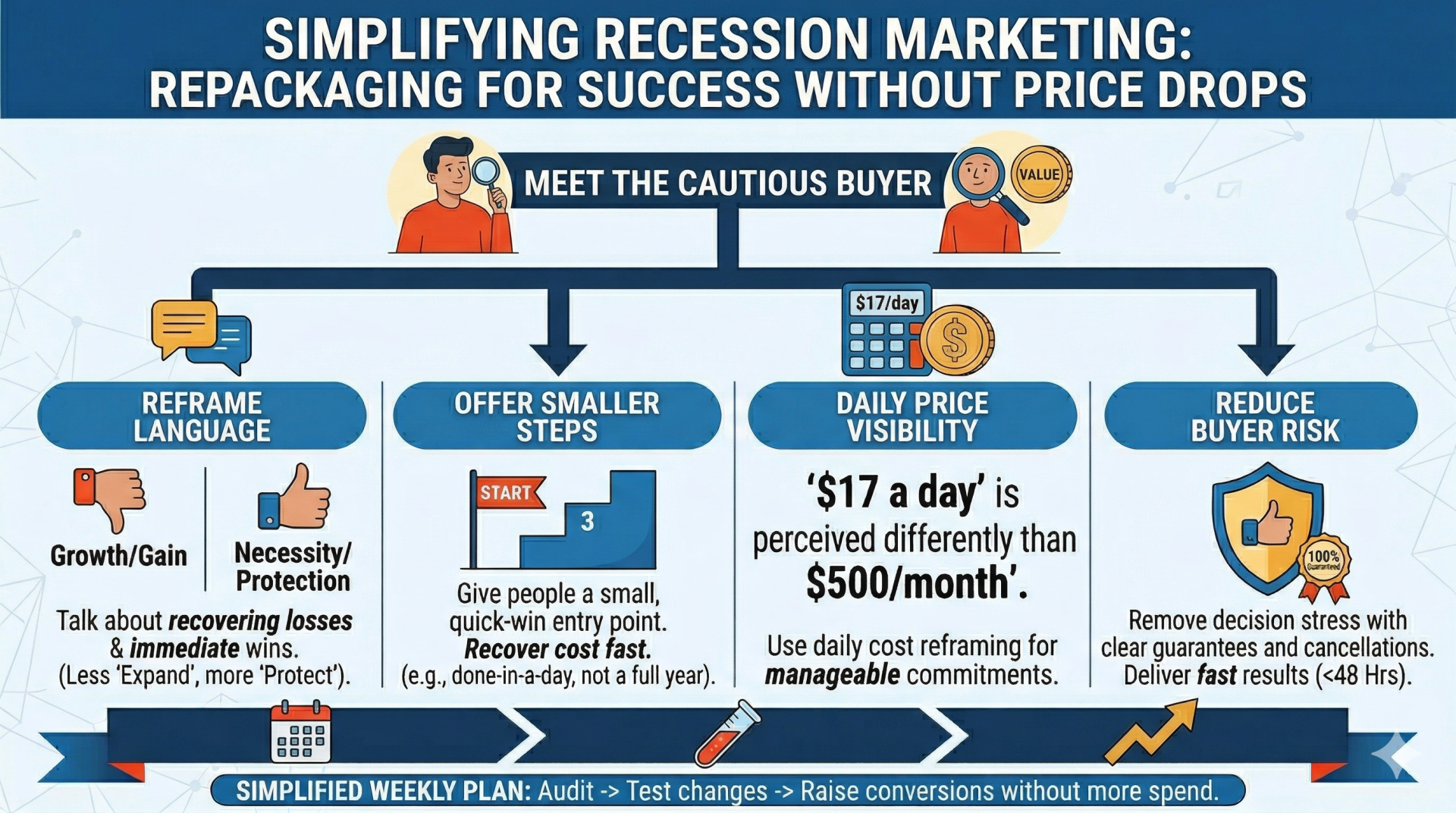
Then price it so the mental math feels like a daily cost, not a lump sum.
“$17 a day” lands completely differently than “$500/month” — even when the math is identical.
This is not about giving away your value. It’s about meeting your customer where their brain is right now. People under economic pressure don’t stop buying — they stop buying things that feel like big bets. They keep buying things that feel like smart, controllable, low-risk decisions.
Your job is to make your offer feel like the second thing.
The Daily Cost Reframe
Take any of your current offers and run this math publicly:
| Your Offer | Monthly Price | Daily Cost Equivalent |
|---|---|---|
| Marketing Audit | $150 | $5/day for 30 days |
| Monthly Retainer | $500 | $17/day |
| 90-Day Program | $1,500 | $17/day |
| Annual Package | $3,000 | $8/day |
When you show the daily cost, you’re not cheapening the offer. You’re making the mental math feel manageable. That’s the difference between a prospect who thinks “I can’t afford this” and one who thinks “I can do that.”
For a deeper look at building a pricing structure that survives cautious buyers, the DIYMarketers guide to setting a price for your product walks through the full framework.
Why Your Conversion Problem Isn’t About Confidence in You
Here’s something worth sitting with: your hesitating prospects aren’t doubting your expertise. They’re doubting their own ability to follow through — and their own stability over the next six months.
When someone says “I need to think about it,” they’re often not thinking about you at all. They’re thinking about:
- Whether their income is stable enough to justify a commitment
- What happens if they sign up and can’t follow through
- Whether now is the right time given everything else going on
You can’t fix economic uncertainty. You can remove as much decision risk as possible.
That means offering entry points that feel recoverable if things change. It means reducing the perceived gap between saying yes and seeing a result. It means being explicit about what they get quickly — not just what they get eventually.
What “Necessary Services” Means for How You Position
The Conference Board’s phrasing was deliberate: spending is moving toward necessary services and away from highly discretionary activities.
The word “necessary” is doing a lot of work there. And it should inform every marketing decision you make in a recession.
Your offer needs to feel necessary, not optional. Not a luxury. Not a “someday.” Not a “nice to have when things settle down.”
Ask yourself: is my offer positioned as something customers want or something they need?
For most service businesses, the positioning answer lives somewhere in the middle — and right now, the middle isn’t converting. You need to move your language toward the necessity end of the spectrum.
Compare these two:
- “Grow your business with better marketing strategy” → optional, can wait
- “Stop losing customers you already paid to acquire” → immediate, necessary
Both describe the same work. One of them converts in a cautious economy. One doesn’t.
The shift is from growth language to protection language. From aspiration to prevention. From “here’s what you could gain” to “here’s what you’re losing right now by not fixing this.”
This mirrors what happened during the shrinkflation wave — the businesses that survived stopped pretending nothing had changed and started giving customers choices that matched their new reality.
Practical Language Shifts That Convert Cautious Buyers
| Instead of This | Say This |
|---|---|
| “Grow your revenue” | “Stop losing the customers you already have” |
| “Optimize your marketing” | “Find out exactly what’s working and cut what isn’t” |
| “Build your brand” | “Get the clarity you need to make your next marketing decision” |
| “Transform your business” | “Fix this one thing. This week.” |
The Offer Audit You Should Do This Week
Pull up your current offer — your main service, your primary package, whatever you’re selling right now — and run it through these five questions.
1. What does the customer get in the first 24–48 hours?
If the answer is “nothing yet,” that’s a problem. Cautious buyers need immediate evidence that saying yes was the right call.
2. What’s the smallest version of this someone could buy?
If the only path in is a big commitment, you’re filtering out buyers who would absolutely pay for a smaller entry.
3. What’s the daily cost?
Calculate it. Write it down. Use it in your copy.
4. Is the language about protection or aspiration?
Right now, protection converts. Aspiration can wait until your customer feels more stable.
5. What’s the risk if it doesn’t work out?
If the answer to that question is scary for your customer, add a guarantee, a cancellation option, or a refund window. Reduce the downside.
How to Get More Customers Without Spending More on Marketing
The most expensive thing you can do in a cautious market is keep running the same offer the same way and wonder why conversion rates are dropping.
The least expensive thing you can do is reframe what you already have.
Here are three specific moves that cost nothing except 30 minutes of your time.
Move 1: Add a “quick win” front end.
Create a $97–$150 offer that delivers one specific, tangible result in 24 hours or less. This is your trust-builder. It converts cautious buyers into paying clients — and paying clients are far easier to upsell than prospects.
Move 2: Rewrite your offer headline using protection language.
Stop leading with what they’ll gain eventually. Start leading with what they’re losing right now. One sentence. Test it for two weeks.
Move 3: Show the daily math.
Add the daily cost breakdown to your sales page, your proposals, and your conversations. “This works out to $17 a day” is not a negotiating tactic. It’s a reframe that makes the commitment feel manageable.
None of these require a new website, a new service, or a new price. They require a new way of presenting what you already do. That’s what effective marketing in a recession looks like — same offer, smarter frame.
According to a DIYMarketers survey on small business marketing spend, 92% of small business owners feel their marketing is effective despite recent budget cuts — because they got smarter about what they were saying, not just where they were spending. That’s the move.
Frequently Asked Questions About Marketing in a Recession
Why are customers hesitating even when they want what I sell?
Marketing in a recession means selling to people who are calculating every commitment more carefully than they were 12 months ago. The University of Michigan Consumer Sentiment Index hit 53.3 in March 2026 — near record lows — while year-ahead inflation expectations posted their largest single-month jump since April 2025. Your customers aren’t doubting your value. They’re calculating the risk of a commitment when they feel uncertain about their own financial stability over the next six months. The fix is reducing perceived risk, not reducing price. Offer smaller entry points, faster results, and clearer daily cost framing.
Should I discount my prices to convert more customers right now?
No. Discounting trains your market to wait for sales and signals that your original pricing was inflated. The more effective move is to create a smaller-entry-point offer at full value — a session instead of a package, a monthly option instead of annual, a quick-win service before the full engagement. For a full breakdown of how to build that structure, see how to set a price for your product or service.
What is “treatonomics” and how does it affect my small business?
Treatonomics is a documented consumer behavior shift identified by Kantar in their 2026 Marketing Trends research. It describes consumers spending on small, affordable pleasures that feel controllable — especially when bigger milestones like homeownership or financial security feel out of reach. For your business, it means positioning your offer as a small, accessible win rather than a large transformation. “One session to get clarity on this one problem” converts better right now than “a complete business overhaul.”
How do I reframe my offer using protection language without sounding negative?
Shift from growth language to loss-prevention language. Instead of “grow your revenue,” try “stop losing the customers you already paid to acquire.” Instead of “optimize your marketing,” try “find out exactly what’s working and stop spending on what isn’t.” You’re not being negative — you’re acknowledging what your customer is already thinking about. That acknowledgment builds trust, which converts. The 3 marketing strategies for small business guide covers how to pick the right channel to deliver that message once your framing is tight.
What’s the fastest, lowest-cost way to improve my conversion rate right now?
Rewrite your offer headline using protection language, calculate your daily cost equivalent and add it to your copy, and create a $97–$150 quick-win front-end offer that delivers one specific result in 24 hours. None of these require new tools, new services, or new ad spend. For a full action plan, how to increase sales on a tight budget covers the same no-spend approach in detail.
Additional Reading
- 3 Marketing Strategies for Small Business — Pick One and Commit
- How to Build a Simple Marketing Process That Stops the Overwhelm
- Small Business Marketing Budget Risk in 2026 and How to Reduce It
- Why Your Personal Brand Drives Sales When Your Marketing Budget Doesn’t
Not Sure What’s Actually Blocking Your Conversions?
Sources: University of Michigan Consumer Sentiment Index (March 2026) · Conference Board Consumer Confidence Index (March 2026) · Kantar Global MONITOR 2026 · Journal of Consumer Research / Mindforce Research 2024