
In This Article

Updated: April 2026
A small business marketing strategy is one decision that determines how your business gets customers — and there are exactly three options to choose from.
Three people asked me the same question at a networking event last month: “Why is my marketing not working?” Each one had a different answer for what they were doing — Instagram, email, BNI, some Google ads, a newsletter they barely send. Different tactics. Same problem. Not one of them had made the single most important small business marketing decision a owner has to make.
They hadn’t chosen a small business marketing strategy.
Not a platform. Not a tactic. A strategy; the one foundational decision that determines what all your tactics are supposed to accomplish. Without it, you’re not doing marketing. You’re doing random acts of marketing. And random acts don’t compound.
What Is a Small Business Marketing Strategy and Why Does It Matter
A small business marketing strategy is a single, deliberate decision about how your business gets customers. It is not a list of platforms. It is not a content calendar. It is not a budget allocation. It’s the answer to one question: what is my primary method for attracting and converting customers?
The confusion between strategy and tactics is the most expensive mistake small business owners make. Here’s the difference in plain terms.

A strategy is the direction. A tactic is a step you take in that direction. “I’m going to build relationships and earn referrals” is a small business marketing strategy. “I joined BNI and I send a monthly email to past clients” are tactics inside that strategy. When you have tactics without a strategy, every new marketing idea looks equally valid — and you end up doing everything, finishing nothing, and wondering why nothing works.
According to a Keap survey, 30% of small business owners have no marketing plan at all, and 48% say lack of time is their top reason for not marketing more. That’s not a time problem. That’s a strategy problem. When you haven’t chosen a strategy, every new marketing idea adds to the pile instead of building toward something.
The Only 3 Small Business Marketing Strategies That Exist
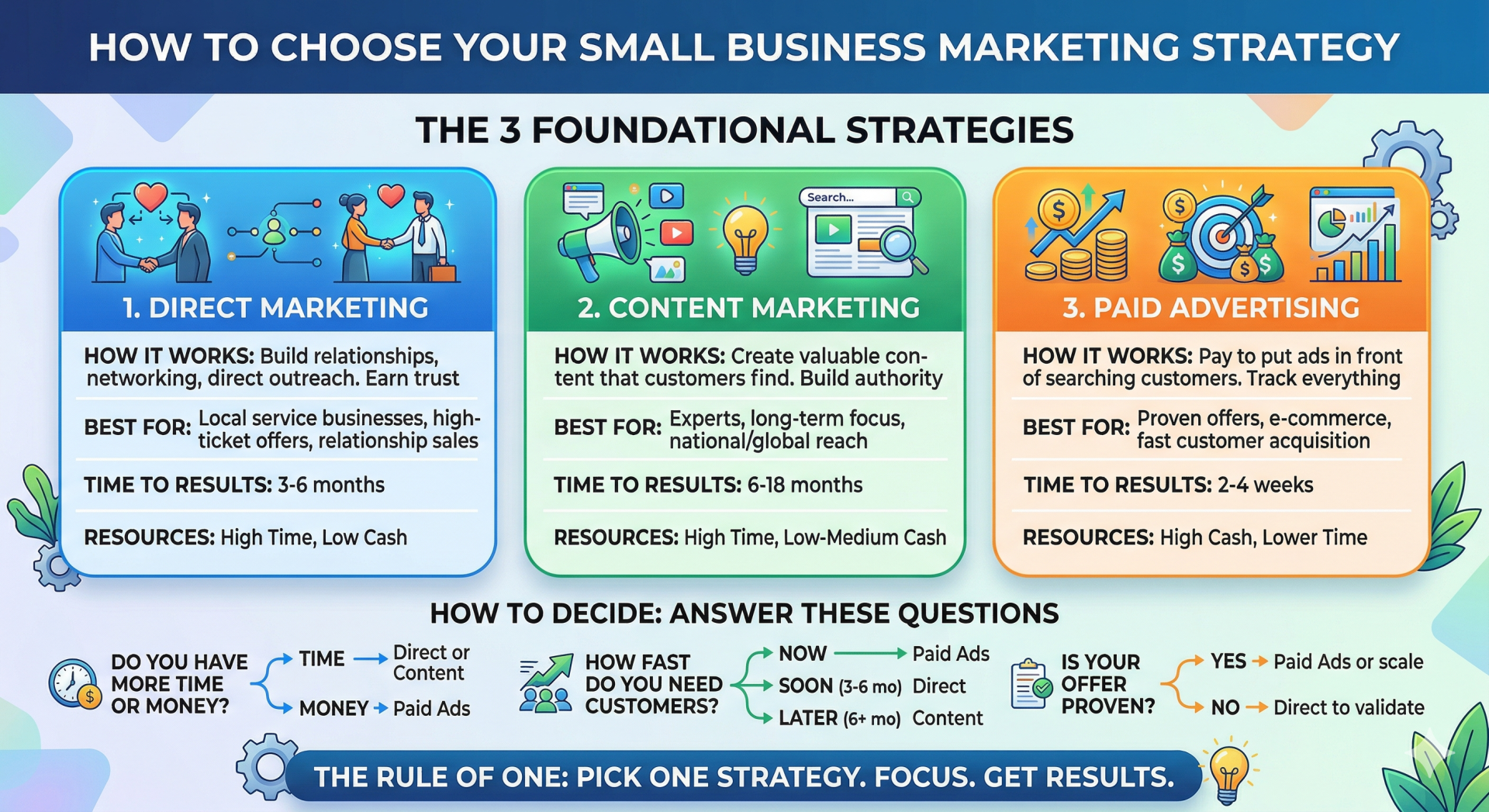
Every marketing approach — every trend, platform, tool, and tactic — fits inside one of these three strategies. Understanding the category matters more than knowing every individual tactic inside it. Read all three before you decide which one is yours.
Strategy 1: Direct Marketing
Bottom line: Direct Marketing means you go directly to the people most likely to buy from you, build a relationship, and earn their business through trust — not advertising.
This is the oldest small business marketing strategy and still the most reliable one for local service businesses. Word of mouth, referrals, networking, direct outreach, and email to people who already know you all live inside Direct Marketing. You build one-on-one relationships. Trust develops. People buy when they’re ready — often before they’ve searched Google or seen an ad.
Who Direct Marketing works best for:
- Local service businesses — consultants, accountants, contractors, coaches, attorneys
- Anyone selling something where trust is required before a purchase
- High-ticket offers that need a conversation before a commitment
- Businesses with a small, high-value customer base
What your tactics look like inside Direct Marketing:
- Joining a referral-based networking group like BNI or your local chamber
- Learning how to ask for referrals as a consistent part of your process
- Exploring networking groups beyond BNI that fit your industry
- Direct outreach by email or LinkedIn to warm contacts
- Speaking at events where your best customers already show up
Resources required: Low cash, high time. Or if you have budget, hire people to do the relationship-building for you.
Timeline to results: 3–6 months to build real momentum. Referrals start slow and compound fast.
Strategy 2: Content Marketing
Bottom line: Content Marketing means you create material your ideal customer searches for, they find it, consume it, trust you as the expert, and eventually buy — without you ever reaching out to them.
This is the strategy I built DIYMarketers on. An article I published three years ago still brings in new readers every single day. But — and this is the part most people skip — it takes time. A long time. If you need customers in the next 90 days, Content Marketing is not your answer right now.
Who Content Marketing works best for:
- Experts, educators, consultants who teach a methodology
- Businesses competing nationally or internationally where local networking doesn’t scale
- Service providers who want to attract clients instead of chase them
- Anyone with more time than money and patience for a long game
What your tactics look like inside Content Marketing:
- Writing SEO-optimized articles on topics your customers search for
- Creating YouTube videos or podcast episodes that answer real questions
- Building lead magnets and templates that collect email addresses
- Consistent LinkedIn or Instagram posting that demonstrates expertise
- Guest articles on publications your audience already reads
Resources required: Minimal cash, significant time. Or budget to hire writers and editors.
Timeline to results: 6–18 months before meaningful organic traffic. There is no shortcut.
Strategy 3: Paid Advertising
Bottom line: Paid Advertising means you pay to put your offer in front of people already searching for what you sell — they click, you measure everything, and you optimize until the math works.
This is the fastest of the three strategies and the most unforgiving. If your offer isn’t clear, your landing page doesn’t convert, or you don’t know your customer lifetime value, paid ads will drain your budget before you can fix it. My honest recommendation: validate your offer through Direct Marketing first. Find out what works in real conversations before you pay to scale it.
Who Paid Advertising works best for:
- Businesses with a proven offer and a tested conversion process
- E-commerce or product businesses with clear margins
- Companies that need customers fast and have budget to spend
- Businesses that have already validated their offer through Direct Marketing
What your tactics look like inside Paid Advertising:
- Google Search Ads targeting people actively searching for your service
- Facebook and Instagram ads reaching your specific audience profile
- LinkedIn ads for B2B services targeting by job title or industry
- Retargeting ads to people who visited your site but didn’t convert
Resources required: Minimum $500–$2,000/month in ad spend, plus management time or a manager.
Timeline to results: 2–4 weeks to gather real data. 2–3 months to optimize toward profitability.
How to Choose Your Small Business Marketing Strategy
Answer these three questions and your strategy becomes obvious. Do not try to choose based on what sounds exciting or what you see competitors doing. Choose based on your actual resources right now.
| Your Situation | Your Strategy | Your First Move |
|---|---|---|
| More time than money, need customers in 3–6 months | Direct Marketing | Join one networking group. Build a referral ask into your existing process. |
| Willing to wait 12+ months, want traffic that works while you sleep | Content Marketing | Pick ONE platform. Publish consistently for 6 months before judging results. |
| Proven offer, know your numbers, need customers now and have budget | Paid Advertising | Start with Google Search Ads. Test small. Scale only what converts. |
| No budget, just starting out, need traction fast | Direct Marketing (free version) | Reach out to everyone you know. Ask for introductions. Referrals cost nothing and convert faster than any other lead. |
Comparing the 3 Marketing Strategies Side by Side
Use this table to see at a glance which strategy fits your business stage and resources.
| Strategy | Time to Results | Budget Required | Best For |
|---|---|---|---|
| Direct Marketing | 3–6 months | Low (time-heavy) | Local services, high-ticket offers, relationship-based sales |
| Content Marketing | 6–18 months | Low–Medium | Experts, national reach, long-term compounding traffic |
| Paid Advertising | 2–4 weeks | Medium–High | Proven offers, immediate leads, e-commerce |
Why Choosing a Strategy Matters More Than Choosing a Platform
The platform is not the strategy. This is the single most misunderstood concept in small business marketing.
Instagram is not a strategy. Email is not a strategy. BNI is not a strategy. Each of those is a tactic — a specific action you take inside a strategy. Instagram serves Content Marketing if the goal is organic discovery. It serves Direct Marketing if you’re using it to reach out to specific people and start conversations. The platform is the same. The strategy — and therefore the purpose, the metrics, and the expected outcome — is completely different.
When you don’t know which small business marketing strategy you’re executing, you can’t evaluate whether a platform is working. You end up switching platforms every 90 days instead of going deeper on the approach that fits your business.
This is also why I recommend reading about the marketing mindset shift that makes this easier, and understanding how direct marketing differs from digital marketing — because most small business owners conflate the two.
What Happens After You Choose a Strategy
Once you have a strategy, the next step is building a consistent system around it — not adding more tactics.
Strategy gives you a direction. Then you need three things to make it work: a marketing theme that ties your message together for the year, a simple marketing process you can actually execute consistently, and a way to measure whether it’s working.
Without those three, even a well-chosen strategy devolves into random. The strategy tells you what direction to go. The process tells you how to walk there every single week. The theme tells you what to say when you get there.
If your marketing feels chaotic right now, the fix is almost never “do more things.” It’s almost always “get clear on your small business marketing strategy — and execute it properly.” For more on how to manage marketing when everything feels uncertain, see how to build a marketing strategy when times are tough.
Frequently Asked Questions About Small Business Marketing Strategy
What is the best marketing strategy for a small business?
The best small business marketing strategy is the one that matches your available resources right now. For most small businesses with limited budgets and limited time, Direct Marketing — referrals, networking, and direct outreach — is the fastest path to customers. It costs almost nothing, produces feedback quickly, and forces you to get clear on your offer before spending money on ads or content. Content Marketing is best for businesses willing to invest 6–18 months in building organic traffic. Paid Advertising is best for businesses with a proven offer and budget to test.
What is the difference between a marketing strategy and a marketing tactic?
A marketing strategy is the decision about how you get customers; a marketing tactic is a specific action you take to execute that decision. “I’m building my business through referrals and word of mouth” is a strategy. “I joined BNI and I ask every satisfied client for two introductions” are tactics. The strategy sets the direction. The tactics are the steps. Most small business owners skip the strategy and jump straight to tactics — which is why their marketing feels scattered and inconsistent.
Can a small business use more than one marketing strategy?
Yes, but only after one small business marketing strategy is consistently producing results. The most common mistake is trying to build Direct Marketing, Content Marketing, and Paid Advertising all at the same time. Nothing gets enough attention to compound. Start with one. Get it producing customers consistently. Then add a supporting strategy — not a replacement, a supplement. Most successful small businesses run one primary strategy with one supporting element, not three full strategies at once.
How long does a small business marketing strategy take to work?
Timeline depends entirely on which strategy you choose. Direct Marketing produces results in 3–6 months as relationships develop and referrals start generating consistently. Content Marketing takes 6–18 months before organic traffic becomes meaningful — the compound growth is real but it’s slow. Paid Advertising can generate leads in 2–4 weeks, but takes 2–3 months to optimize toward profitability. Whichever strategy you choose, give it the full timeline before evaluating whether it’s working.
What is the cheapest marketing strategy for a small business?
Direct Marketing is the lowest-cost small business marketing strategy because it requires time rather than budget. Joining a networking group, reaching out to warm contacts, asking satisfied customers for referrals, and attending industry events can all be done for little to no cash. The trade-off is time — Direct Marketing is relationship-intensive. Content Marketing is also low-cost but requires consistent content creation over a long period. Paid Advertising is the highest-cost strategy and the least appropriate for businesses with tight budgets.
Additional Reading
- BNI Review: Is It Worth It for Small Business Owners
- Networking Groups Like BNI: Which One Is Right for You
- How to Use a Marketing Theme to Focus Your Entire Year
- Free Marketing Plan Templates You Can Actually Use